New dwarf planet found sneaking through the inner Oort cloud

A new, planet-like body has been found on the outer edges of the solar system. This object, called 2012VP113, is the second body of its class found since the identification of the dwarf planet Sedna in 2003. It joins an exclusive club composed of some of the strangest objects in the solar system.

The observable solar system can be divided into three regions: the rocky planets including the Earth and asteroids of the inner solar system, the gas giant planets, and the icy Kuiper Belt objects, which include Pluto. The Kuiper belt stretches from beyond Neptune, which is at 30 astronomical units (one astronomical unit, AU, represents the distance between the Earth and the sun), to about 50AU.

Sedna and 2012VP113 are strange objects, because they reside in a region where there should be nothing, according to our theories of the solar system formation. Their orbit is well beyond that of Neptune, the last recognised planet of the solar system, and even beyond that of Pluto, which differs from planets because of its size, unusual orbit, and composition. (Pluto, once considered a planet, is now considered the lead object of a group of bodies called plutinos.)

The closest Sedna, which is 1000km-wide, gets to the sun is about 76AU and for 2012VP113, which is 450km-wide, that distance is 80AU. Their orbits are also at weird inclinations compared to most other solar system objects.

The results of the discovery have been published in Nature. Chadwick Trujillo of Gemini Observatory in Hawaii, who was also involved in finding Sedna, and Scott Shepherd of the Carnegie Institution for Science, who found 2012VP113 with Trujillo, propose that these objects are members of the inner Oort cloud.

The Oort cloud is a hypothetical region that is thought to stretch outwards beyond the Kuiper belt. Beyond 5000AU, the Oort cloud expands out into a sphere centred on the sun. We have no direct evidence that the Oort cloud exists, but indirect evidence comes in the form of comets with extremely elongated orbits.
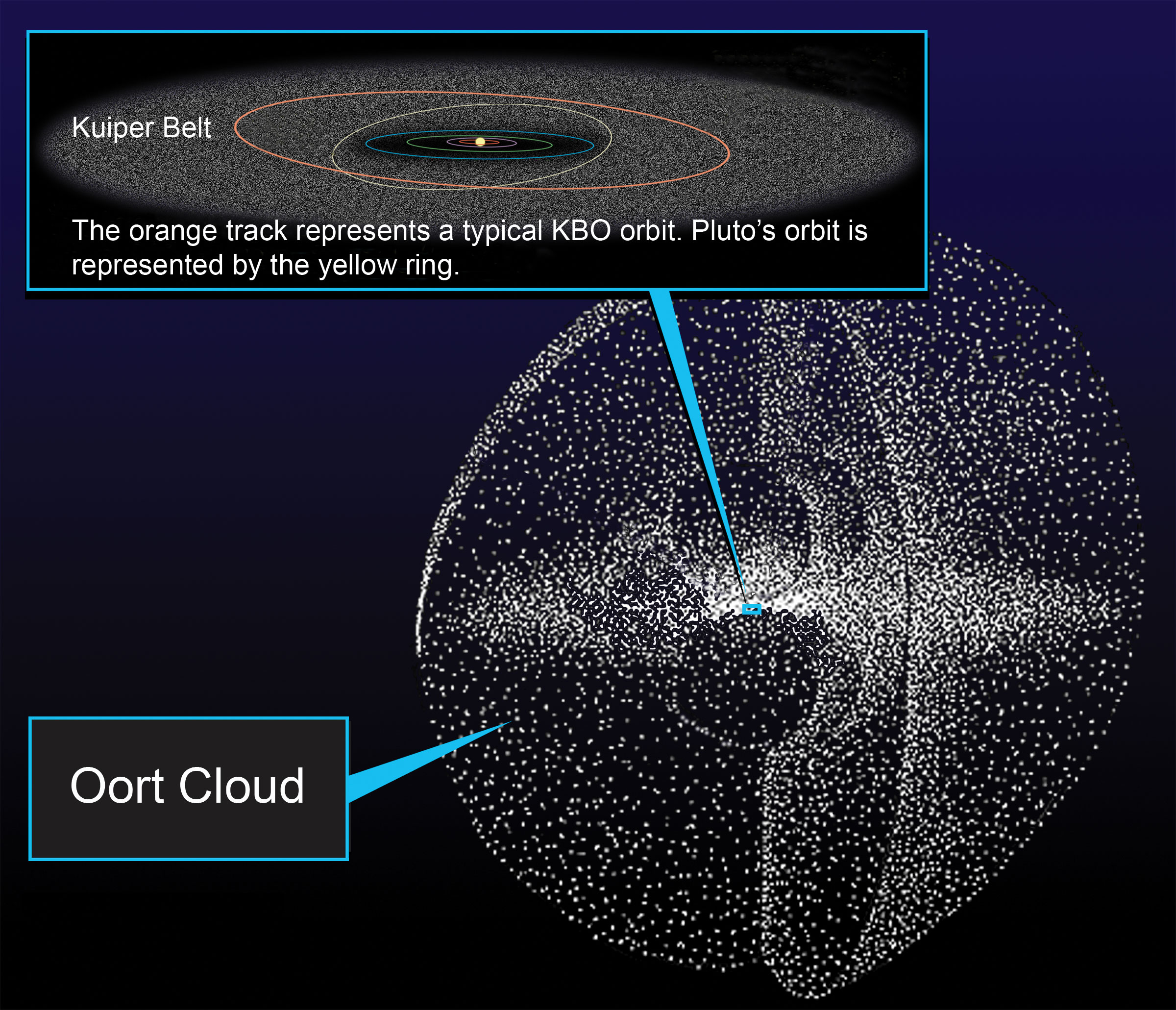
Oort_Cloud

Stephen Lowry at the University of Kent said: “The orbital properties of these two objects are so very different from that of the Kuiper belt objects that it wouldn’t be wrong to suggest they may be part of the inner Oort cloud.”

The fact that these objects exist is remarkable, since they exist in a region where material is thought to have been too sparse for them to form. Current thinking is that they actually formed in the giant-planet region, and that their orbits may carry the signature of whatever events caused them to scatter to such distances. It is hoped that this discovery will lead efforts to find other objects.

David Rothery of Open University said: “This is a remarkable discovery, but it is not entirely surprising. When they found Sedna, there was hope that they would find others in that region.”

But the fact that it took Trujillo, who was involved in the original team that found Sedna, more than ten years to find Sedna’s neighbour speaks to the challenge of discovery. “The farther you get from the sun, the less sunlight falls on these objects, which makes the task of locating them harder,” Lowry said.

“Worse still,” Lowry continued, “the eccentric orbits of these objects means that there is very tiny window in which they can be observed from even the most powerful telescopes on Earth. What is needed to find these objects is not just technology but persistence.” For example, Sedna gets as close as 76AU away from the sun, but at its farthest it is nearly 1000AU. Its orbital period is about 11,400 years, which means it spends lots of time too far out to be detected.

While 2012VP113 and Sedna provide some information about the inner Oort cloud, to say any more, scientists are going to need more than two data points. Next generation instruments such as the Subaru telescope in Hawaii and Large Synoptic Survey Telescope in Chile may hold the answers.The Conversation

First published on The Conversation. Images by NASA.

Bill Gates on the world and things he cares about

Jeff Goodall of Rolling Stone magazine does a great job of interviewing one of the greatest men of our times. Gates falls in the five greatest thinkers I follow. As Goodall summarises, he is one of the most optimistic persons alive who thinks “the world is a giant operating system that can be debugged”. That is why a long interview with him is much welcome. Here I have snippets and some crystallised gems from it:

On comparison with Zuckerberg:

I start with architecture, and Mark Zuckerberg starts with products, and Steve Jobs started with aesthetics.

On Edward Snowden:

I think he broke the law, so I certainly wouldn’t characterize him as a hero.

On taxation:

In general, on taxation-type things, you’d think of me as a Democrat. That is, when tax rates are below, say, 50 percent, I believe there often is room for additional taxation.

On helping the poor:

Should the state be playing a greater role in helping people at the lowest end of the income scale? Poverty today looks very different than poverty in the past. The system’s ability to distinguish between somebody who has family that could take care of them versus someone who’s really out on their own is not very good, either. It’s a totally gameable system – not everybody games it, but lots of people do. Why aren’t the technocrats taking the poverty programs, looking at them as a whole, and then redesigning them?

On government’s ability to tackle big problems:

You have to have a certain realism that government is a pretty­ blunt instrument and without the constant attention of highly qualified people with the right metrics, it will fall into not doing things very well. If I could wave a wand and fix one thing, it’d be political deadlock, the education system or health care costs.

On money in politics:

I’m not sure you’d want money to be completely out of politics. We’ve got a system with a lot of checks and balances. When you get into a period of crisis where the overwhelming majority agrees on something, government can work amazingly well, like during World War II.

On innovation:

Innovation can actually be your enemy in health care if you are not careful. If you accelerate certain things but aren’t careful about whether you want to make those innovations available to everyone, then you’re intensifying the cost in such a way that you’ll overwhelm all the resources.

On prioritisation:

I want to focus on things where I think my experience working with innovation gives me an opportunity to do something unique. The majority of the foundation’s money goes to a finite number of things that focus on health inequity – why a person from a poor country is so much worse off than somebody from a country that’s well-off. It’s mostly infectious diseases.

On “no poor countries by 2050”:

Assuming there’s no war or anything, we ought to be able to take even the coastal African countries and get them up to a reasonable situation over the next 20 years. You get more leverage because the number of countries that need aid is going down, and countries like China and India will still have problems, but they’re self-sufficient. And over the next 20 years, you get better tools, new vaccines, a better understanding of diseases and, hopefully, cheaper ways of making energy.

On investment:

(Not a quote) Philanthropy has a better hit rate than venture capital. And yet, because of successes like Google, people give it more importance.

On climate change:

It’s a big challenge, but I’m not sure I would put it above everything. I think it’s a real test of the boundary of science and politics – and an acid test of people’s time horizons. I happen to think we should explore geo-engineering.­

On alternative power:

Intermittent energy sources like wind and solar . . . you can crank those up, depending on the quality of the grid and the nature of your demand. You can scale that up 20 percent, 30 percent and, in some cases, even 40 percent. But when it comes to climate change, that’s not interesting. You’re talking about needing factors of, like, 90 percent.

With so many problems, people feel pessimistic:

Really? That’s too bad. I think that’s overly focusing on the negatives. I think it’s a pretty bright picture, myself. But that doesn’t mean I think, because we’ve always gotten through problems in the past, “just chill out, relax, someone else will worry about it.” I don’t see it that way.

What is your biggest fear?

I understand how every healthy child, every new road, puts a country on a better path, but instability and war will arise from time to time, and I’m not an expert on how you get out of those things. I wish there was an invention or advance to fix that. There’ll be some really bad things that’ll happen in the next 50 or 100 years, but hopefully none of them on the scale of, say, a million people that you didn’t expect to die from a pandemic, or nuclear or bioterrorism.

On immigration:

US immigration laws are bad – really, really bad. I’d say treatment of immigrants is one of the greatest injustices done in our government’s name.

Do you believe in God?

I agree with people like Richard Dawkins that mankind felt the need for creation myths. Before we really began to understand disease and the weather and things like that, we sought false explanations for them. Now science has filled in some of the realm – not all – that religion used to fill. I think it makes sense to believe in God, but exactly what decision in your life you make differently because of it, I don’t know.