Akshat Rathi is a senior reporter for Bloomberg News. He has previously worked at Quartz, The Economist and The Conversation. His writing has appeared in Nature, The Guardian and The Hindu. He has a PhD in chemistry from Oxford University and a BTech in chemical engineering from the Institute of Chemical Technology, Mumbai.
You find a lady clad in a filthy ragged coat. She is holding onto something in her right hand and flipping it at a regular pace. She is mumbling, almost as if chanting, and her eyes are transfixed on something. What separates her from what she is staring at is a glass window.
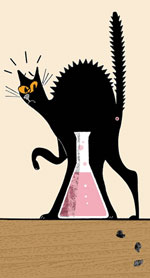
The scene is not set in a Buddhist monastery in Cambodia or a busy temple in India but in a chemistry lab. The lady is a chemist wearing a stained old lab coat, holding her lucky charm and staring at the flask in her fume cupboard, in a hope that her reaction works this time.
There is much that our high school education gives us. Our time in the school leaves indelible marks on our lives.It makes an impact on our future whether we appreciate it or not. The contribution that my school has made towards who I am is substantial.
My school entrance (credit: Fravashi Academy)
High school is where the first impressions of our future professions are made. Whether we chose to be a scientist, an engineer, a doctor, an artist, a designer, a businessman or something else, the seeds get sown at this tender age of our lives. This is the age when our brains get ‘shaped’. Although it wasn’t obvious when I was there in Fravashi Academy that I will go on to do a PhD, I can connect the dots today.
It is the place where we make long-lasting friendships. These connections that are made with a pure heart and naive minds are amongst the best ones we will make in our lives. Of course holding onto them is easier today than it was when my Dad went to high school. But even if you haven’t stayed in touch for so many years, these are the people you can connect to almost instantaneously. My Dad’s high school reunion that happened last year stands as a testament to this fact. He met his high school friends after almost 35 years and boy, did have a good time.
Over the years since I graduated from Fravashi in 2002, we school friends have metmany times. The number of people varies every time but there are many who come everytime. We remind ourselves of what fun things we did and what mischiefs we were up to. The tone of the conversations have changed only a little over the years but the content has remained same (with only more things getting added to the list ever year of course).
This year when I went back home, I visited my school. Unlike all the times when I visited the school after 2002, this time I had an aim to accomplish. I wanted to understand in what way could I give back to my school.
The school has grown since we left and new curricula have been introduced. Classes have gotten smaller in size and the uniforms are different. And yet there are so many things that are still the same. Two of those things are the ambitions of those at Fravashi and curiosity amongst them.
I had an opportunity to speak to the kids in an impromptu discussion. I told them the short story of what I did after I left Fravashi and what is it that I exactly do in my PhD. But more importantly I spoke about the importance of books and why science is such a fascinating subject to study. I was amazed by some of the questions I got asked after the discussion. And those discussions made it possible for me to understand what students think and on some more reflection, I knew what I could do to contribute to the school.
After discussions with the teachers in school, we decided to do hold an essay competition centred on a topic in science and technology. The aim of the competition was to get the students to think about science and technology and to communicate those ideas to a wider audience.
In the first week of February, with the help of Kaumudi teacher and Neena teacher, the essay competition was held. The topic for the classes of 7th, 8th and 9th was ‘How will science and technology affect the future development of the society?’
It was a pleasure to read all the essays and it was fascinating to see what the students dreamt about as the future of our society. I think that there were lots of budding science fiction writers amongst the entries that I received. And as always, choosing a winner was a hard decision to make.
The winners are being given popular science books with a hope that once they finish the book they will share it with their peers. This should spark some conversations and some new ideas amongst the young guns. The winners are listed as follows and their essays can be read by clicking on their name.
The list of the books being given (in no particular order) are as follows:
The curious incident of the dog in the night-time by Mark Haddon
Can you feel the force? by Richard Hammond
What Einstein told his cook by Robert Wolke
What Einstein told his barber by Robert Wolke
Really short history of nearly everything by Bill Bryson
Why don’t Penguins feet freeze? by the New Scientist
I am hoping to hold this essay competition annually. And I also know I am going to run out of suggestions for the books that I will give as prizes so if there are any books that you would like to suggest please do by leaving a comment below.
This is what I think I can contribute to the school at the moment. I am hoping that whenever I go home, I will get a chance to speak to the students at the school and spark a few more interesting conversations. But I also think that if I start this early then I can surely build a habit of giving back to the places that have made me who I am.
When scientists write journal articles their main purpose is to inform the readers about the new discovery or invention that they have made. But that is not all, to be able to communicate their results they often weave a ‘story’. Journal articles consist of not just data and its interpretation but also a ‘narrative’.
General structure of a journal article:
Introduction: Brief background, limitations of current state of the art
Discussion of how the authors dealt with the problem
Results of their work and discussion of why they think things worked or why things were better in their research
Conclusion: short description of what was achieved and raise challenges for the future
Essentially, an academic paper is a lot of facts tied together in a coherent narrative. The purpose of such narrative being not to entertain the readers but to inform them effectively.
In comparison, popular non-fiction books are also a lot of facts tied together in a coherent narrative but the narrative is meant to be entertaining and compelling. The writer develops his theory by drawing on examples that the reader can either relate to or feel wowed on reading. There is a structure to the book but it is never as rigid as the structure of an academic article. The books are written in active voice as against the passive voice used in academic writing. The illustrations used are carefully chosen such that they can appeal to a large audience.
The result of such differences in the two types of writing is that non-fiction books seem to hold on to your attention for a longer time (without you feeling exhausted) than academic papers seem to achieve. In the process of informing the reader in a succinct and yet coherent manner, academics end up condensing many ideas in fewer words and causing too much information to flow in a reader’s mind.
The one idea per paragraph rule doesn’t exist in academic writing. Actually, I am surprised at how irrelevant does the idea of paragraphs seem to some academics. Many a times authors seem to create paragraphs for no good reason and also not create paragraphs when actually they should have.
There are many lessons that academic writing can take from good non-fiction authors. And similarly, there are many lessons that academic publishers can learn from book publishers but I am not here to share those ideas. Instead, today I want to talk about how can you improve your effectiveness at reading technical documents.
Note taking: Because academic papers are essentially so ‘fact-heavy’, it is a good idea to note down the important facts as you read through a paper. This essentially means that you are sifting through the facts and choosing the important ones. And even without taking notes, in your mind you are doing that sifting. Note taking only helps you further by helping you unload the brain from sifting and also remembering.
Pausing: When I am reading many papers at a time or reading about a subject in which I have to refer to many sources, I tend to take many breaks. These breaks are more a necessity than just for fun. They are necessary because I tend to feel overwhelmed by the amount of data I am taking in. The breaks aren’t like a tea break but more like short pauses. In those short pauses, I stop reading and review what I have read till now in my head (or using my notes if necessary). I try to understand if I have a coherent idea in my head yet and if not, then I try to understand what is lacking.
Ideas: More often than not, while reading an academic paper, I come across some ideas related to the subject matter that I am reading. Most of those ideas may be useless but I have found that if I note them down, irrespective of their quality, it helps me understand things faster. Note taking becomes even more important.
I think this happens because those ideas may be born out of my incomplete understanding of what I am reading. It might be that I missed out on an important factor that has caused me to think about something new. Putting those ideas on paper and then getting back to them after I have finished reading helps me understand what I was missing.
And of course, there are those rare times when the ideas are actually useful! So even if there is very little chance of coming up with a brilliant idea, it is worth noting all of them down.
Hopefully, these three points might make the whole process of reading a lot of academic papers a lot more easier than it is now and in the meantime, there is no harm in dreaming about that time when all academics will write papers like good non-fiction authors do!


 Akshat Rathi