Shifting the burden of proof away from karma

In the comments on my post on karma, Alex picked up on an assumption I made while trying to explain how the concept of karma saves its face from any arguments against it. I said it was the case of shifting the burden of proof away from karma. Let me elaborate now.

My claim is that karma does not exist.

The argument against the claim is that “You have no proof that karma does not exist and that is why it must exist.”

To that my argument is that “There is no proof that karma does exist and that is why I refuse to believe that it does.”

The argument against that would be “You will believe in karma in your next life when you are born a beggar.”

To that my argument is “Isn’t that easy to say? I don’t think I have a ‘next life’ and even if I have, I am not ready to wait that long to know if there is any karma or not.”

Of course, the argument against that would be “You don’t know if you don’t have another life and that’s why you don’t believe in karma. I hope in your next life you are told that this is what you thought in the life before and that is why you are suffering in that life.”

This can easily keep going on and on without either side accepting defeat. And Massimo, in his post, picks up on the same issue except that he is trying to explain to his daughter that ghosts do not exist. She argues that he does not have evidence that ghost do not exist, so it’s reasonable that she believes that they do. He tells his daughter that:

In a court of law, the burden of proof is always on the part making a positive claim, not on the one making a negative one that is to say that the you are ‘innocent unless proven guilty’. It would be grossly unfair if we went around presuming people to be guilty of crimes with no other “evidence” than the fact that they can’t prove that they didn’t do it.

But apparently, what we think is a fair argument when we debate the abstract concept of ghosts (or karma or god)  is suddenly unfair when people are involved.

That is to say that these two seemingly different situations are logically equivalent. Therefore, it is clear that it is not rational to believe in ghosts without evidence at the same time that one wouldn’t dream of convicting a person of a crime just on the basis that one cannot prove their innocence.

Given my knowledge of the world, my rational self cannot accept that such a universal calculator of people’s karma can exist unless there is a God who has the superpower to do it. All evidence we have today points towards the nonexistence of such an entity. Thus, however hard I tried to shift the burden of proof away from karma, a day came when my appeal to ignorance was revealed. I did not feel bad that I had been an idiot for so long because being enlightened by the knowledge was enough to balance that feeling.
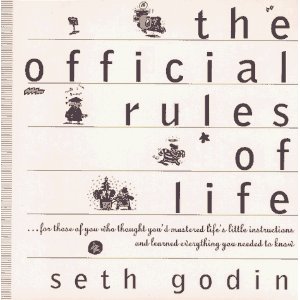
The official rules of life

I just finished reading the official rules of life by Seth Godin. It was a wonderful read especially because it took me only over an hour to read through it. What I’ve gained through the book though is far beyond the effort of reading it and I would like to share with you excerpts of the book that I enjoyed the most.

I am going to write disparate sets of rules from the book and don’t be surprised if they don’t seem coherent!

Baltasar Gracian’s Oraculo Manual

  • Keep affairs in suspense
  • Make people depend on you
  • Avoid victories over your superiors
  • Control your imagination
  • Know how to take and give hints
  • Without lying, do not tell the whole truth
  • Be a man without illusions
  • Behave as if you were watched

Code for cartoons: Storylines should enhance self-esteem & co-operative behaviour

Father Flanagan’s Axiom: There are no bad boys. There is only bad environment, bad training, bad example, bad thinking.

Similarly, there are no trivial people. There are only trivial thoughts and trivial interests.

How to deal with boys? Keep them occupied, keep them busy, keep them playing on the football field, on the basketball court, keep them in our shops, our crafts, our hobby clubs. This is how you can develop good boys and help eliminate so-called juvenile delinquency

Work, rest and recreation are important the year round to get the most and the best out of the human side of life.

General Colin Powell’s Rules to Live by:

  • It ain’t as bad as you think. It will look better in the morning.
  • Get mad, then get over it.
  • Avoid having your ego so close to your position that your position falls and your ego goes with it.
  • It can be done.
  • Be careful what you want. You may get it.
  • Don’t let adverse facts stand in the way of a good decision
  • You can’t make someone else’s choice. You shouldn’t let someone else make yours.
  • Check small things.
  • Share credit.
  • Remain calm and be kind.
  • Have a vision.
  • Don’t take counsel of your fears or naysayers.
  • Perpetual optimism is a force multiplier

How karma screwed me over

I was born and brought up in a progressive Hindu family. Everyone around me was ‘mildly’ religious. We celebrated all the usual festivals and said the mantras and recited prayers. Customs and traditions were followed with a certain degree of flexibility. I have some of my fondest memories associated with these festivals because they were, more than anything, a time to meet people and celebrate. And as such, during all those days even thought I did all the religious things asked of me, I was never forced to believe in God. I am very glad that I have always had the freedom to have my own religious views and my own philosophy of life.

Yet, that freedom could not stop me from absorbing many of the core values of Hinduism. During those years, sometime quite early in my life, I was introduced to the concept of karma which is undoubtedly one of the core values. As most of us know, the laws of karma are quite simple: “Every action has a reaction” or “What goes around, comes around”. It seemed like a beautiful concept and everyone around me believed in it; some even without consciously treating it as karma. Some people strongly believed that God plays a role in the delivery of karma and such divine intervention then put the concept beyond the realms of reason and doubt.

Then somewhere along the way, with the help of my little brain, I transformed that concept into something that seemed more practical to me. I started treating ‘efforts’ as a way of building up ‘good’ karma or countering ‘bad’ karma. I thought that if I worked hard and put in enough efforts then, of course my ‘good’ karma bank will increase and I can cash it for good results.

What I did not realise at that point was that the underlying assumption of all this philosophy or the basic tenet on which all this was based on was that ‘the world is a fair place’. And that thought became an integral part of my way of thinking, unfortunately, unknowingly so. Once I started viewing the world through these glasses, it was very easy for me to start strongly believing in a meritocratic society and a just world. It wasn’t that unnerving to see corruption or crime in the media because, of course, the karmic balance will be preserved; the corrupt will be caught and the perpetrators punished. I believed, naively so, that people who made use of their clout to achieve something or earn a business contract or gain some fame must not be happy or satisfied people. They must not have been able to have a good night’s sleep.

It was a great coping mechanism; when things did not work my way, I partially blamed my karma but mostly blamed my efforts.  When things did not work my way and worked for someone else who used unfair means then I would partially blame my karma but mostly blame their karma and believe that some day they will learn their lesson. Often without my knowledge, I would also filter the kind of friends I made by simply understanding if their beliefs aligned with mine. All the news about corruption or violence or discrimination did not affect me as much because I believed that justice will be served someday. My way of studying was literally governed by these rules, I used to put in a certain amount of effort and then only take a short break to save my karma points. I helped others because that gained me more karma points. It let me be selfish and selfless at the same time.

As it is said, it soon became of a way of living. I mostly saw things that reinforced my belief like the time when my exam results came out as I had expected, or a politician got caught and was sentenced or a friend suffered when he cheated. I opened myself to these experiences because they could be aligned with my philosophy. When things did not work the way karma should have made them work, I closed myself to those experience. Then came the most common excuse that spiritual leaders make: “In a complex world, it’s too simplistic to always expect thing to work immediately. What goes around will come around one day”. And, of course, it was easy to believe in that excuse because it helped me align the irregularities to my beliefs. So questions about unfair means could be countered with an argument that karma is not bound by time and thus justice will be served in this life or the next or the next or questions like ‘what about the innocents who die in a terrorist attack, did they all deserve it?’ could be countered with ‘Surely not, but karma can be carried to the next life and then they will live a better/happier/longer life then’ or the questions like ‘what about the massive inequalities that we see around us?’ could be countered with ‘those who are on the richer end of the scale must’ve got good karma from their previous life or vice-versa’. All this logic (it’s the issue of shifting the burden of proof) helped me to preserve my view of the world and NOT change it.

But finally now I’ve broken out of this bubble and I know that the world is not a fair place. Although changing my belief system has been a lot of pain, I think it’s for the best that I have undergone this transformation. More about the transformation in the next post.