Emotions and writing

A friend recently told me that she finds it hard to write about something unless she has strong feelings for it. ‘It’ can be any thing, any person, or any thought. There is a lot of truth in that submission, I cannot help but agree.

I started blogging because I wanted to get better at writing but even then, I wrote only about things that I really cared about. This blog soon became the thing that I turned to when I had a lot on my mind and needed to organise my thoughts, rationalise my feelings, evaluate a situation…or just stand back and observe something that I deeply cared about. I could feel the words flow when I had strong emotions about what I was writing.

But isn’t that obvious?

When emotions are involved we always tend to be able to do more (good or bad). We are more energised, more enthusiastic and more focused. These strong emotions that can fuel such a rush can range from anger and jealousy to happiness and love.

It seems like the way forward then, doesn’t it? When I want to write about something I must create a strong emotion (of sort) about it and I will be able to write about it. But it’s not as easy as that. Emotions cannot always be controlled that easily. One needs to experience a particular string of events to be able to create that emotion and more often than not we don’t know what are those particular string of events to help us achieve this.

Just when I seemed lost I came across A. J. Jacob’s talk on ted. com.

An editor at Esquire magazine, he takes his writing very seriously. He dives right into it to be able to write about it. He calls his life a series of experiments:

  • He read the whole 32 volumes of an Encyclopedia for a whole year and then a wrote book called The know-it-all.
  • He asked some people in India to live his life for him for a couple of months and then wrote an article called My outsourced life.
  • He spent a whole year living by the words of the bible, literally and wrote a book called A year living biblically

Surely having been through such experiences for extended times (sometimes a year) of his life, must have benefited him in more than one way. It must have not just given him ‘stuff’ to write about but also create emotions that he could use in his writing. In his talk, you may realise that certain events stirred his emotions (such as the last two months of the year when his wife wouldn’t kiss him because he had decided not to shave or the time when he had to stand in his own house because he couldn’t sit on seat where a woman sat during her periods).

Emotion: Shock! I haven't missed the opportunity of harnessing this emotion in my writing.

Of course, it may not always (rather it may rarely) be the most practical way to be able to write well. But then why not treat writing as actors treat acting. Actors dive in to being the person they want to play: they bend their way of thinking to be able to respond the way the character would’ve responded or they push their emotional frontiers such that they can feel the emotions that the character would’ve felt. Basically, they try to become the character by doing what they can so that the character feels real on-screen. Aren’t we all in awe of great performances where we are not able to distinguish the celebrity from the character?

Can writers do something similar? Become actors so that they can create strong emotions to be able to harness the power of emotions to write. Or do good writers already do that?
Shifting the burden of proof away from karma

In the comments on my post on karma, Alex picked up on an assumption I made while trying to explain how the concept of karma saves its face from any arguments against it. I said it was the case of shifting the burden of proof away from karma. Let me elaborate now.

My claim is that karma does not exist.

The argument against the claim is that “You have no proof that karma does not exist and that is why it must exist.”

To that my argument is that “There is no proof that karma does exist and that is why I refuse to believe that it does.”

The argument against that would be “You will believe in karma in your next life when you are born a beggar.”

To that my argument is “Isn’t that easy to say? I don’t think I have a ‘next life’ and even if I have, I am not ready to wait that long to know if there is any karma or not.”

Of course, the argument against that would be “You don’t know if you don’t have another life and that’s why you don’t believe in karma. I hope in your next life you are told that this is what you thought in the life before and that is why you are suffering in that life.”

This can easily keep going on and on without either side accepting defeat. And Massimo, in his post, picks up on the same issue except that he is trying to explain to his daughter that ghosts do not exist. She argues that he does not have evidence that ghost do not exist, so it’s reasonable that she believes that they do. He tells his daughter that:

In a court of law, the burden of proof is always on the part making a positive claim, not on the one making a negative one that is to say that the you are ‘innocent unless proven guilty’. It would be grossly unfair if we went around presuming people to be guilty of crimes with no other “evidence” than the fact that they can’t prove that they didn’t do it.

But apparently, what we think is a fair argument when we debate the abstract concept of ghosts (or karma or god)  is suddenly unfair when people are involved.

That is to say that these two seemingly different situations are logically equivalent. Therefore, it is clear that it is not rational to believe in ghosts without evidence at the same time that one wouldn’t dream of convicting a person of a crime just on the basis that one cannot prove their innocence.

Given my knowledge of the world, my rational self cannot accept that such a universal calculator of people’s karma can exist unless there is a God who has the superpower to do it. All evidence we have today points towards the nonexistence of such an entity. Thus, however hard I tried to shift the burden of proof away from karma, a day came when my appeal to ignorance was revealed. I did not feel bad that I had been an idiot for so long because being enlightened by the knowledge was enough to balance that feeling.

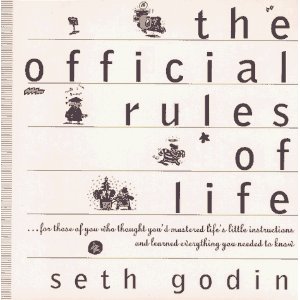
The official rules of life

I just finished reading the official rules of life by Seth Godin. It was a wonderful read especially because it took me only over an hour to read through it. What I’ve gained through the book though is far beyond the effort of reading it and I would like to share with you excerpts of the book that I enjoyed the most.

I am going to write disparate sets of rules from the book and don’t be surprised if they don’t seem coherent!

Baltasar Gracian’s Oraculo Manual

  • Keep affairs in suspense
  • Make people depend on you
  • Avoid victories over your superiors
  • Control your imagination
  • Know how to take and give hints
  • Without lying, do not tell the whole truth
  • Be a man without illusions
  • Behave as if you were watched

Code for cartoons: Storylines should enhance self-esteem & co-operative behaviour

Father Flanagan’s Axiom: There are no bad boys. There is only bad environment, bad training, bad example, bad thinking.

Similarly, there are no trivial people. There are only trivial thoughts and trivial interests.

How to deal with boys? Keep them occupied, keep them busy, keep them playing on the football field, on the basketball court, keep them in our shops, our crafts, our hobby clubs. This is how you can develop good boys and help eliminate so-called juvenile delinquency

Work, rest and recreation are important the year round to get the most and the best out of the human side of life.

General Colin Powell’s Rules to Live by:

  • It ain’t as bad as you think. It will look better in the morning.
  • Get mad, then get over it.
  • Avoid having your ego so close to your position that your position falls and your ego goes with it.
  • It can be done.
  • Be careful what you want. You may get it.
  • Don’t let adverse facts stand in the way of a good decision
  • You can’t make someone else’s choice. You shouldn’t let someone else make yours.
  • Check small things.
  • Share credit.
  • Remain calm and be kind.
  • Have a vision.
  • Don’t take counsel of your fears or naysayers.
  • Perpetual optimism is a force multiplier