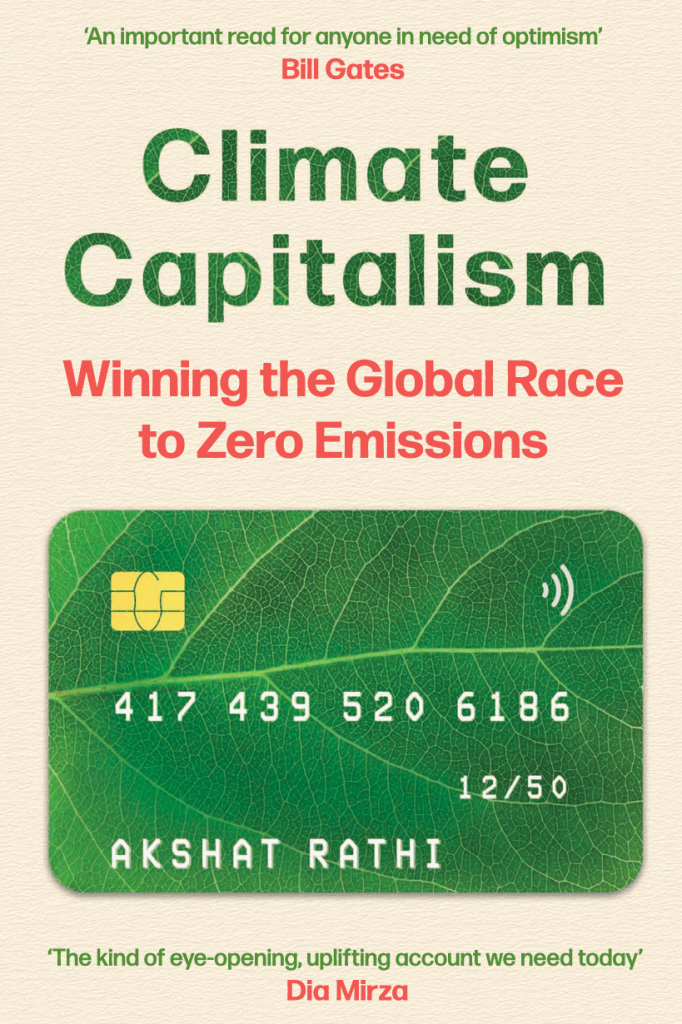
Find out all the details of the book here.
Highlights
Mar 12: Thinkers & Ideas (with Martin Reeves)
Jan 15: The Guardian (by Ajit Niranjan)
“When I was writing this book, it was absolutely crucial to try and bring the stories of scaling solutions in developing countries,” said Rathi. “Historically, they’re not the largest emitters, but we know that the climate problem is a global problem that will either succeed or fail depending on what India and China do … if we can show that clean energy technologies can scale in India and China, which they are doing, and learn from those lessons, we may be able to apply them in South Africa and Kenya and Nigeria.”
Oct 15: Interview on Sky News Australia
Other media coverage
Nov 13: El Confidencial (Spanish paper)
Why climate change is the biggest market failure in history.
Jul 19: De Staandard (Dutch newspaper)
Klimaatjournalist Akshat Rathi: “Het is nu goedkoper om de wereld te redden dan te vernietigen”
Jun 20: Today, Explained (with Noel King)
Jun 11: The Energy Gang (with Ed Crooks)
Jun 8: The Times
Climate Capitalism features on the reading list for the next UK prime minister.
May 21: MIT Sloan (by Kara Baskin)
Reforming capitalism might be the only practical way to get to zero emissions quickly, says author Akshat Rathi. To start, focus on people, policy, and technology.
May 1: Politics Guys (Part 1)
May 1: Sustainable Planet (Part 2)
Apr 25: Science Magazine (by Valerie Thompson) Climate despair is among the hardest pessimistic viewpoints to shake, but as journalist Akshat Rathi reminds readers in Climate Capitalism, we have effective technologies at our disposal that can help mitigate global warming and generate profit for those who wield them.
Apr 25: Huff Post (by Alexander C. Kaufman) Rathi shares many critiques of the type of financialized laissez-faire form of capitalism that triumphed after the Cold War with his own critics on the left. But he points out that even leftist Noam Chomsky recognizes there’s not enough time to rewire the entire global economy to use far less fossil fuel and to peacefully reorder the rest of human society.
Apr 19: The Hindu (by Sudhirendar Sharma) Although these are still early days for capitalism to wear a natural look for addressing impending climatic concerns, a faint ray of optimism seems to have been generated.
Apr 12: Merryn Talks Money (with Merryn Somerset Web)
Apr 9: Radio Davos (with Robin Pomeroy)
Apr 5: Lombard Odier “If you’re a big thinker looking at climate and economy trends, there’s no way you can think about them separately anymore.”
Apr 1: NPR’s Book of the Day
Apr 1: The Indian Express (by Vikram S Mehta) Rathi does not whitewash the contribution of “unfettered capitalism” to global warming. But, as the title of the book suggests, and his stories establish, he holds the view that carbon emissions can most effectively be curbed under the canopy of capitalism, albeit under a patient and reformed capitalism, designed to respond to the longer lead times associated with climate economics.
Apr 1: Center for Strategic and International Studies (with Ben Cahill)
Mar 22: LA Progressive (by Walter G. Moss) In Climate Capitalism, Rathi seems to be arguing for a similar “progressive” approach. And such an economy would tackle climate change with a non-dogmatic combination of market and government incentives and whatever government regulation and cross-national cooperation is required.
Mar 21: Covering Climate Now Extensive interviews with Bill Gates, International Energy Agency head Fatih Birol, and an international cast of investors, entrepreneurs, and scientists animate Rathi’s smoothly delivered argument that contemporary capitalism is compatible with preserving a livable planet. Journalists can benefit from the book’s deep dives.
Mar 20: The Energy Transition Show (with Chris Nelder)
Mar 20: Climate Positive (with Gil Jenkins)
Mar 19: The New York Times (by David Gelles) Combating the climate crisis is the ultimate long-term challenge. Can society rapidly overhaul energy production, transportation, heavy industry, agriculture and more in order to prevent truly catastrophic global warming?
Mar 17: National Observer (by Christopher Hatch) There’s a whole genre of techno-optimism out there and you probably know the script — solar panel prices have plummeted, and presto, the fossil fuel age is doomed. Climate Capitalism is, refreshingly, not one of those books.
Mar 17: Toronto Threads (with David Peck) An hour with David Peck, as he peels back the layers to reveal triumphs, struggles and the resilience that defines the community.
Mar 16: Toronto Star How human-rights court challenges are moving the needle on climate change. Cases in Netherlands and Germany are examples of a tactic that activists can use successfully to force action.
Mar 16: The Free Press (by Matt Henderson) In Climate Capitalism, the Oxford graduate posits that a newly reformed climate capitalism will help us get to net zero through innovation, government policy and a responsiveness to stakeholders who are making more demands for corporate responsibility.
Mar 14: NPR’s Here & Now (with Scott Tong) “It’s now cheaper to save the world than destroy it.” That’s the slogan, the rallying cry, animating entrepreneurs and investors worldwide who believe capitalism can help solve the climate crisis.
Mar 13: Spring Wise (with Angela Everitt) We sat down with the award-winning climate reporter Akshat Rathi to get a peep behind the curtain of his popular podcast, and came away with three lessons for effective climate communication.
Mar 12: Columbia Energy Exchange (with Bill Loveless)
Mar 6: The Arts Fuse (by Ed Meek) This encouraging book highlights the preponderance of positive developments regarding the efforts, worldwide, to deal with climate change.
Mar 5: Business Green Roger Harrabin reflects on a wave of books that argue we can save the planet if we really try, and asks if we need optimism to tackle the climate crisis.
Mar 4: Important, Not Important (with Quinn Emmett)
Feb 18: Energi Talks (with Markham Hislop)
Feb 16: BNN Breaking (Kalinga Literary Festival) The award for business literature went to Akshat Rathi’s ‘Climate Capitalism: Winning the Global Race to Zero Emissions’, a timely exploration of the intersection between environmental sustainability and economic strategies. Rathi’s insightful analysis presents a compelling argument for the integration of green policies within the capitalist framework, sparking a necessary conversation on the future of industry and innovation in the face of the global climate crisis. This recognition underscores the festival’s commitment to honoring works that not only entertain and enlighten but also challenge and inspire change.
Feb 15: Energy Monitor (by Kris Cooper) The concept of ‘green capitalism’ has been variously touted, including recently by Bloomberg reporter Akshat Rathi, who argues that the climate crisis was caused not by “capitalism but the corruption of capitalism” and that it is “cheaper to save the world than destroy it”.
Feb 12: Harvard Business Review (by Scott LaPierre) In Climate Capitalism, the Bloomberg reporter Akshat Rathi describes companies pushing key innovations with the help of governments. For example, through subsidies and regulations, China jump-started its electric car industry, spurring 300% growth in some years and making the country the world’s largest EV market. This shows, Rathi writes, “that succeeding in scaling a green technology requires supportive government policies, substantial public and private investment, and empowering entrepreneurs.”
Jan 30: Climate Tech 360 (with Samia Qader)
Jan 29: Exeter College (by Abdulhakeem Ibraheem Abdulkareem) Climate Capitalism explores a change in thinking in the battle against climate change. Akshat provides a nuanced analysis of capitalism’s successes and failures in responding to climate change, focusing on the endeavours that have propelled the development of safer and cleaner technologies, making them environmentally friendly and profitable.
Jan 27: La Repubblica (in Italian by Luca Fraioli) Per Akshat Rathi, autore di “Climate Capitalism”, “non si può puntare al profitto ignorando i costi che dovremo pagare, e che non sempre possono essere valutati con strumenti econometrici tipo il Pil”
Jan 24: Leaders in Cleantech (with David Hunt)
Jan 23: The Third Pole (by Omair Ahmad) The book is heavy on hope, data and examples. Despite its vast scope – telling the story of climate entrepreneurs from China, India, the US and much of the developed world – Rathi presents an engaging read of all that is going right in the battle with climate change.
Jan 21: The Climate Question (with Graihagh Jackson)
Jan 21: The Financial Express (by Mohit Hira) Climate Capitalism serves as a crucial starting point for a necessary conversation. Rathi urges us to recognise the limitations of our current economic model while acknowledging its potential for positive change.
Jan 19: Times Literary Supplement (by Peter Geoghegan) The Conservatives and Labour divide over environmental targets
Jan 17: In Our Hands (with Ramanan Raghavendran)
Jan 15: BBC Radio 4’s Start the Week (with Kirsty Wark)
Jan 12: The Hindu’s Frontline magazine (by Abhinav Chakraborty)
Dec 24: The Japan Times With the need to cut planet-warming emissions now overwhelmingly recognized by governments and companies the world over, the focus has shifted to how to manage the energy transition and its associated trade-offs and costs — with these debates becoming more acute amid the Russia-Ukraine war and occasional policy pushback at the ballot box.
Also in year-end lists for BNN and MoneyControl
Dec 22: BBC’s The Climate Question
Dec 17: The Economic Times We already have the major solutions for electricity, with solar panels, wind turbines and lithium-ion batteries. Those batteries can also power EVs. There’s still a lot to do. But the puzzle is starting to fall in place. The same can’t be said about the industrial sector.
Dec 16: New Statesman (by Adrienne Buller) Through detailed success stories, from China’s electric vehicle and batteries sectors to Bill Gates’s climate investment fund, and from the green pledges of oil majors to shareholder activism, the book contends that capitalism is well on its way to becoming green and, however imperfect, is perhaps the only system capable of delivering the innovation, incentives and investment needed to meet climate targets. “The green economy,” Rathi’s book suggests, “is not only possible, but profitable.”
Dec 1: Chatham House (by Ann Pettifor) Rathi’s enthusiasm and conviction are infectious. Who knew that carbon capture and storage has been in use for some time? CCS was deployed by the oil industry ‘not to reduce the amount of greenhouse gases dumped in the atmosphere. Rather it was to increase the production of oil from ageing fields.’ It was that alignment with the oil sector that has since plagued the technology’s development for climate good, writes Rathi. Climate Capitalism fizzes with positive ideas for technologies that could win ‘the global race to zero emissions’.
Nov 30: The Spectator
Nov 25: DW News
Nov 24: The Times (by Ben Cooke)
One of the best science and environment books of 2023 Environmentalists aren’t famously keen on capitalism. Given that its rise has coincided with a two-thirds decline in wildlife worldwide, it’s not hard to see why. Many conclude that if capitalism got us into these dire ecological straits, it has little chance of getting us out. Akshat Rathi cautions against that conclusion: we’ve left it so late to do anything about climate change that we don’t have time to invent a new economic system to fight it. What’s more, he argues, capitalism properly regulated can be very good at driving the green innovation we need. In Climate Capitalism he tells the story of that innovation through the perspectives of those driving it.
Nov 22: Interview with Amy Westervelt on Drilled
https://open.spotify.com/episode/3kxdEoFuBbk1LIjzPOj1Hl?si=d70752963e7e4624
Nov 21: Network Capital
Nov 21: Business Standard (by Saurabh Sharma) Divided into 12 chapters, the book effortlessly jumps from problem statements to solutions or solution providers through its elegant prose and seemingly balanced, optimistic outlook.
Nov 20: London Business School
Nov 14: Borderless Journal (by Bhaskar Parichha) Which economic policies are most effective at reducing greenhouse gas emissions and combating climate change? Climate Capitalism examines the economics and politics of market-based climate change solutions. It is essential reading for all students and teachers, unionists and business leaders, grassroots activists and politicians.
Nov 10: Fintech Insider Insights
Nov 7: The Daily Maverick (by Ed Stoddard) In ‘Climate Capitalism: Winning the Global Race to Zero Emissions’, Akshat Rathi shines a light on an issue of enormous importance: how the energy of capitalism is being unleashed in the fight against climate change. It is an important message for South African policymakers.
Nov 6: Youth ki Awaaz (by Natasha Ramarathnam) This book is an antidote for people living from eco-anxiety. It shows us that all is not lost; that if enough individuals demand accountability and climate justice, they can force governments, capitalists, and scientists to come together to start working on their ambitious climate goals.
Oct 27: Benchmark Source (by Henry Sanderson) “Energy storage will be the bottleneck for a clean energy grid”: Q&A with author Akshat Rathi
Oct 27: The Progress Playbook (by Nick Hedley) The Indian government has provided a critical lifeline to farmers in marginal food-growing areas by leasing portions of their land to accelerate the country’s ambitious solar energy programme. “What’s happening in India can be a model for countries in Africa, Central and South America and South East Asia, which combine to make up more than half of humanity,” writes Rathi in Climate Capitalism
Oct 26: France24
Oct 26: The Federal (by Chintan Girish Modi) If you, like many other people in the world, believe that capitalism is the root cause of the climate crisis, and that Rathi is erroneously rebranding the problem itself as the solution, you should read the book to understand his viewpoint before you make up your mind. It might prod you into thinking in a new direction, or expand your understanding of the possibilities that humanity can choose from when faced with an overwhelming challenge.
Oct 22: Irish Independent (by Colin Murphy) Amid all the bad news, there’s fresh hope we can reverse climate change. This is happening not in spite of capitalism, but — in part — because of it. In his new book, Climate Capitalism, Akshat Rathi, a climate reporter with Bloomberg Green, notes “It will be cheaper to achieve climate goals — tens of trillions of dollars cheaper — than to deal with the costs that come from the damages caused by missing them. Capitalists have woken up to both the cost of inaction and the opportunity of action.”
Oct 21: InfoLibre – Spanish (by Daniel Lara) “If you talk to any large business, they recognise that climate change isn’t just a problem for the world, but also for their own business.“
Oct 20: Inside Story When the history of electric vehicles is written, who will be seen as central? It will be a little-known Chinese bureaucrat named Wan Gang. An excerpt from Climate Capitalism.
Oct 20: Scroll.in A new book shows how innovators like Bill Gates are making green energy possible and profitable. An excerpt from Climate Capitalism.
Oct 20: Renewable Energy World This story discusses guest Akshat Rathi’s new book titled “Climate Capitalism,” which touches on how climate and capitalism are compatible.
Oct 19: Terra.do Climate School Keynote address
Oct 15: European Business Review Net zero is the word of the day, and even if governments like the UK do successfully roll back their commitments, the wheels of capitalism have already altered the economics of the low carbon transition. As Akshat Rathi claims in his new book Climate Capitalism, it is now cheaper to solve climate change than not.
Oct 12: Book excerpt in Bloomberg News
How China Left the World Behind in the Battery Race “The agreement was an acknowledgement that the industry, which had been the country’s economic backbone, had finally failed. Not because it couldn’t make cars that people wanted, but because it hadn’t developed a crucial technology – lithium-ion batteries – that would power them in the 21st century. While countries are finally seriously trying to catch up, China has taken a commanding lead.“
Oct 11: Semafor
Oct 10: NewsPicks (Japanese)
Oct 10: Business without BS
Oct 5: Sifted (by Freya Pratty) “The goal of the book is to show that we are at a place where things are bad and they’re going to get worse,” Rathi said during our interview, “but, behind the anxiety, there is a set of solutions that are being deployed at scale, and we don’t talk about them enough.”
Oct 3: The India Energy Hour
Sep 24: BBC Radio 4
Sep 23: Interview on Times Radio
Sep 17: Financial Times (by Pilita Clark) Striking technological, financial and policy progress is being made around the world, argues Rathi, who brings this shift to life with engaging stories of people behind some of the most important advances in recent decades.
Sep 15: Politico (by Karl Mathiesen) In his upcoming book ‘Climate Capitalism,’ journalist Akshat Rathi details how the Chinese government used a clean air push around the 2008 Beijing Olympics as a springboard for electric vehicle and battery industries that are now globally dominant. China has also practically cornered the supply chains of many of the minerals used in these products.
Aug 30: Exponential View Let’s consider the example of Orsted. If you’ve heard the name, you probably know it’s the world’s largest developer of offshore wind power. What you may not know is that the company used to be called DONG, which stood for Danish Oil and Natural Gas. That transformation from an oil and gas company to a renewable energy giant is a case study at management schools about how careful planning and foresight can pay off. It’s only half the truth. Much of how Orsted came to be is down to Danish government’s policy trials as the country navigated a changing energy landscape.
Jul 25: Money FM (Singapore)
 Akshat Rathi