The greatest mass extinction may have been the doing of microbes

The worst time to be alive in Earth’s history is unarguably the end-Permian, about 250 million years ago. It is the period when the greatest-ever extinction event recorded took place, killing 97% of all species, an event so severe it has been called The Great Dying.

This event has generally been blamed on massive volcanic eruptions that took place at the same time. But now, in a new analysis, researchers at the Massachusetts Institute of Technology (MIT) argue that the mass extinction event may have been instigated by microbes. These microbes led to a perturbation of the carbon cycle that caused environmental shocks, such as global warming and ocean acidification. The shocks wiped out species in great numbers over a period of tens of thousands of years – a blip on geological scales.

Felt like the end of time

The end-Permian extinction, which took place about 250 million years ago, is the most severe of five known mass extinction events. It killed off the last of the trilobites – a hardy marine species that had survived two previous mass extinction. While land plants survived, almost all forests disappeared. Worse of all, it is the only known extinction event where even insects weren’t spared.

For an event of this size to take place, a lot of things would have had to go wrong. At the time the world was made up of a single supercontinent called Pangea. This large landmass, by altering the dynamics of how carbon is cycled with subducting plates, may have pushed global temperatures to the highest they had ever been.

Then, over the course of about a million years, huge eruptions in Siberia created basalts that cover an area that was about seven times the size of France. This may have pushed the environment past a tipping point by sending even more carbon dioxide into the atmosphere. That would have caused the oceans to acidify, killing more marine life, and heat up, releasing frozen methane. The upshot of all this would have been a “runaway” climate that kept heating up and removing more oxygen from the environment.

The mighty microbe

But Daniel Rothman of MIT thinks that the numbers don’t add up. “The changes in the carbon cycle globally are difficult to reconcile with only volcanic activity in Siberia,” he said.

His calculations, just published in the Proceedings of the National Academy of Sciences, were hinting that something else must have caused the runaway event. One hypothesis was that microbial life may have been responsible for that.

“This hypothesis is not as outrageous as it seems. After all, about 2.4 billion years ago, it was microbes in the form of cyanobacteria that gave our atmosphere all of its oxygen,” Rothman added. That period, called the Great Oxygenation Event, also killed most organisms that were adapted to the lack of oxygen and began one of the longest cold periods in Earth’s history. So microbes can certainly have global impact.

With colleagues at MIT, Rothman looked at the evolutionary history of Earth and spotted the rise of a particular type of microbe that occurred around the time of the Great Dying. That microbe, called Methanosarcina, had the ability to digest organic matter to produce methane. (Molecular biologists at MIT have shown that Methanosarcina evolved this ability thanks to the transfer of a single gene from the Clostridia class of bacteria.)

Rothman knew that the chemical process involved in creating the methane relied on the metal nickel. He went looking for evidence that Methanosarcina was thriving at the time in the sedimentary layer of the Meishan region of China. If the environment at that time had any more nickel than normal, then the sediments would hold the record of it.

Rothman chose the Meishan region to look for nickel because it is a particularly well-studied region. Its sedimentary layers have been used to mark and standardise different periods of Earth’s geological history, and they span the period of the Great Dying.

The search was successful. There was indeed a higher amount of nickel in the sediments deposited during that period. Methanosarcina would not have just been effective at creating methane – they would have flourished.

The nickel, Rothman suggests, would have been added to the oceans, where Methanosarcina lived and grew, by the continuous volcanic activity occurring in Siberia. The growing amount of nickel, transported by ocean currents, would have allowed more Methanosarcina to convert organic matter into methane, which would be converted to carbon dioxide through reactions with oxygen. This would have meant increased global temperatures and acidification of the oceans. The latter would have combined with the loss of oxygen (used up in creating the carbon dioxide) to accelerate the extinction in the oceans. And the dead organisms would have provided Methanosarcina with more organic matter to digest.

In short, a microbial innovation may have tipped over the balance to cause the Great Dying.

Marc Reichow at the University of Leicester remains sceptical of these results. He argues that there is no evidence that the increased nickel came from Siberian volcanoes. Rothman agrees that current data cannot identify the source of the nickel.

“This is an interesting hypothesis, but I think that Great Dying was the doing of many ‘kill mechanisms’ rather than just a single mechanism suggested here,” Reichow said.

There is also doubt over the exact period in which Methanosarcina actually evolved. Current techniques for estimating its origins based on DNA sequence differences have a huge error margin, which means it could have been well before or after the Great Dying.

Rothman concedes that there are limitations. “We believe that volcanism alone could not have caused this extinction event. Instead, what we have done is broadened the conversation by suggesting that it is possible that microbes may have caused it to happen.”

“The implications for today are that there many ways in which natural fluctuations can happen in Earth’s carbon cycle. When studying the changes happening to the carbon cycle now, we should try to take into consideration as many of those as possible to make future predictions.”The Conversation

This article was originally published on The Conversation. Image credit tjt195 (CC-BY-NC).

New dwarf planet found sneaking through the inner Oort cloud

A new, planet-like body has been found on the outer edges of the solar system. This object, called 2012VP113, is the second body of its class found since the identification of the dwarf planet Sedna in 2003. It joins an exclusive club composed of some of the strangest objects in the solar system.

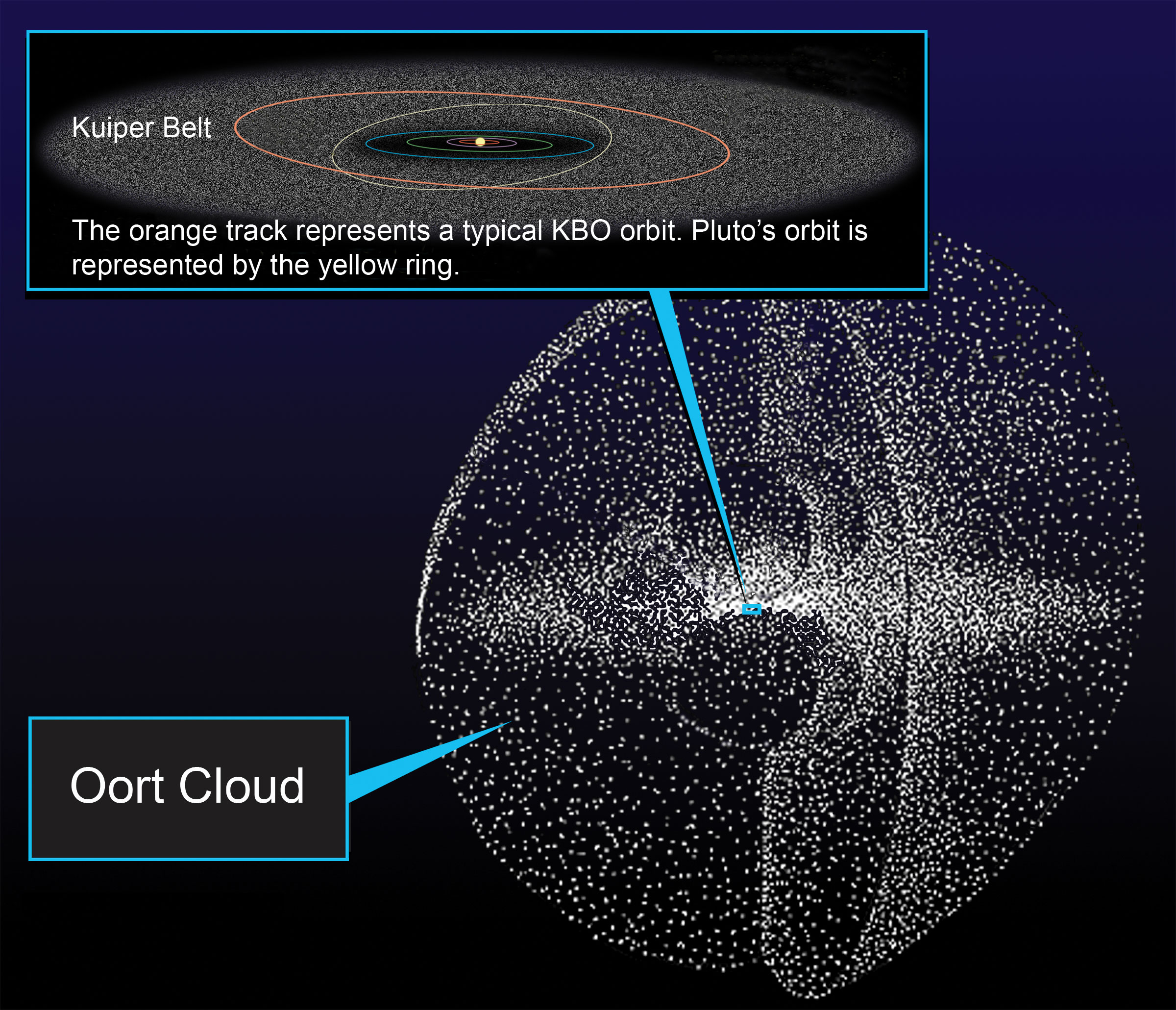
The observable solar system can be divided into three regions: the rocky planets including the Earth and asteroids of the inner solar system, the gas giant planets, and the icy Kuiper Belt objects, which include Pluto. The Kuiper belt stretches from beyond Neptune, which is at 30 astronomical units (one astronomical unit, AU, represents the distance between the Earth and the sun), to about 50AU.

Sedna and 2012VP113 are strange objects, because they reside in a region where there should be nothing, according to our theories of the solar system formation. Their orbit is well beyond that of Neptune, the last recognised planet of the solar system, and even beyond that of Pluto, which differs from planets because of its size, unusual orbit, and composition. (Pluto, once considered a planet, is now considered the lead object of a group of bodies called plutinos.)

The closest Sedna, which is 1000km-wide, gets to the sun is about 76AU and for 2012VP113, which is 450km-wide, that distance is 80AU. Their orbits are also at weird inclinations compared to most other solar system objects.

The results of the discovery have been published in Nature. Chadwick Trujillo of Gemini Observatory in Hawaii, who was also involved in finding Sedna, and Scott Shepherd of the Carnegie Institution for Science, who found 2012VP113 with Trujillo, propose that these objects are members of the inner Oort cloud.

The Oort cloud is a hypothetical region that is thought to stretch outwards beyond the Kuiper belt. Beyond 5000AU, the Oort cloud expands out into a sphere centred on the sun. We have no direct evidence that the Oort cloud exists, but indirect evidence comes in the form of comets with extremely elongated orbits.

Oort_Cloud

Stephen Lowry at the University of Kent said: “The orbital properties of these two objects are so very different from that of the Kuiper belt objects that it wouldn’t be wrong to suggest they may be part of the inner Oort cloud.”

The fact that these objects exist is remarkable, since they exist in a region where material is thought to have been too sparse for them to form. Current thinking is that they actually formed in the giant-planet region, and that their orbits may carry the signature of whatever events caused them to scatter to such distances. It is hoped that this discovery will lead efforts to find other objects.

David Rothery of Open University said: “This is a remarkable discovery, but it is not entirely surprising. When they found Sedna, there was hope that they would find others in that region.”

But the fact that it took Trujillo, who was involved in the original team that found Sedna, more than ten years to find Sedna’s neighbour speaks to the challenge of discovery. “The farther you get from the sun, the less sunlight falls on these objects, which makes the task of locating them harder,” Lowry said.

“Worse still,” Lowry continued, “the eccentric orbits of these objects means that there is very tiny window in which they can be observed from even the most powerful telescopes on Earth. What is needed to find these objects is not just technology but persistence.” For example, Sedna gets as close as 76AU away from the sun, but at its farthest it is nearly 1000AU. Its orbital period is about 11,400 years, which means it spends lots of time too far out to be detected.

While 2012VP113 and Sedna provide some information about the inner Oort cloud, to say any more, scientists are going to need more than two data points. Next generation instruments such as the Subaru telescope in Hawaii and Large Synoptic Survey Telescope in Chile may hold the answers.The Conversation

First published on The Conversation. Images by NASA.

China’s exceptionally well-preserved fossils may have been the result of a volcanic eruption

A series of fossil discoveries in the 1990s changed our understanding of the lives of early birds and mammals, as well as the dinosaurs they shared an ecosystem with. All those discoveries had one thing in common: they came from a small region in northern China that preserved what is now called the Jehol Biota.

Until now, however, no one knew why so many well-preserved fossils have been found in that region. In a new study published in Nature Communications, researchers have found that this remarkable preservation might have been the result of a Pompeii-like event, where hot ash from a volcanic eruption entombed these animals.

Dino colours

According to Sarah Gabbott at Leicester University, who wasn’t involved in the study, “unravelling the environments in which fossilisation took place, as the authors do in this paper, is very important. It places the fossils within the context of their habitat and it allows us to determine what filters and biases may have played a part.” These biases may affect which organisms get preserved.

The fossils of the Jehol Biota are from the Early Cretaceous period, about 130 million years ago, and they comprise a wide variety of animals and plants. So far, about 60 species of plants, 1000 species of invertebrates, and 140 species of vertebrates have been found in the Jehol Biota.

Photos show the typical entombing poses of the Jehol terrestrial vertebrate fossils. This boxer-like pose is typical of victims of pyroclastic density currents, resulting from postmortem tendons and muscles shortening. Baoyu Jiang

One of the most remarkable discoveries to arise from these fossils came in 2010, when Michael Benton of the University of Bristol found colour-banding preserved in dinosaur fossils. These stripes of light and dark are similar to stripes in modern birds, and provided further evidence that dinosaurs that evolved into birds. Benton also found that these fossils had intact melanosomes – organelles that make pigments. This discovery allowed paleontologists, for the first time, to tell the colours of dinosaurs’ feathers.

Rising from the ashes

Baoyu Jiang of Nanjing University, the lead researcher of the new study, has been studying fossils from Jehol Biota for more than a decade. “About two years ago, we realised that the sediments and their enclosing skeletons may provide key clues about what happened to these animals when they were killed and buried,” he said.

The fact that so many fossils were found exquisitely preserved from the same time period suggested some form of mass death. Even before Baoyu started this work, there were suggestions that volcanoes may have been responsible.

Using 14 different fossils from five locations within the deposits, Baoyu found marks of fast-moving ash and hot gas, known as pyroclastic flows, that can only result from a nearby volcanic eruption. The bones showed black streaks, which suggests charring had occurred.

Almost Pompeii

But questions remain. The area that supported the Jehol Biota is suspected to have been a wetland with many lakes. Most fossils are found in lakebeds, suggesting that either the fossils were washed into these lakes by floods or that the animals were in the lakes before fossilisation took place.

Baoyu believes that if fossils don’t separate at bone joints, it means the animals must have been in the lake before dying. But that is not a convincing argument, Gabbott said. “A freshly dead carcass, buoyed by decay gases which collect in the stomach, can be transported for tens if not hundreds of kilometres without such disarticulation (separation of bones at joints).”

No other fossil location, let alone that which produced so many well-preserved samples, has ever been suggested to have undergone a similar event. A comparison can be made to what happened in Pompeii in 79 AD, when Mount Vesuvius erupted. The ensuing destruction led to the preservation of the city’s architecture and objects but not of people or animals. The human and animal remains we see from Pompeii are plaster casts of the empty spaces their decomposed bodies left in the ash.

Still, Jehol Biota and Pompeii both show how mass tragedies at the feet of volacanoes can preserve the past for future generations to discover.The Conversation

First published on The Conversation. Image credit: Chuang Zhao and Lida Xing