The blogging dilemma

I have two opposing arguments in my head. One that wants me to support blogging and one that makes me ignore it. I can’t seem to convince myself to choose a side. But does it really matter if I choose a side?

The internet has given everyone a platform to publish. An ability to share their views and thoughts on absolutely anything with those of their choosing or with the world at large. Surely that is a good thing but as a consumer of media, I feel overwhelmed with the sheer volume of things being created. There is just too much to keep up with.

We have so many quality newspapers, great TV channels, lots of interesting people to follow on twitter, good friends to keep up with on facebook and of course, there is the non-virtual life stuff. With a limited 24 hours daily, I would be surprised to find anyone who is able to keep abreast with everything and not feel overpowered by it all.

My solution to the problem was the information diet. Oh yes, it works if followed like the bible. But unlike a normal diet, this diet is much harder because all it takes to break the diet is the click of a mouse. I do my best to keep up with the diet and what allows me to keep going this way is the presence of a cheat day. It is that one day a week when I allow myself the luxury of reading/watching/stalking whatever I like.

It’s on the cheat day that I open my google reader to find 100+ unread blog posts. I quickly skim through and read what I like (a few). It’s rare that I ever reach the end of the list before the end of the day. Those unread blog posts usually remain unread and the number of unread posts keeps growing. It’s those unread blog posts which have incited me to write this blog post (what an irony!)

I look at that growing number on my google reader and I feel like saying ‘what a waste!’. All those hours that really good people have spent writing those blog posts have gone to waste. And even if I forget the ones that I did not read, what is it that I gain from the ones that I do end up reading? May be a few moments of pleasure and wonder. If that’s all that blog posts are worth and if most will remain as unread posts in someone’s reader then isn’t blogging a big waste of time? These are thoughts that pursue me to ignore blogging.

But then I remember. Every week I derive immense pleasure in being able to share my thoughts here on this blog. I know people read the posts (at least a few). If their two minutes were spent reading this then I better write something that is worth their time. But it’s not just about them (although readers are very important), it’s also about me.  I learn every day. I can see a part of myself evolve with every blog post. There is a peculiar sense of joy in being able to convert a thought into a well-written piece of prose.

Beyond the reader’s pleasure and mine, there is something that we tend to ignore about the power of blogs. They can be places to gain some really good ideas. Steven Johnson explains this is in a superb talk (only 4 mins). He says that good ideas usually come from a process he calls the slow hunch. That usually, a good idea is a combination of two or more part ideas. This combination occurs when you allow them to brew in your head for sometime. This time allows them to come together in your head, if you have all the part ideas, or allows you to gather the remaining part ideas from people you meet, places you visit and things you learn.

Reading blogs can more often than not serve that purpose. A blog is usually a place where raw ideas are shared and they are given for free to the readers for use. You can find parts of that great idea which has been waiting for its remaining parts and waiting to mature. I subscribe to a selected few blogs through email. These are the blogs that I religiously read and I’ve found many really good ideas through them. It’s probably because I’ve taken the time to grab everything that is on offer which meant that I did not miss out on that part idea which I was looking for.

There is one another advantage of reading blogs which is commonly ignored. If you read someone’s blog and read enough of it, you connect with the person in a way which is very different from any other connection that you can have with the person. Whenever I have to look someone up on the web, I try to look if they have a personal website or blog. If it’s someone you want to impress then just the words, “I read on your blog..” are enough to make the person take notice of you and give you a great first impression.
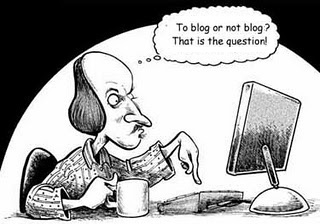
So should I support blogging or ignore it? As with most answers in life, there isn’t a yes or no answer to this. There are certainly a lot of poor blogs out there. They simply don’t deserve your attention but then there are some which absolutely do deserve your attention. It’s for you to find them. As for whether you should blog or not? I think it’s a very personal choice and one that only you can make. May be this extended conversation on blogging will be of some help.

Written while listening to Chillout radio on Last.fm.

Do as I say if you want to become a leader

We’ve built education systems which teach us to be obedient. They make us experts in following instructions. It is hoped that eventually through this obedience will emerge self-control that will enable us to become leaders. Leaders need self-control, there is no doubt that. They need to obey themselves, only then will they be able to make a difference in the important roles that play.

Seth Godin writes today about how it is an expensive mistake to assume that obedience will lead to self-control and thus to leadership. He asks

Help me understand why obedience is the way to get there?

That’s a rhetoric, of course (compliant sergeants rarely become great generals). Interestingly, I’ve found myself asking that question again and again over the years but without the clarity of expression that Godin possesses.

At high school, I remember that if we ever solved a math problem in a way that wasn’t shown in the ‘Ideal Answers Guide’ then we were doing something wrong. If we answered a question in a history test without using bullet points then we’d lose half the marks. If an English essay did not have some quotation by a legendary person then our teacher never gave us that elusive A, no matter the brilliance. Making up arbitrary rules seemed the prerogative of a teacher. If someone dare asked why, the answer was always ‘do you want to score marks in the finals or not?’.

Things don’t stop at high school though. Even in university, I remember that we were told by lab instructors to add some chemicals in the stated order if we wanted to finish the experiment and leave in time. No explanations. Want to study abroad at a good university? Publish something somewhere. Want to write a good Statement of Purpose? Use a quotation by a legendary person (yes, he crops up everywhere this legendary person).

Arbitrary rules to teach us to become obedient are everywhere. And if the purpose is to teach us to become disciplined individuals then the rationale is that anything that makes us more obedient will only help – Do as I say if you want to become a leader.

But no. That’s not how things work. Some of my most rewarding experiences have come because I’ve not broken rules that did not make sense to me. I’ve taken bigger strides when I’ve challenged the status quo. The most fulfilling writing experience have come to me when I’ve thought without rules and constraints.

O   O   O
O   O   O
O   O   O

We had a creativity workshop in the lab last week. In the very first exercise of the day, we are shown a A3 sized sheet of paper with nine circles (like I’ve shown above). We were then asked to connect all the nine circles with straight lines only and report the number of solutions we could come up with. That’s it, no more instructions.

Virtually everyone sat there drawing out the dots and then connecting them with straight lines. The answer is infinity of course but that wasn’t the point. We were at a creativity workshop and the presenter was looking for some creative answers. But may be one or two people came up with something that was close to being called creative.

‘That was usual’ the presenter said at the close of the exercise, ‘remember I’ve given you no rules here. That is a sheet of paper with nine circles on them, that’s it. You can do what you like with it.’ Then he helped us think out of the box to come up with creative solutions and we found so many of them.  Start drawing a straight line and rotate the paper to cut through all the circles. Cut the sheet into nine pieces and re-arrange them to put all the nine circles in a line and draw a straight line through. Use the same nine pieces, stack them on top of each other and then pierce a pin through the paper…. you can keep going this way and come up with many solutions to the same idea but none that resemble the solutions that the group had before. That’s because we had just broken the rules that we had set for ourself. There were no rules set by the presenter, all of us just set the rules for ourselves and kept working in two dimensions.

The creativity workshop wasn’t part of a leadership exercise but it might as well could be. Every leader needs to be creative. Of course, there are solutions to the common problems and leaders can solve them without being creative but the great leaders are those who are able to solve the uncommon problems that need a creative approach. Obedience not only may never lead to the emergence of self-control but also stifles creativity. And yet we build institutions to produce leaders who are obedient students.

PS: Just to be clear. I am not making a case against rules (I think they are important) just against the requirement of being obedient no matter what.

Written while Air played Alpha Beta Gaga on repeat.

The internet, social media and relationships

Whenever I sign in to my Facebook account, I am greeted by hundreds of smiling faces wanting to tell me about their lives. I can at the choice of my whim get entertained by my friends doing stupid things or choose to wonder about the beautiful world through that friend’s pictures who just spent the last month in New Zealand. I can feel nostalgic by hearing that old song which was posted by another friend or even choose to cry reading about the sad story of a friend who met with an accident and who’s ‘wall’ is full of messages from well-wishers. I can choose to feel jealous about my mate who just found the hottest girl-friend or go to the profile of my class topper and get a dose of Schadenfreude from knowing that he is on a minimum wage job. I have the whole platter of emotions served to me everyday at whatever time I would like.

The cherry on top of this platter is that I also have the choice of declining to listen to any of these stories without it being considered rude. It’s great. Even King Louis XIV could not afford this kind of social luxury with all the power and money he had.

We live today with hundreds of friends on Facebook and similar number of followers on twitter. We have the ability to broadcast are thoughts in words, written or spoken, to millions of people for free. I can build friendships across the seas and over the mountains. I can have intellectual debates or learn something that blows my mind away. I can buy gifts for my parents sitting at my desk at work. The Internet has made plenty possible and yet I can’t stop but wonder when I heard the following from my dad.

“I was at your aunt’s place the other day and had a somewhat surprising experience. I was chatting with your cousin and asking her about her work. She explained it well in detail and we had a nice chat which was interrupted only because she had to leave. When she left your aunt came to me and told me, ‘You know she has never before explained to me what she does at work, despite having asked many times before.’ On further enquiry your aunt explained that she spends most of her time at home on the computer. She’s either on Facebook or watches some videos on YouTube. Rest of the time she doesn’t talk much. And I could not disagree because this was the first conversation that I had had with her in many years where she answered in more than a few words.”

I know my cousin somewhat well. We used to have lots of fun as kids but it has been many years since we spent any substantial time together. I know that she is a smart girl and although I can’t say much about her conversational skills. It makes me wonder that if the social media revolution had happened while I was still at home, would I have fallen in to the same ‘trap’ – showing a lack of interest in the people around me but paying more attention to those on Facebook. I tried to dismiss it as a singular case but my dad retorted that it is not a singular case. He’s heard the complain from many other parents in the recent months. More importantly though, the case my dad described was of an urban Indian family. In India, Facebook hasn’t quite reached the levels of penetration that it has in the US or UK.