Thinkers should wallow in the middle ground, but doers should choose a side

A widely-accepted definition of progress is that it is the improvement in the standard of living of the greatest number of people, and by that definition the world has progressed much since the beginning of civilisation.
6a00d83451b14d69e200e5509cfcff8833-800wi

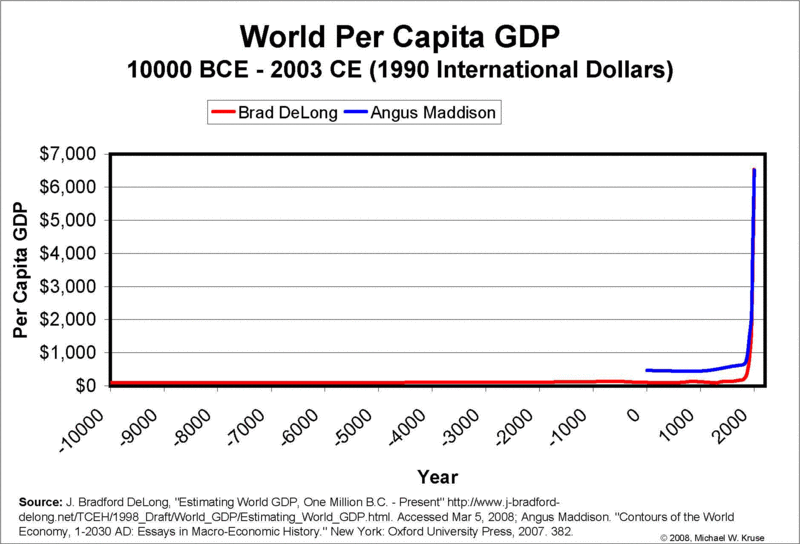
As a crude indicator of progress, in the last 2000 years per capita GDP (gross domestic product) has increased from a few hundred dollars to about $7000 (in 2000). Even if on average humanity has been progressing rapidly, most of that progress has happened in fits and starts—in different times it has benefited different groups of people.

Consider, for example, the fact that real incomes in the UK scarcely doubled from the beginning of the common era to 1570. They then tripled from 1570 to 1875, and more than tripled from 1875 to 1975. Yet, from 1770 to about 1830, during the industrial revolution, real wages in Britain remained stagnant.

Ryan Avent, economics correspondent for The Economist, makes a case that technological progress disproportionately benefits those with capital, before raising everyone’s income in the long term. During these short periods of high innovation, the creation of inequality in society may be inevitable. (He further argues that we may be in just such a phase right now.)

This is why techno-optimists (including myself) need to be careful. There is an expectation among this breed that technology will always lead to progress within their lifetimes—say that to the textile workers of the industrial revolution. When slagging off technocritics, like Evgeny Morozov, it is worth keeping in mind that neither extremes of the argument are correct.

Neither left nor right

Another place where disillusionment is common is on the left-right political divide. Those on the left think progress will come through reducing inequality and providing everyone with the same opportunities. Those on the right think survival of the fittest through competition is the only way humanity has progressed so far. History proves both of them wrong.

Take the example of US presidents. Republican presidents, widely representing the right, have had 88 years in power, whereas Democratic ones, widely representing the left, have had 85. In the UK the corresponding numbers for prime ministers are skewed slightly to the left, but not by a lot.

More often than not, however, in new elections people elect a party with an opposing ideology as they get fed up with the policies of the ruling party. Continuous power of the same ideology at the top for a long time is an exception than the norm.

This signifies that progress is often achieved by a mixture of left and right policies. Competition is good, but it can lead to crony capitalism. Egalitarianism is great, but it can lead to stagnation as the history of communist governments make clear.

(An exception here is that of the likes of China and Singapore, which have single party rule and have still done spectacularly well when it comes to “progress”. So what I’m proposing here must be taken to be applicable to countries which conduct free and fair elections, at least to a large extent.)

Being in the middle is not cool

Politicians on the left and right bring their own baggage of biases during their time as leaders. The flip-flop between the ideologies of those elected to lead, in some ways, shows that people try to correct for the biases of their leaders. When the left-leaning party pushes a country far to the left, say, by making it less competitive in the global market, people elect a right-leaning party to correct the situation. (There may be other factors at play, including randomness, but I would argue on the whole pre-election voter sentiment seems to agree to this hypothesis.)

So if this is the case, why is the following among centrist parties of the world so small? I’m not sure, but I think the answer may lie in the fact that human herd behaviour works best when people believe in a certain set of tenets very strongly. This must work better when there is a left-right divide than when those in the middle take beliefs from either side.

Another reason may be that it is easier to act in unison on certain kinds of beliefs, say by being a blind techno-optimist, than it is to be in a position where one is continuously re-evaluating which side to lean to. In other words, rationality among an individual or a small group matters less than rationality of a crowd which may be split into two moderately extreme sides.

All this leads me to conclude that, for a thinker, it may be good to wallow in the middle ground. But for a doer, it would be better to choose one side and stick to it.

Thanks to Alex Flint and Deeksha Sharma for reading a draft of this article.

We suffer from the what’s new syndrome

The idea behind meditation is to sit in a comfortable pose with your eyes close and back straight, and then empty your mind of any thoughts. Sounds easy of course, but getting rid of thoughts is difficult. To aid the process, the form of meditation I have been taught involves focusing on breathing. The process is a rhythmic one and there is much to learn about something we don’t consciously think about much.

I start by getting rid of any thoughts I’ve been holding on to. This could be about an email, a person or a chore. I consider it and then let it go. Within a few minutes, I am truly staring into the dark (minus magic lights of the eye or phosphene). Then I start focusing on my breath.

You can consider many things: the pace of breathing, which parts of your body when you breath, how much does each part move, what sensation does breathing cause in different parts, how much detail can you gather from each of those parts, what is the temperature of the air as you breathe it in and out, etc.

But soon enough I run out of things to learn about breathing. Usually this starts about 12-15 minutes in. And that is the most vulnerable time of my meditation session. If I let an interesting thought in, down I go the rabbit hole. By the time I realise that, I’ve lost the peace and quiet that comes from meditation.

Why do I hit that wall every time I meditate? How can I overcome it?

I think I hit that wall because my mind has had enough of the breathing and its related experiences. Now it wants something new. Anything new. Something worth thinking about or reminiscing or observing or experiencing.

The world of new awaits
The world of new awaits.

I don’t think this is a problem of our modern day lives with the continuous social media feeds, email and app notifications. (I could be wrong, but I haven’t come across evidence to prove that). I think it’s something to do with human beings love for the new.

In any form distraction is hard to deal with. While meditating, the mundaneness of the activity makes it easier to get distracted. We all suffer from what I provocatively call the what’s new syndrome.

That’s just a new name for something psychologists have studied for quite sometime. They call it novelty-seeking behaviour. Its genetic roots and relations to brain chemistry have linked the trait with problems like “attention deficit disorder, compulsive spending and gambling, alcoholism, drug abuse and criminal behaviour”.

Researchers separate people in three categories: neophobes , neophiles and, on the extreme, neophiliacs. A recent study suggests that neophiliacs are the ones most like to suffer from disorders. But, if these people can combine their neophiliac nature with persistence and “self-transcendence” (losing yourself in something you love), then that may be the perfect cocktail for success.

I might be a neophiliac, given that I enjoy working as a journalist. But I don’t think people can be cleanly classified into three categories. I might be a neophiliac when it comes to news, but I hate changing houses. My interest in new people waxes and wanes based on an algorithm that I haven’t yet cracked. And I certainly fixate on things, like certain foods or computer games, for quite a while before moving on.

All this is to say that there must be a mixture a neophobe, a neophile and a neophiliac in me. And I suspect that might be the case for others too.

How then can it help me solve my meditation problem? Perhaps I have to channel some of neophobe nature into hating new thoughts for a little while. I know I can be persistent, so may be I have a chance at achieving this.

Let us pick our battles, feminists

I recently reread Rudyard Kipling’s poem “If—”. And it reminded me of an online encounter I had with some feminists. The beautiful poem ends with this:

If you can fill the unforgiving minute
With sixty seconds’ worth of distance run,
Yours is the Earth and everything that’s in it,
And—which is more—you’ll be a Man, my son!

If those feminists could have their way, reprints of Kipling’s poem will be forced to add a few words to the last line: “And—which is more you’ll be a Man, my son, and a Woman, my daughter!”

Kipling had a son and a daughter, but “If—” was written as paternal advice to his son John. It was written in the Victorian era, which was a much more patriarchal society than today. And it might seem like an exaggeration that feminists today will want such a change made to a great work of literature, but may be it isn’t.

Even today many such feminists scoff at The Economist Style Guide‘s use of “he” over “he or she”. It says on political correctness:

If you believe it is “exclusionary” or insulting to women to use he in a general sense, you can rephrase some sentences in the plural. But…do not be ashamed of sometimes using man to include women, or making he do for she.

I have been on one occasion publicly asked to change “the common man” to a more gender neutral term “the people on the streets”. Something I didn’t really have any strong views about and was happy to oblige to making the change.

That incident did make me think that it’s important to pick your battles when fighting for a good cause. I care deeply about the rights of women, and as an Indian I feel ashamed at the monstrous acts committed against them every day in my country. In my personal life, I work consciously to keep my biases in check. This year I sat down with my extended family to talk about how much more an educated and well-off family like ours still needs to do to help the cause. But I wonder why some feminists make such trivial things their pet peeves. Aren’t there more important feminist issues to worry about than this?