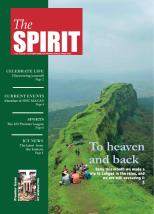
As a student in the third-year of my undergraduate degree, with a few friends, we brought to our Institute a bi-monthly newsletter called The Spirit. It was an attempt to give a platform to the students to voice their opinions, explore their interests, develop good writing and editing skills but most of all it was an attempt to have fun doing something interesting. If the newsletter were still in print it would have been in its sixth year of publication. But like everything that is born, it will die…
While I worked on the newsletter, we spent many many hours putting little things in place. There used to be some special kind of energy that I derived from working on it. Not just while I was there but even after having left the Institute. Believe it or not, I followed up on the progress of the newsletter till last year, its fifth year. Whenever I had a chance, I used to speak to the team working on it. Of course, all the work was done by the particular team but it gave me tremendous pleasure that our baby was still being looked after and I was always ready to do what I could to help them in some way. But the signs of it’s ‘death’ were visible.
Things had started to change as soon as I had left. The teams that came did not seem as motivated as the teams I had the pleasure to work with. They had new ideas which was great but implementation of those great ideas, more often than not, did not happen. The co-ordination amongst the teams fell quite rapidly and it was not hard to see why the number of issues being printed kept falling till finally in its fifth year the students decided to make it an online-only publication.
One of the reasons that I was very keen to keep it going was because we had made a promise that we will ensure that it will go on. We weren’t allowed by our faculty members to start a newsletter until we had thought of how we would be able to sustain students’ efforts to keep it going in the future. We were also told that we had to find our own money to get it printed. For the first two years, we managed alright. It was hard work but the enthusiasm of the team and the response we got from the readers made the effort worthwhile.
I don’t know what went wrong. I wasn’t there to watch what happened. Sure I spoke to people but there wasn’t a clear reason. Money was a concern but it wasn’t a big enough worry because one way (Institute’s backing) or the other (contributions from alumni) it could be tackled. The lack of motivation might have been the biggest reason. Looking back I think our team was so motivated because we had made public commitments and also because we were the guys who started it. The responsibility combined with the thrill allowed to us to go that extra-mile.
Amongst the other reasons, of course, could be what has been one of the most difficult questions that the print media faces today. People spend more and more time reading online than in print. (I probably pick up a newspaper once in a month!) When we started the Spirit, it was the time when internet was becoming cheap enough to afford a personal connection in your own room in the hostel. I imagine that now everyone has their own in the Institute. Of course, the move to making it an online-only publication should have worked then, no? But it hasn’t. Or so it seems.
Moreover, the Spirit unlike Manzar or Sportsaga (both inter-collegiate events of ICT which I believe are still going strong) was not a one-off ‘event’. So a team of ten people had to work round the year to sustain the newsletter as opposed to a team of fifty or more people who worked for a few months to make the events happen (I am not trying to undermine the work put in to make the events happen but merely commenting on the sustained efforts needed for the newsletter).
I suppose once the team that had started these things had left, the main motivation for students to keep doing anything would be the value they get out of doing it. Value in learning new skills, in having fun while doing it, in making new relationships and, of course, adding to the CV fancy titles that come with doing these things. In that respect, all these activities taught people how to manage people and relationships, how to market/sell what you are doing, how to be responsible for your actions, etc. But one unique advantage of working on the Spirit as opposed to other activities was that the students would develop the critical skill of writing and editing.
Many of those at this esteemed Institute will one day be leaders in their own fields and one way or the other will have to learn how to communicate effectively using written words. In my opinion, the sooner that skill is developed the better it is. But may be that isn’t a priority for the students in the Institute anymore.
You may be wondering where am I going with this. Well, I brought up this issue today because of two reasons. First, I wanted to put down in words my experience of working on the Spirit so that if by chance in the future someone decides to bring it back to life (even under a different name) there will be something that they can read about and may be do it better than we did.
Second, I am now ready to close this chapter of my life and wanted to do it justice by giving it the respect that it deserved. The Spirit meant a lot to me (as it must to the teams that worked on it), I learnt a lot of time on it during those days. Whatever little writing that I do today, I know that the Spirit played a key role in making that happen. As such, I feel a little hurt that I am closing the chapter much sooner than I wanted to. In our days while working on an issue of the Spirit, we used to talk about coming back to the 10th anniversary celebrations of our graduation and still finding copies of the Spirit. I don’t think that will happen but I hope I am proved wrong.
***
Don’t believe a word I say. See for yourself what people had to say about The Spirit:
M Sriram: Hope you and your team are able to come up with the second issue rising to the higher expectations which your first issue has triggered.
Raghavendra Ravi: I saw “The Spirit” It is very nice.. UDCT has changed a lot. In our times ( sorry to sound old – 1975-78 ) such thing were not easy. Though the notice board journalism was on.
Prashant Mullick: Surprisingly fresh! It was interesting that H(B)ollywood figured in a substantial number of stories. Overall a nostalgic eclectic mix of UICT news and social topics. I enjoyed it. Hope to see you guys continue putting this together.
Smita Lele: UD – UG = Body – Spirit!!!!
In other words UG’s are the fire, the electricity in the UD environment
and the knowledge pool created by PGs and research will loose its charm
without bright UGs who are the star personalities at this young age.
Let me share a secret of UD’s research story — why most of the UD
teachers want to combine teaching and research and do not want to be only
full time researcher in any National or International Research lab? The Undergraduate teaching charges the battery of the researcher’s mind
and intellect and keeps him (her) young at heart!
That is why I feel, UD – UG = Body – Spirit!!!! Best wishes to “spirit”.
Asmita Atre: The issue 3 has come up really well. The presentation is very attractive and I am certain that you people will continue working the same way.
Anil Nair (the guy who motivated us to start this newsletter): More than anything, it is your verve and the enthusiasm which brought Spirit to such levels. As in case of any magazine the passion tells the story. I don’t know if it is inappropriate to tell this — the first day when Akshat sat with me through the night skipping a date with his girl-friend to design Spirit, I knew where the magazine will reach. Most often, when I got the magazine I read it cover to cover. Everyone’s contribution was excellent. I am not surprised by all the accolades for Spirit. At the risk of sounding patronising I should add that the new team should keep the good thing going. Also, all of you should try to touch base with your friends in the pretext of Spirit. Friendship is more important than anything.



 Akshat Rathi