Solar wind and space dust create new source of water

Water ice is the most abundant solid material in the universe. Much of it was created as the byproduct of star formation, but not all. John Bradley of Lawrence Livermore National Laboratory and his team may have discovered a new source of water in our solar system. His lab experiments reveal that the solar wind may be creating water on interplanetary dust.

The sun ejects high-speed charged particles in all directions. Bodies in the inner solar system get bombarded by this wind of particles, which continuously varies in intensity.

Small bodies, such as dust particles or tiny asteroids, can be eroded by these harsh winds. Larger bodies that do not have an atmosphere, such as the Moon, are bombarded by both the solar wind and tiny meteorites. This form of bombardment causes a phenomenon called space weathering. (Atmospheres protect planets from tiny meteorites, while a magnetic field can deflect solar winds.)

The lunar dust brought back by the Apollo missions showed for the first time the result of space weathering—though not immediately. A careful examination of the dust returned from the lunar surface had to wait until the 1990s when scientific instruments became good enough. When finally observed under sufficiently powerful microscopes, the dust particles revealed what have been called “rims.”

These dust particles are usually made of silicates—compounds of silicon, oxygen, hydrogen and few metallic elements. The rims are the result of chemical modification of the surface of the particle, caused by high energy impacts and the continuous bombardment of the solar wind.

The modification leads to an imbalance in the chemical structure of the particle, sometimes loosening the bonds holding oxygen and hydrogen atoms in the silicates. This made scientists speculate that there is a chance that water could be formed somewhere in these rims .

Water needs two atoms of hydrogen and one of oxygen. If silicates provide one atom of each element, then only one more hydrogen atom is needed. Conveniently, hydrogen atoms are available in abundance in the solar wind, where they are found as high-energy protons (hydrogen atoms stripped off their electrons). If the conditions are right, this charged hydrogen atom can react on a dust particle’s rim to form water.

Plausible as this seems, past attempts to find water on these rims gave mixed results. The problem was that the reactions were happening at such tiny scales, and instruments weren’t good enough to unambiguously detect water.

That’s where Bradley’s work comes in. The team attempted to locate water using a highly-sensitive method of analysis called valence electron energy-loss spectroscopy. The method involves exposing a sample to a beam of electrons that, on hitting the material, will get deflected at different speeds. The deflection and the speeds can reveal how much energy was lost by the electrons in the process, which is based on the type of atom it hits. The instrument can identify the composition of a material at very small scales, just enough for Bradley to analyse silicate rims.

The best way to determine whether water forms on silicate rims is to do these experiments on the types of silicate material that exist in space. Bradley did this by using three types of these minerals: olivine, clinopyroxene, and anorthine. These were exposed to charged hydrogen and helium particles, which were a proxy for the solar wind.

If water is formed by the solar wind, it would only be found in the samples that were exposed to hydrogen—not in those exposed to helium. And that is what happened. As reported in PNAS, Bradley’s sensitive tests repeatedly found water, but only in the samples that were bombarded by hydrogen.

Martin McCoustra at Heriot-Watt University in Edinburgh finds the work convincing. He said: “I am not very surprised that water could be formed on silicates. However, now that they have shown that it can, it could be an important source of water.”

Bradley’s work implies that water molecules must have been forming for billions of years on interplanetary dust particles, on the Moon, and possibly on asteroids. However, McCoustra warns that “This source of water, albeit new, won’t be able to account for a large proportion of water in the solar system. Most of that water was formed during the process of star formation that our sun went through.”

Some have argued that water-rich comets planted water on our planet. But McCoustra reckons that a single-source is unlikely. And this study provides another potential source for the material that helps make our planet habitable.The Conversation

PNAS, 2013. DOI: 10.1073/pnas.1320115111First published at The Conversation.

Why Scotland wants to leave the UK

From a historian’s perspective the reasons are simple:

  1. In the past, as the minority of Protestants in a largely Catholic Europe, Scotland preferred to be part of a group rather than stand alone. With religiosity on the decline, that identity isn’t as strong any more.
  2. During the time of the Empire, Scotland reaped lots of economic benefits of being part of the union. These days economic benefits of the union aren’t as strong.
  3. In the past, geography mattered because as an island nation, Scotland could better defend itself. Now that matters little.
  4. Britain is held together by the English, who are London-centric and don’t give the North as much attention as it deserves.
  5. With the EU, both Ireland and Scotland have a new centre to identify with other than London.


Thinkers should wallow in the middle ground, but doers should choose a side

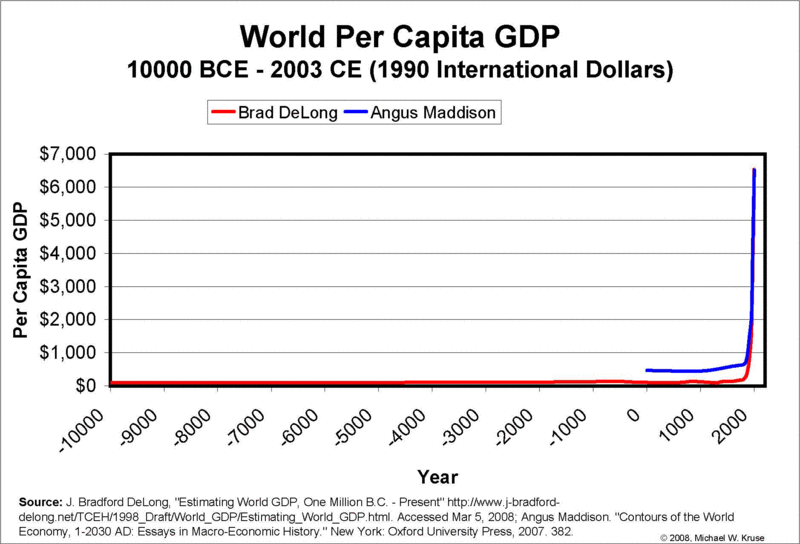
A widely-accepted definition of progress is that it is the improvement in the standard of living of the greatest number of people, and by that definition the world has progressed much since the beginning of civilisation.

6a00d83451b14d69e200e5509cfcff8833-800wi

As a crude indicator of progress, in the last 2000 years per capita GDP (gross domestic product) has increased from a few hundred dollars to about $7000 (in 2000). Even if on average humanity has been progressing rapidly, most of that progress has happened in fits and starts—in different times it has benefited different groups of people.

Consider, for example, the fact that real incomes in the UK scarcely doubled from the beginning of the common era to 1570. They then tripled from 1570 to 1875, and more than tripled from 1875 to 1975. Yet, from 1770 to about 1830, during the industrial revolution, real wages in Britain remained stagnant.

Ryan Avent, economics correspondent for The Economist, makes a case that technological progress disproportionately benefits those with capital, before raising everyone’s income in the long term. During these short periods of high innovation, the creation of inequality in society may be inevitable. (He further argues that we may be in just such a phase right now.)

This is why techno-optimists (including myself) need to be careful. There is an expectation among this breed that technology will always lead to progress within their lifetimes—say that to the textile workers of the industrial revolution. When slagging off technocritics, like Evgeny Morozov, it is worth keeping in mind that neither extremes of the argument are correct.

Neither left nor right

Another place where disillusionment is common is on the left-right political divide. Those on the left think progress will come through reducing inequality and providing everyone with the same opportunities. Those on the right think survival of the fittest through competition is the only way humanity has progressed so far. History proves both of them wrong.

Take the example of US presidents. Republican presidents, widely representing the right, have had 88 years in power, whereas Democratic ones, widely representing the left, have had 85. In the UK the corresponding numbers for prime ministers are skewed slightly to the left, but not by a lot.

More often than not, however, in new elections people elect a party with an opposing ideology as they get fed up with the policies of the ruling party. Continuous power of the same ideology at the top for a long time is an exception than the norm.

This signifies that progress is often achieved by a mixture of left and right policies. Competition is good, but it can lead to crony capitalism. Egalitarianism is great, but it can lead to stagnation as the history of communist governments make clear.

(An exception here is that of the likes of China and Singapore, which have single party rule and have still done spectacularly well when it comes to “progress”. So what I’m proposing here must be taken to be applicable to countries which conduct free and fair elections, at least to a large extent.)

Being in the middle is not cool

Politicians on the left and right bring their own baggage of biases during their time as leaders. The flip-flop between the ideologies of those elected to lead, in some ways, shows that people try to correct for the biases of their leaders. When the left-leaning party pushes a country far to the left, say, by making it less competitive in the global market, people elect a right-leaning party to correct the situation. (There may be other factors at play, including randomness, but I would argue on the whole pre-election voter sentiment seems to agree to this hypothesis.)

So if this is the case, why is the following among centrist parties of the world so small? I’m not sure, but I think the answer may lie in the fact that human herd behaviour works best when people believe in a certain set of tenets very strongly. This must work better when there is a left-right divide than when those in the middle take beliefs from either side.

Another reason may be that it is easier to act in unison on certain kinds of beliefs, say by being a blind techno-optimist, than it is to be in a position where one is continuously re-evaluating which side to lean to. In other words, rationality among an individual or a small group matters less than rationality of a crowd which may be split into two moderately extreme sides.

All this leads me to conclude that, for a thinker, it may be good to wallow in the middle ground. But for a doer, it would be better to choose one side and stick to it.

Thanks to Alex Flint and Deeksha Sharma for reading a draft of this article.