Domestic cats are mass killers

The Oatmeal got it right. How much do cats kill? Too. Damn. Much.

A study just published in Nature Communications estimates that, in the US alone, domestic cats (owned and un-owned) could kill up to 3.7 billion birds, 20.7 billion mammals (rats, rabbits, squirrels), 800m lizards and 300m frogs every year (even lower estimates are scary: 1.4 billion birds and 6.9 billion mammals). Domestic cats are one of the worst non-native invasive species in the world, according to the lead author of the study Scott Loss, of the Smithsonian Conservation Biology Institute.

Previously it was argued that the number of cat killings was small compared to deaths caused by, say, collisions to windows, buildings or communication towers, or even habitat destruction. But this systematic study finds otherwise.
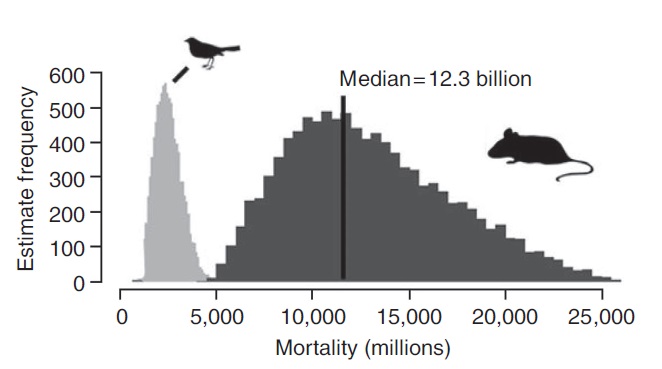
Credit: Nature Communications

Perhaps you knew this, but earlier estimates (like that of the Oatmeal) were lower. Loss remarks that it may be because those studies were not conducted with the same rigour or depth as the current study. According to Loss the new estimates indicate that cat killings are causing population decline some species. A 2011 study even recorded extinctions caused by cat killings. The study conducted on islands showed that free-ranging cats caused extinction of 33 species of birds, mammals and reptiles.

Although un-owned cats are to blame for majority of the kills, owned cats kill a substantial number too. What should ring alarm bells for policymakers is the fact that the number of owned and un-owned cats is growing rapidly across the globe. But Loss admits their estimates based on all available data are still not accurate, and more accurate calculations can only made based on better collection of data.

Methods currently in use to bring these killings under control involve trapping feral cats and sterlising them to stop their colonies from growing. Although this may seem like a good idea, there is no scientific evidence that it works. Loss says, “Management decisions [for controlling cat killings], both in the US and globally, must be informed by fine scale research that allows analysis of population responses to cats and assessment of the success of particular actions.”

While cats with guns (or cats as guns) make for funny pictures, there is more truth to that image than you might think.

ReferenceLoss, Will & Marra, The impact of free-ranging domestic cats on wildlife of the United States, Nature Communications 2013. http://dx.doi.org/10.1038/ncomms2380

Image not from the study. Credit: some tumblr blog.

Best way to remember names

Associate names with a powerful visual image. Reagan with ray guns. Lincoln with chain links. Manmohan with a smiling brain. It can be more powerful if you place this image in your mind at the place you came to know about their name.

Now read on to know why this technique works. Here is the Baker-baker paradox which helped develop the best way of remembering names:

A researcher shows two people the same photograph of a face and tells one of them that the guy is a baker and the other that his last name is Baker. A couple days later, the researcher shows the same two guys the same photograph and asks for the accompanying word. The person who was told the man’s profession is much more likely to remember it than the person who was given his surname.

This happens because:

When you hear that the man in the photo is a baker, that fact gets embedded in a whole network of ideas about what it means to be a baker: He cooks bread, he wears a big white hat, he smells good when he comes home from work. The name Baker, on the other hand, is tethered only to a memory of the person’s face. That link is tenuous, and should it dissolve, the name will float off irretrievably into the netherworld of lost memories. 

From Joshua Foer’s Moonwalking with Einstein

Ten books in one month

100 books

I hadn’t heard about Aaron Swartz before his demise on January 11th. He was a brilliant chap: master computer programmer, co-founder of Reddit, activist for open data and much more. He was also just 26 years old.

After the news of his suicide, the web exploded with eulogies. Much was said about bullying by US prosecutors, openness of data and difficulties of dealing with depression, all of which contributed in someway to his suicide. But what stood out for me came mostly through Aaron’s own words. (His blog Raw Thought is a treasure trove and a great way of learning about him.)

One thing in particular stuck with me: his ability to read more than 100 books every year. (He dropped out of high school and that’s how he taught himself.) I want to do this. And I know managing that with a full-time job and my other writing work is going to be a hard thing to do. So I’ve decided to start by setting a goal of reading 10 books in the next 4 weeks. (This is a little more than the 2 books per week needed to make up 100 books per year.)

At first glance this seems like a difficult task given that previously I averaged about 1 or 2 books per month. But some simple calculations show that this is not a ridiculous aim. At an average size of 300 pages (70,000 words), I’m aiming to read 25,000 words per day. This means at an average reading speed of 200 words per minute, I will need just over two hours of reading time. Allowing for sometime for note-taking and breaks will make it 2.5-3 hours every day.

If I cut out watching TV and I read only the most essential things online, I should be able to do this. If I can do 10 books before February 24th and manage the rest of my life properly, I’ll extend this challenge to 100 books before January 27th, 2014.

With help of friends on Twitter and Facebook and my own reading list, I’ve compiled a list of 10 books that I am planning to read in the next four weeks:

  1. Breakout Nations by Ruchir Sharma
  2. The Disappearing Spoon by Sam Kean
  3. Erwin Schrödinger and the Quantum Revolution by John Gribbin
  4. The End of Science by John Horgan
  5. Genome by Matt Ridley
  6. To Kill a Mockingbird by Harper Lee
  7. Moonwalking with Einstein by Joshua Foer
  8. Flow by Mihaly Csikszentmihalyi
  9. The Curious Incident of the Dog in the Night-Time by Mark Haddon
  10. Fabric of Reality by David Deutsch

If I find the book not worth my time, I will replace it with another one and update the list here. Although I doubt that this list of 10 will need any replacing. I will post a review of the book once I’ve read it (here and on Amazon). If you are keen to support me in this endeavour, you can buy me one of the books above. At present I only first 5 of them. Here is my Amazon wish list. (PS: email me if you need my address).

The #100bookschallenge starts now.

PS: I’m taking the average word count of a book as 70,000 because I am planning to read more non-fiction than fiction. Image from here.