A decade ago, the government of India launched a tourism campaign called Incredible India, and over the years critics have praised its posters and videos. The annual $6m spent on the campaign probably gets paid back to the country many times over. (Foreign-exchange earnings from tourism in India stood at $14.2 billion in 2010.) Yet the campaign’s most recent attempt at demystifying the Hindi language for foreigners—the Hinglish Project—is a bit of a mess.
Of course “Hinglish”, a portmanteau of “Hindi” and “English”, has already been used for some time, to describe the hybrid language that many Indians use naturally. It is spoken so commonly that your correspondent, like many others who grew up in a city in India, sometimes doesn’t realise that he has used an English word while speaking in Hindi. With the large number of English loanwords, even non-Hindi-speakers can often figure out what someone is talking about. Try
मेरे boss ने मुझे एक assignment दी थी. लेकिन मैं उसे complete नहीं कर पाया.
You probably figured out the context, and if you had heard the intonations while someone said this, you would also know that he couldn’t finish that assignment.
But the Hinglish Project has nothing to do with this hybrid language. The website explains:
To make our country a little more familiar to you, we present ‘The Hinglish Project’. Through this unique font design, you can tell the phonetic sound of a Hindi character by looking at the corresponding Roman letter superimposed on it. Hindi is written in the Devanagiri script, which has many more characters than the English alphabet. This font, then, cannot teach you how to read words as they are spelt in Hindi, but its aim is to demystify individual letters in its script and make India more approachable. Despite the superficial distinctiveness of English and Hindi, the two borrow from the same phonetic pool – the Indo-European group of languages, the largest linguistic group in the world. This typeface design playfully highlights these commonalities. To quote a now-popular phrase, “We’re same same, but different!”
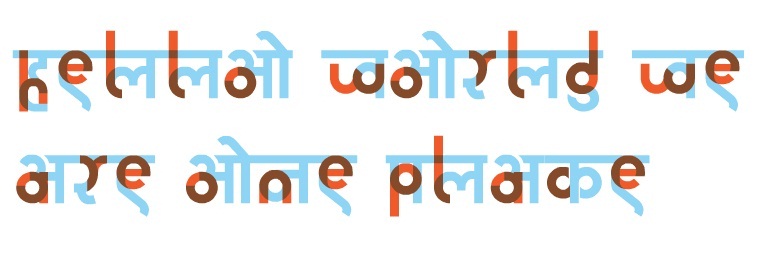
Earlier in the year, the project won a gold medal for Consumer Services and a bronze medal for Design Typography at the Cannes Lions, dubbed “the Oscars of the advertising industry”. The design may well tickle those interested in interesting fonts, but as a practical matter, it is likely to end up unused in the free booklets handed out to tourists.
As the makers of the font make it clear, it cannot be used to construct a meaningful word if you begin knowing only English. Nor can it be used to decode most Hindi words. As the official explanation acknowledges, Hindi has many more than 26 letters. Some of them are conjunct consonants (ka and sha make क्ष = ksh) that cannot be superimposed on any English letter. The written script also uses “matra”, “bindu” and “chandrabindu”, the Hindi equivalent of diacritic marks, to modify the way the letters are used. So even if a user could memorise which Hindi squiggles correspond to the proper Roman-letter squiggles, he will still be unable to sound most words out phonetically. It’s a little like giving a motorist lost in Delhi a map of the city’s footpaths, and even at that, not all of them. It’s better than nothing, but not by much.
Your correspondent has a better solution. It so happens that he exploits the phonetic similarities of Hindi and English every day when he texts his family and friends in Hindi using the Roman alphabet. A simple list of common Hindi words with Roman transliterations and good English translations would be much more useful to tourists in India than what is, in effect, a clever optical illusion.
First published on economist.com.


 Akshat Rathi