Having been suppressed for so long, when countries are liberated from dictatorial or colonial rule, they prefer stability to economic growth. Thus political parties that provide for such stability tend to reap benefits of continuing at the top for some time.
In India, and now in South Africa these honeymoons have lasted over two decades (longer than most places). From 1950 to 1977 Congress party ruled India even though India grew at only 3% per annum (dubbed the Hindu rate of growth). Similarly, since the end of apartheid in South Africa the ANC has ruled with only modest (now 3%) growth figures to boast of.
The Oatmeal got it right. How much do cats kill? Too. Damn. Much.
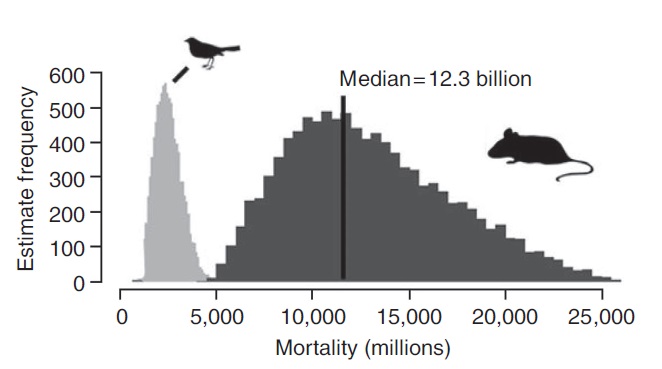
A study just published in Nature Communications estimates that, in the US alone, domestic cats (owned and un-owned) could kill up to 3.7 billion birds, 20.7 billion mammals (rats, rabbits, squirrels), 800m lizards and 300m frogs every year (even lower estimates are scary: 1.4 billion birds and 6.9 billion mammals). Domestic cats are one of the worst non-native invasive species in the world, according to the lead author of the study Scott Loss, of the Smithsonian Conservation Biology Institute.
Previously it was argued that the number of cat killings was small compared to deaths caused by, say, collisions to windows, buildings or communication towers, or even habitat destruction. But this systematic study finds otherwise.
Credit: Nature Communications
Perhaps you knew this, but earlier estimates (like that of the Oatmeal) were lower. Loss remarks that it may be because those studies were not conducted with the same rigour or depth as the current study. According to Loss the new estimates indicate that cat killings are causing population decline some species. A 2011 study even recorded extinctions caused by cat killings. The study conducted on islands showed that free-ranging cats caused extinction of 33 species of birds, mammals and reptiles.
Although un-owned cats are to blame for majority of the kills, owned cats kill a substantial number too. What should ring alarm bells for policymakers is the fact that the number of owned and un-owned cats is growing rapidly across the globe. But Loss admits their estimates based on all available data are still not accurate, and more accurate calculations can only made based on better collection of data.
Methods currently in use to bring these killings under control involve trapping feral cats and sterlising them to stop their colonies from growing. Although this may seem like a good idea, there is no scientific evidence that it works. Loss says, “Management decisions [for controlling cat killings], both in the US and globally, must be informed by fine scale research that allows analysis of population responses to cats and assessment of the success of particular actions.”
While cats with guns (or cats as guns) make for funny pictures, there is more truth to that image than you might think.
Reference: Loss, Will & Marra, The impact of free-ranging domestic cats on wildlife of the United States, Nature Communications2013. http://dx.doi.org/10.1038/ncomms2380
Image not from the study. Credit: some tumblr blog.
Associate names with a powerful visual image. Reagan with ray guns. Lincoln with chain links. Manmohan with a smiling brain. It can be more powerful if you place this image in your mind at the place you came to know about their name.
Now read on to know why this technique works. Here is the Baker-baker paradox which helped develop the best way of remembering names:
A researcher shows two people the same photograph of a face and tells one of them that the guy is a baker and the other that his last name is Baker. A couple days later, the researcher shows the same two guys the same photograph and asks for the accompanying word. The person who was told the man’s profession is much more likely to remember it than the person who was given his surname.
This happens because:
When you hear that the man in the photo is a baker, that fact gets embedded in a whole network of ideas about what it means to be a baker: He cooks bread, he wears a big white hat, he smells good when he comes home from work. The name Baker, on the other hand, is tethered only to a memory of the person’s face. That link is tenuous, and should it dissolve, the name will float off irretrievably into the netherworld of lost memories.

 Akshat Rathi