An experiment with delegation

I recently attended one of the best talks I have been to in Oxford. It was a talk by Felix Dennis of Dennis publishing. He is one of the most famous self-made billionaires in Britain. And to his credit he can do much more than just make money. He is a great poet, a philanthropist and in my opinion, a great orator.

At the talk, he spoke about his life story, some lessons that he has learnt and what he plans to do ahead. In question and answers he also gave a brief picture of what it takes to be an entrepreneur. I was particularly impressed by an answer that he gave in response to a question of how to deal with employees. He said:

I am only really good at two things. First is recognising talent. I can say within a very short time whether someone is suitable for a certain task or not. Second is delegating. And by delegating I don’t mean giving work away to someone so that I don’t have to do it. What I mean is really delegating, letting that person handle the task on their own, giving them the space to work and making them understand the expectations I have of them. I’ve seen very few people delegate work effectively.

Although, I can say very little about recognising talent (which on occasions all of us do), there is something I can say about delegating. For any of us who has been in a position of responsibility (however big or small), where we lead a team to a complete a task, we will know that delegation is a really important aspect of the job. It requires us to understand the other person well enough to assign a particular task to them and to be able to ask them, in the most effective manner, to do that task for the team. In most cases, there is also a degree of trust that needs to be present

Looking at my previous experience with delegation, I realise that I am able to do it and to a certain degree well enough. And I say well enough because according to my definition (not Dennis’) delegation means getting someone who to do a certain thing for the team. In that regard, I have definitely managed to get a fair amount of work done.

But according to Dennis’ definition, I feel I have utterly failed at it. That’s because very rarely have I come across a piece of work that I have delegated and which has come back to me in a way that serves the set purpose best. I tend to feel that it could be done better or sometimes, that it would have been better had I done it.

Clearly, there is something I need to change about the way I delegate work. And I think after listening to that answer by Dennis, I realise that I can definitely improve on communicating my expectation of the task that I am about to delegate.


Delegation is important. Credits: pmtips.net

Here’s what I think I will do: when delegating a piece of work, I will ensure that I will give the person doing the job as much detail as possible about what I expect as the outcome of the job. After that, I will set a deadline for the task and then give them complete freedom to do it on their own. And at the end, I would request them to let me give them some constructive feedback about the task they just completed.

I think this in many ways should improve the quality of work that I receive on delegation. With this freedom, of course, there comes some added responsibility on the person doing the job. And I think that is what can serve as the true driving force of some quality work.

The feedback idea should also serve the purpose well because it then gives the person who has been delegated the task a chance to reflect upon what they have done and take in the feedback in much a better setting. Doing this at the end is advantageous, of course, because they don’t have the pressure to finish the task. Additionally, it is a better setting because interrupting someone while they are doing something is very inefficient (and I realise that because I have done it on some occasions).
 

Finding sources of motivation

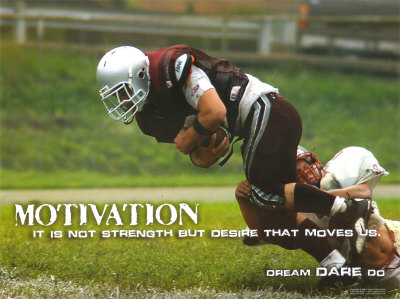
Motivation to do something acts as that driving force which helps us through every phase of an activity. It gives us the energy to initiate the task, then to continue through its ups and downs, and finally also to bring it to an end.

Without the right amount of motivation, doing anything feels like dragging yourself down a road that you don’t want to walk. I am sure you can all relate to this feeling especially when as teenagers you were asked to do certain things by your parents without a good reason, for example cleaning your own room 😉

Additional motivation always help us to do something better or faster. Or at least that is what you feel happens when you feel that wee bit more motivated.

I don’t think I have to give you more reasons to convince you that motivation is an important factor in our everyday lives. I have spent quite some time in trying to understand this mysterious force with a wish to know how can I harness it better.

After speaking to many people about their source of motivation, I can conclude that almost always people have multiple sources of motivation. And it is not surprising that there are many common sources of motivation. We are all human after all. I’ll enlist a few:

Some positive sources: the desire to constantly improve (to be a better person, a better scientist, a better father or a better son), to achieve higher pleasures of life (happiness derived from completing a massive project, from helping someone or achieving a big goal)

Some negative sources: peer pressure (if she can do it, why not me? admittedly it can be a positive force sometimes), fear of failure (almost always bad and which causes so much anxiety).

Some of these sources may have struck a chord with you (like the one in the picture). And may be that after reading this short list you may not be surprised because they are very commonly the sources of motivation that many people use.

But my exploration has helped me find an additional source of motivation. One that I have used many a times unknowingly. That source of motivation comes from my constant quest to find a new source of motivation. It’s as if I treat my motivation to do something as drawing from a motivation bank. And because I treat it as a bank, I tend to look for sources that can replenish this bank.

And I don’t think I am alone in that quest, people seek new sources of motivation all the time. See for example what Alex says:

A friend told me that she had a three-tiered approach to motivation: First is motivation from the cause itself, but this is simply not enough to sustain motivation indefinitely in all situations, so the second layer was motivation from fun: the work itself should be enjoyable, but it’s just not possible to always make work fun, so the third tier was friendship: that you would work through tough times buoyed by friendship with colleagues and co-workers.

Have you got any sources of motivation that you could share with us?

What high schools did for us and what we can do for them

There is much that our high school education gives us. Our time in the school leaves indelible marks on our lives. It makes an impact on our future whether we appreciate it or not. The contribution that my school has made towards who I am is substantial. 

My school entrance (credit: Fravashi Academy)

High school is where the first impressions of our future professions are made. Whether we chose to be a scientist, an engineer, a doctor, an artist, a designer, a businessman or something else, the seeds get sown at this tender age of our lives. This is the age when our brains get ‘shaped’. Although it wasn’t obvious when I was there in Fravashi Academy that I will go on to do a PhD, I can connect the dots today.

It is the place where we make long-lasting friendships. These connections that are made with a pure heart and naive minds are amongst the best ones we will make in our lives. Of course holding onto them is easier today than it was when my Dad went to high school. But even if you haven’t stayed in touch for so many years, these are the people you can connect to almost instantaneously. My Dad’s high school reunion that happened last year stands as a testament to this fact. He met his high school friends after almost 35 years and boy, did have a good time.

Over the years since I graduated from Fravashi in 2002, we school friends have met many times. The number of people varies every time but there are many who come everytime. We remind ourselves of what fun things we did and what mischiefs we were up to. The tone of the conversations have changed only a little over the years but the content has remained same (with only more things getting added to the list ever year of course).

This year when I went back home, I visited my school. Unlike all the times when I visited the school after 2002, this time I had an aim to accomplish. I wanted to understand in what way could I give back to my school.

The school has grown since we left and new curricula have been introduced. Classes have gotten smaller in size and the uniforms are different. And yet there are so many things that are still the same. Two of those things are the ambitions of those at Fravashi and curiosity amongst them.

I had an opportunity to speak to the kids in an impromptu discussion. I told them the short story of what I did after I left Fravashi and what is it that I exactly do in my PhD. But more importantly I spoke about the importance of books and why science is such a fascinating subject to study. I was amazed by some of the questions I got asked after the discussion. And those discussions made it possible for me to understand what students think and on some more reflection, I knew what I could do to contribute to the school.

After discussions with the teachers in school, we decided to do hold an essay competition centred on a topic in science and technology.  The aim of the competition was to get the students to think about science and technology and to communicate those ideas to a wider audience.

In the first week of February, with the help of Kaumudi teacher and Neena teacher, the essay competition was held. The topic for the classes of 7th, 8th and 9th was ‘How will science and technology affect the future development of the society?’

It was a pleasure to read all the essays and it was fascinating to see what the students dreamt about as the future of our society. I think that there were lots of budding science fiction writers amongst the entries that I received. And as always, choosing a winner was a hard decision to  make.

The winners are being given popular science books with a hope that once they finish the book they will share it with their peers. This should spark some conversations and some new ideas amongst the young guns. The winners are listed as follows and their essays can be read by clicking on their name.

7th standard

  1. Pranjali Kulkarni
  2. Preksha Mandlecha

8th standard

  1. Mitali Suryawanshi
  2. Rupandey Parekh

9th standard

  1. Tanmayi Gidh
  2. Rucha Amale

The list of the books being given (in no particular order) are as follows:

  1. The curious incident of the dog in the night-time by Mark Haddon
  2. Can you feel the force? by Richard Hammond
  3. What Einstein told his cook by Robert Wolke
  4. What Einstein told his barber by Robert Wolke
  5. Really short history of nearly everything by Bill Bryson
  6. Why don’t Penguins feet freeze? by the New Scientist

I am hoping to hold this essay competition annually. And I also know I am going to run out of suggestions for the books that I will give as prizes so if there are any books that you would like to suggest please do by leaving a comment below.

This is what I think I can contribute to the school at the moment. I am hoping that whenever I go home, I will get a chance to speak to the students at the school and spark a few more interesting conversations. But I also think that if I start this early then I can surely build a habit of giving back to the places that have made me who I am.