The price of gaining an accurate theory has been the erosion of our common sense

Review of Richard Feynman’s QED: The strange theory of light and matter

The title of the post is a quote from Feynman’s book. Written by a Nobel laureate and one of the most beloved scientists, it is perhaps the best explainers of a theory that flips everything we know about physical phenomena on its head. It explains quantum electrodynamics (QED), a theory that explains 99% of all phenomena that involve photons and electrons.

But to be able to understand it one must, as Feynman puts it:”accept some very bizarre behaviour: a single beam of light reflecting from all parts of a mirror, light travelling in paths other than a straight line, photons going faster or slower than the speed of light, electrons going backwards in time, photons disintegrating into a positron-electron pair, and so on.”

This book is a series of four lectures that Feynman gave in 1983 at the University of California in Los Angeles. It is a short and entertaining, but intense read. Feynman goes into quite a lot of detail about how QED can be explained by the use of arrows drawn on a sheet of paper (!). But as Feynman claims, more than a few times in the book, what you get from the book is the spirit of the theory. To be able to use it accurately students regularly study it for several years. (Here’s an example of how I used QED to explain a new type of flat lens).

There is enough packed into the last few pages of the book as is in the remainder. In them Feynman, who says “Being a professor means having the habit of not being able to stop talking at the right time”, tries to explain the rest of physics apart from QED. His aim is to show that physicists’ search for elegance in nature through theories of physics is necessary, mostly because of the complexity of understanding how nature works. Perhaps we are being too naive, perhaps not. We won’t know till we make theories and test them. QED has stood 70 years of rigorous testing.
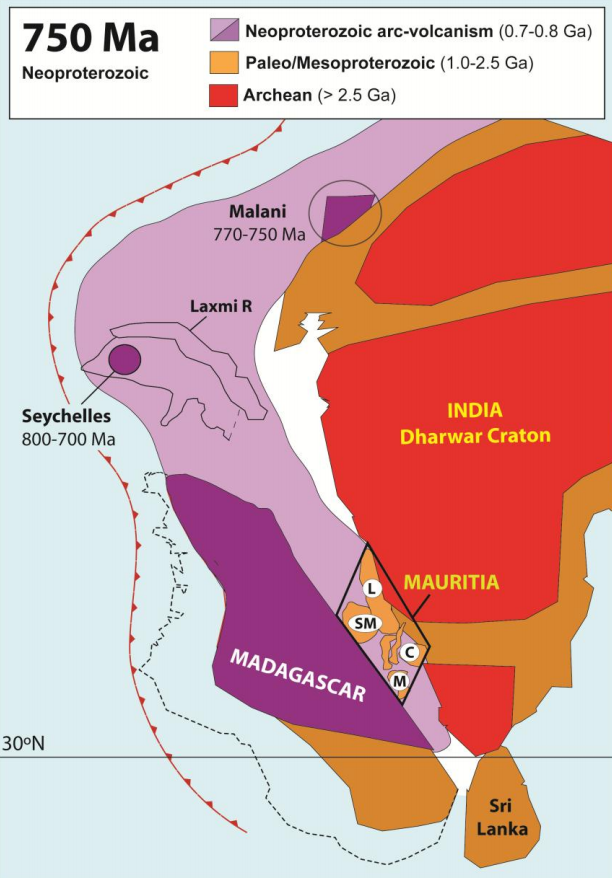
TLDR: Submerged continent found in the Indian ocean

The island M stands for Mauritius

Scientists have discovered a submerged continent in the Indian ocean, between Madagascar and India. According to sediments found on the coast of Mauritius, at some point during the last 2 billion and 600 million years ago, there was an archipelago that separated from Madagascar and the Indian sub-continent. They then got submerged during the tectonic plate movements that resulted in the way land masses exist today.

Reference:  Torsvik, T. H. et al. Nature Geosci. 2013, 223. http://dx.doi.org/10.1038/NGEO1736

Further reading: Sid Perkins in Nature News

Image credit: Nature Geoscience (Supplementary information)

Update: A reader pointed out that perhaps this was the origin of the legends of Lemuria. Although that is not accurate, the Wikipedia article on Lemuria is worth a read.

Fatal flaw in Facebook’s privacy promises?

I follow Calvin and Hobbes on Facebook. And some of the cartoon strips are such gems that I cannot help but share them beyond Facebook. Given Calvin and Hobbes has a public page and makes its posts public, I can just copy the post’s URL and share it on Twitter. But, like many others, I hate sharing links from Facebook on Twitter. Mostly because it loads slowly on mobile or asks people to sign in, or *invent your own excuse*, etc. So to work around that problem I copied the image’s URL (right click, select “copy image URL”), and checked to see if it works in an independent browser tab.

Sure it does. It is a publicly shared image, so it should work.

Then I tried the same thing on a personal image that I’ve shared only with friends on Facebook (not even friends of friends). Even that URL works. It works in an incognito tab on Chrome. It works on another browser where I’ve never signed in on Facebook. You can even see a private image from a person’s albums as long as you have the image URL. This shocks me. What happened to all the things that Facebook said about protecting our content?

Up until now I haven’t taken social media privacy too seriously. I’ve tended to follow the mantra: everything I do online is public. And Scott McNealy (CEO, Sun Microsystems) said in 1999You already have zero privacy. Get over it.

But that doesn’t stop me from calling out Facebook’s empty promises. Facebook insists that it is up to you to decide how much you share. Bullshit.

Update: A user has found that Facebook doesn’t kill the link even after you delete the photo.