I want to be an astronaut

Review of Mark Haddon’s The Curious Incident of the Dog at the Night-time, as part of my #100bookschallenge.

During my time as a demonstrator in Oxford’s historic Dyson Perrins lab, I had the opportunity of supervising a student with Asperger’s syndrome. His name is Edward (name changed), and he is one of the smartest and weirdest student I’ve ever taught. Reading Mark Haddon’s book made me realise for the first time what was going through Edward’s mind in all those hours that we spent setting up reactions, distilling compounds and taking various measurements.

Haddon’s book is a strange but wonderful read. It draws you in by starting with a murder of a dog that is being investigated by a 15-year old, Christopher Boone, who suffers from (although it is not stated) Asperger’s syndrome. Written in first person, it gives you a deep insight into what it is to suffer from an autism spectrum disorder. The book has received rave reviews, and, from what I understand, it does a remarkably good job of portraying Christopher’s challenges.

Somewhere in the middle of the book, the storyline becomes predictable. But that is no bad thing. By that time I found myself so engrossed in Christopher’s world that I wanted to know how he experiences the rest of the story.

There are some truths about our human existence that we normal people are too scared to admit. But Christopher’s disability doesn’t stop him from seeing through them and thinking how stupid everyone can be. That constant reminder throughout the books is very humbling.

The book is also, in many ways, a really good example of science communication. Throughout the book Christopher talks about wanting to be an astronaut. For his age, he also shows a remarkable grasp of science and maths, and discusses ideas from relativity to algebra with ease and clarity.

There are many quotes from the book that I’ve marked, but one that struck me the most was: I think prime numbers are like life. They are very logical but you could never work out the rules, even if you spent all your time thinking about them.

PS: This was my first fiction book in a long time and it was over in a flash. I’m considering tweaking my non-fiction to fiction ration after this reading!
Domestic cats are mass killers

The Oatmeal got it right. How much do cats kill? Too. Damn. Much.

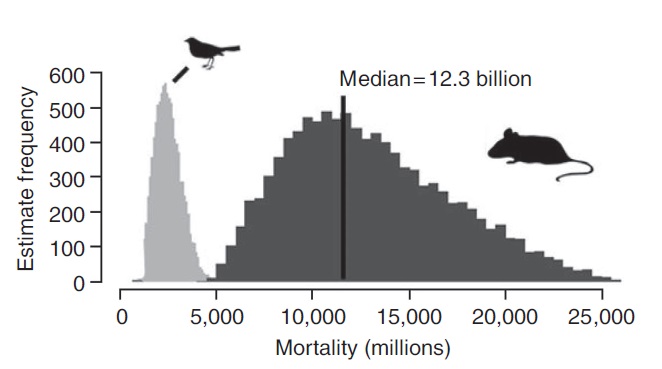
A study just published in Nature Communications estimates that, in the US alone, domestic cats (owned and un-owned) could kill up to 3.7 billion birds, 20.7 billion mammals (rats, rabbits, squirrels), 800m lizards and 300m frogs every year (even lower estimates are scary: 1.4 billion birds and 6.9 billion mammals). Domestic cats are one of the worst non-native invasive species in the world, according to the lead author of the study Scott Loss, of the Smithsonian Conservation Biology Institute.

Previously it was argued that the number of cat killings was small compared to deaths caused by, say, collisions to windows, buildings or communication towers, or even habitat destruction. But this systematic study finds otherwise.

Credit: Nature Communications

Perhaps you knew this, but earlier estimates (like that of the Oatmeal) were lower. Loss remarks that it may be because those studies were not conducted with the same rigour or depth as the current study. According to Loss the new estimates indicate that cat killings are causing population decline some species. A 2011 study even recorded extinctions caused by cat killings. The study conducted on islands showed that free-ranging cats caused extinction of 33 species of birds, mammals and reptiles.

Although un-owned cats are to blame for majority of the kills, owned cats kill a substantial number too. What should ring alarm bells for policymakers is the fact that the number of owned and un-owned cats is growing rapidly across the globe. But Loss admits their estimates based on all available data are still not accurate, and more accurate calculations can only made based on better collection of data.

Methods currently in use to bring these killings under control involve trapping feral cats and sterlising them to stop their colonies from growing. Although this may seem like a good idea, there is no scientific evidence that it works. Loss says, “Management decisions [for controlling cat killings], both in the US and globally, must be informed by fine scale research that allows analysis of population responses to cats and assessment of the success of particular actions.”

While cats with guns (or cats as guns) make for funny pictures, there is more truth to that image than you might think.

ReferenceLoss, Will & Marra, The impact of free-ranging domestic cats on wildlife of the United States, Nature Communications 2013. http://dx.doi.org/10.1038/ncomms2380

Image not from the study. Credit: some tumblr blog.

A nebulous future

Before Apple launched iCloud in 2011, Steve Jobs allegedly offered to buy Dropbox, a file-sharing service founded in 2007, for $800m. When Dropbox declined, Apple’s late boss disparaged it as a feature, not a company. Soon after, Dropbox raised $250m, putting its value at over $4 billion. Earlier in December Dropbox concluded a promotional campaign that, in just a few weeks, added 2m new users, bringing the total to over 100m, roughly double the number when Jobs made his comment. Consumers, it seems, can’t get enough of the feature.

Dropbox dominates online file-sharing. It boast three times as many users as its closest direct rival, YouSendIt. (Its dominance is even more pronounced when it comes to the volume of data stored.) It eats up 20% of all bandwidth consumed globally by browser-based file-sharing services, against 1% for YouSendIt. Dropbox users save more than 1 billion files every day.

Most of them use the free version of the service. The company makes money by charging for extra storage. Around 4% of users plump for the premium version, though the proportion is growing, according to Arash Ferdowsi, one of the Dropbox’s co-founders. The recent campaign, called Space Race, gave away free space to university students in return for getting their peers to sign up to the service. The hope is that when access to this extra storage runs out after two years, the students, by then freshly-minted professionals, will pay to keep using it.

Dropbox relies on individuals and small firms, for whom its rudimentary security features are good enough; bigger businesses with sensitive information prefer more secure services like Box.net. The advent of competitors in the nebulous form of iCloud, Google’s Drive and Microsoft’s Skydrive, which come pre-installed on their respective makers’ gadgets, does not seem to have dampened enthusiasm for Dropbox. Unlike iCloud, which boasted 190m users by October thanks to its deep integration with Apple’s mobile devices, the service is “platform neutral”—ie, works across different devices and operating systems—and allows easy file-sharing, both useful traits in an increasingly connected world where few people hew devoutly to a single device-maker.

Google and Microsoft clouds emulate Dropbox in these respects. But at a little over 10m users each, they do not yet benefit from from the incumbent’s powerful network effect. If you are sharing files with a dozen other people on Dropbox, a move to Google or Microsoft would require all 12 to move with you.

Dropbox is also striving to make itself the default choice for smartphone users. In 2011 it struck a deal with HTC, a Taiwanese phonemaker, to preinstall Dropbox on its Android devices. In return it gives HTC users 5GB of space for free. HTC has been struggling of late, but Mr Ferdowsi says that his company is in talks with other manufacturers, hoping for similar arrangements.

A bigger long-term worry is the plummeting price of digital storage. With its vast scale, Amazon has driven down costs substantially for the likes of Dropbox, which leases server space from the e-commerce giant. But Google Drive already offers 100GB for $5 a month, half what Dropbox charges for the same amount of storage. And Google can advertise its cloud across its myriad online offerings. Dropbox’s margins are only likely to get wispier in the future.

First published on economist.com.

Image credit: Dropbox