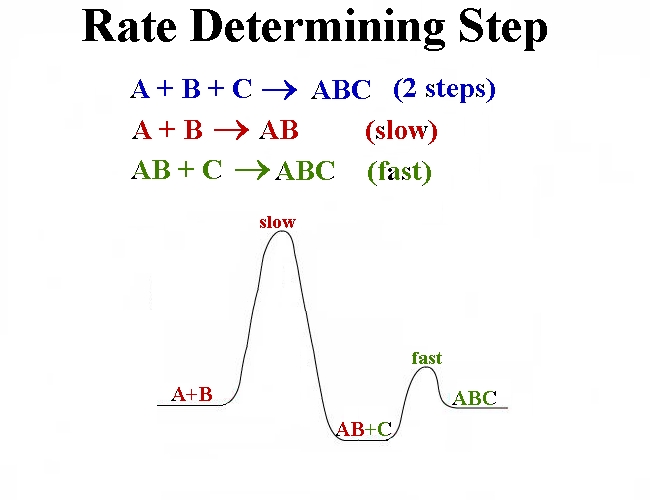
Improving productivity by finding the rate-determining step

The other day a lab-mate who started his PhD work with me made a neat observation. He said:

I find myself quite pleased to see how efficient I’ve become in the lab. While teaching the new student who started last week I realised that what takes them an hour and half to do, I can finish in under 20 minutes. Don’t get me wrong. I am saying this not to question the ability of the new student. Instead, I realise that having learnt the process so well, I plan my task around the rate-determining step in the process and thus, end up doing the whole task so much faster.

It’s an astute observation. I am writing this today because I think that this chemistry concept of ‘finding the rate-determining step‘ (aka the slowest step) can be applied beyond the lab to help improve our daily productivity. Let me explain through a trivial example.

On week days I have my lunch at the college hall. It can take me anything between 25 to 55 minutes to leave the lab, finish lunch and come back. The process can be broken down as below:

  • 3-5 minutes: Ride to the college from the lab
  • 5-20 minutes: Wait in queue to get the meal
  • 15-25 minutes: Eat the meal
  • 3-5 minutes: Ride back to the lab from college

If I now want to make the process productive, I need to find where can I cut down the extra minutes. The slowest step here is ‘eating the meal’ but I am going to skip optimising that because I’d like to enjoy the meal. Also, I don’t want to suffer an accident so I am going to skip optimising my cycling speed to cut down the riding time. That leaves me with ‘waiting in the queue’. I’ve observed that if I reach the college at 12.25 pm then I am usually amongst the first few students in the queue and end up getting served as soon as the hall opens at 12.30 pm. So if I make it in time then I cut my time in queue from 20 minutes to 5 minutes. I’d call this the rate-determining speed in the process and ensure that I reach at 12.25 pm. And I do just that, as Chris our head porter says, “First in the queue again, eh?”

Of course, that is a trivial example. But finding more important situations which parallel the example I gave would not be hard. Take the writing process for example. The longest step in the process turns out to be the editing. I find that if I keep on editing as I write then it takes much longer than editing at the end of finishing the first draft.

While writing about this post I also realised that I’ve been applying the ‘finding the rate-determining step’ process without actually having thought about it that way. Hopefully, this post on wards I’ll think about it in a more-structured manner.

The art of finishing

Even before starting to follow Seth Godin, I believed in the value of finishing what I started.

May be this habit stems from a childhood experience. My parents did not allow me to leave the dining table till I had finished everything on my plate. If I had to over eat then so be it, next time I will learn to put no more food on my plate than was needed.

The habit then extended into other things. I am not satisfied till I’ve finished the book that I started. I cannot leave a cinema midway even if the first half isn’t exactly great. I won’t leave a conversation in the middle (if I had the choice too), I will wait for it to come to a conclusion or bring it to one.

This habit of finishing what I started helps quite a lot. I am able to derive maximum value from an activity that I can. Most importantly, it provides me with enough motivation to keep going. Most activities have a great start, a boring middle and superb end. Many people start something because it looks interesting but give up in the middle because the initial charm has disappeared. Many times if an activity is continued till the end, there is something in store that no one expects. If for nothing else, it is worth finishing something just to get to this unexpected outcome.

There is also a good selfish reason for finishing what you start. An activity when completed can go down on the list of things that you have ‘done’. That list is a self-confidence builder. When you look back, you know that you had the ability to not only start but also finish so many things. It allows you to start something new knowing what all you are already capable of doing. That can be a great motivation to start a new activity that is more challenging than anything you have done before or even motivation to finish something you haven started knowing that you have done something more difficult than this before.

Although finishing is a great habit, it has it’s downsides too. For example, when I am reading an article on the web or even a research paper I would like to read every word of text even though that may be unnecessary.

I think what it boils down to is our ability to judge the value of an activity. And to be able to accurately judge the value of an activity is a hard thing to do. Mostly because of lack of experience, in my case at least. It is then when I decided that if I am not sure what the value of a certain activity might be then I will finish it and evaluate the value at the end of it. In this way I can improve my value judgement for such activities in the future and thus improve my capacity to take the decision to quit or to keep going.

I am proud of many things that I have finished and I am sure to have many more in the future if I can keep going.

An experiment with delegation

I recently attended one of the best talks I have been to in Oxford. It was a talk by Felix Dennis of Dennis publishing. He is one of the most famous self-made billionaires in Britain. And to his credit he can do much more than just make money. He is a great poet, a philanthropist and in my opinion, a great orator.

At the talk, he spoke about his life story, some lessons that he has learnt and what he plans to do ahead. In question and answers he also gave a brief picture of what it takes to be an entrepreneur. I was particularly impressed by an answer that he gave in response to a question of how to deal with employees. He said:

I am only really good at two things. First is recognising talent. I can say within a very short time whether someone is suitable for a certain task or not. Second is delegating. And by delegating I don’t mean giving work away to someone so that I don’t have to do it. What I mean is really delegating, letting that person handle the task on their own, giving them the space to work and making them understand the expectations I have of them. I’ve seen very few people delegate work effectively.

Although, I can say very little about recognising talent (which on occasions all of us do), there is something I can say about delegating. For any of us who has been in a position of responsibility (however big or small), where we lead a team to a complete a task, we will know that delegation is a really important aspect of the job. It requires us to understand the other person well enough to assign a particular task to them and to be able to ask them, in the most effective manner, to do that task for the team. In most cases, there is also a degree of trust that needs to be present

Looking at my previous experience with delegation, I realise that I am able to do it and to a certain degree well enough. And I say well enough because according to my definition (not Dennis’) delegation means getting someone who to do a certain thing for the team. In that regard, I have definitely managed to get a fair amount of work done.

But according to Dennis’ definition, I feel I have utterly failed at it. That’s because very rarely have I come across a piece of work that I have delegated and which has come back to me in a way that serves the set purpose best. I tend to feel that it could be done better or sometimes, that it would have been better had I done it.

Clearly, there is something I need to change about the way I delegate work. And I think after listening to that answer by Dennis, I realise that I can definitely improve on communicating my expectation of the task that I am about to delegate.


Delegation is important. Credits: pmtips.net

Here’s what I think I will do: when delegating a piece of work, I will ensure that I will give the person doing the job as much detail as possible about what I expect as the outcome of the job. After that, I will set a deadline for the task and then give them complete freedom to do it on their own. And at the end, I would request them to let me give them some constructive feedback about the task they just completed.

I think this in many ways should improve the quality of work that I receive on delegation. With this freedom, of course, there comes some added responsibility on the person doing the job. And I think that is what can serve as the true driving force of some quality work.

The feedback idea should also serve the purpose well because it then gives the person who has been delegated the task a chance to reflect upon what they have done and take in the feedback in much a better setting. Doing this at the end is advantageous, of course, because they don’t have the pressure to finish the task. Additionally, it is a better setting because interrupting someone while they are doing something is very inefficient (and I realise that because I have done it on some occasions).