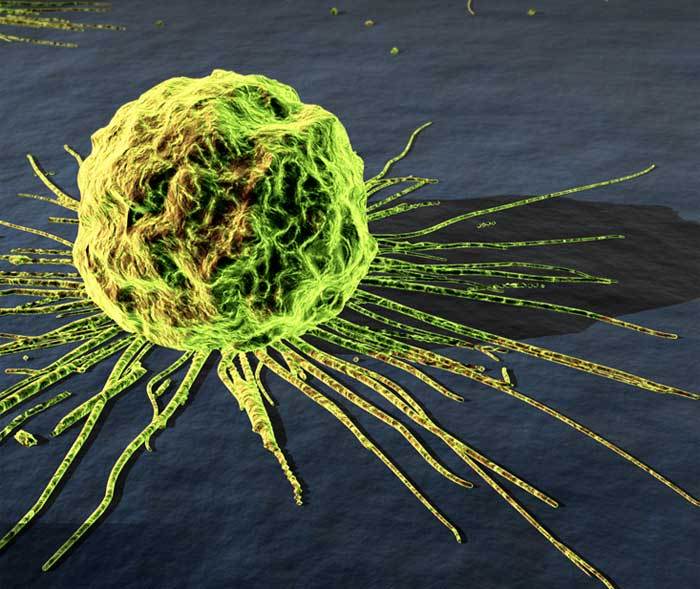
Nanoparticles cause cancer cells to die and stop spreading

More than nine in ten cancer-related deaths occur because of metastasis, the spread of cancer cells from a primary tumour to other parts of the body. While primary tumours can often be treated with radiation or surgery, the spread of cancer throughout the body limits treatment options. This, however, can change if work done by Michael King and his colleagues at Cornell University, delivers on its promises, because he has developed a way of hunting and killing metastatic cancer cells.

When diagnosed with cancer, the best news can be that the tumour is small and restricted to one area. Many treatments, including non-selective ones such as radiation therapy, can be used to get rid of such tumours. But if a tumour remains untreated for too long, it starts to spread. It may do so by invading nearby, healthy tissue or by entering the bloodstream. At that point, a doctor’s job becomes much more difficult.

Cancer is the unrestricted growth of normal cells, which occurs because mutations in normal cell cause it to bypass a key mechanism called apoptosis (or programmed cell death) that the body uses to clear old cells. However, since the 1990s, researchers have been studying a protein called TRAIL, which on binding to the cell can reactivate apoptosis. But so far, using TRAIL as a treatment of metastatic cancer hasn’t worked, because cancer cells suppress TRAIL receptors.

When attempting to develop a treatment for metastases, King faced two problems: targeting moving cancer cells and ensuring cell death could be activated once they were located. To handle both issues, he built fat-based nanoparticles that were one thousand times smaller than a human hair and attached two proteins to them. One is E-selectin, which selectively binds to white blood cells, and the other is TRAIL.

He chose to stick the nanoparticles to white blood cells because it would keep the body from excreting them easily. This means the nanoparticles, made from fat molecules, remain in the blood longer, and thus have a greater chance of bumping into freely moving cancer cells.

There is an added advantage. Red blood cells tend to travel in the centre of a blood vessel and white blood cells stick to the edges. This is because red blood cells are lower density and can be easily deformed to slide around obstacles. Cancer cells Have a similar density to white blood cells and remain close to the walls, too. As a result, these nanoparticles are more likely to bump into cancer cells and bind their TRAIL receptors.

Leukocytes are WBCs and liposomes are nanoparticles. King/PNAS

King, with help from Chris Schaffer, also at Cornell University, tested these nanoparticles in mice. They first injected healthy mice with cancer cells, and then after a 30-minute delay injected the nanoparticles. These treated mice developed far fewer cancers, compared to a control group that did not receive the nanoparticles.

“Previous attempts have not succeeded, probably because they couldn’t get the response that was needed to reactivate apoptosis. With multiple TRAIL molecules attached on the nanoparticle, we are able to achieve this,” Schaffer said. The work has been published in the Proceedings of the National Academy of Sciences.

While these are exciting results, the research is at an early stage. Schaffer said that the next step would be to test mice that already have a primary tumour.

“While this is an exciting and novel strategy,” according to Sue Eccles, professor of experimental cancer therapeutics at London’s Institute of Cancer Research, “it would be important to show that cancer cells already resident in distant organs (the usual clinical reality) could be accessed and destroyed by this approach. Preventing cancer cells from getting out of the blood in the first place may only have limited clinical utility.”

But there is hope for cancers that spend a lot of time in blood circulation, such as blood, bone marrow and lymph nodes cancers. As Schaffer said, any attempt to control spreading of cancer is bound to help. It remains one of the most exciting areas of research and future cancer treatment.The Conversation

First published at The Conversation.

Image credit: Cornell University
Why one hectare of tropical forest grows more tree species than the US and Canada combined

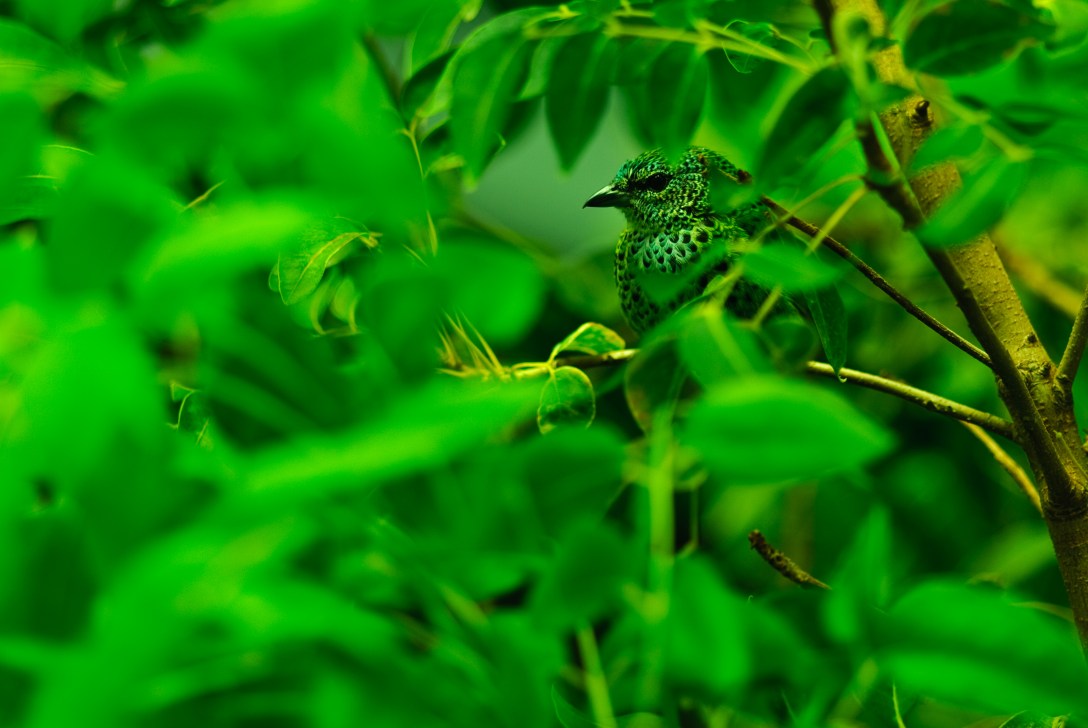
One hectare of land in a tropical forest can hold 650 tree species – more than in all of Canada and the continental US. This has left biologists baffled for decades. Now, with advances in data analysis, Phyllis Coley and Thomas Kursar of the University of Utah may have finally found an explanation.

From a broad perspective, evolution is pretty simple. Successful species survive and reproduce, which depends on how readily they obtain resources. So if two species are too similar in their use of resources, they would compete with each other – unless one evolves to use a different resource and exploits a niche that hasn’t been filled. However, in any environment, niches are limited. That is why the diversity in a tropical forest cannot be explained by the exploitation of niches alone.

The competition for niches is shaped by species’ interactions with the environment, which includes both abiotic elements (climate, water, soil and such) and biotic elements (in other words, other species). Tropical forests have stable abiotic environments, so Coley and Kursar concluded it must be the biotic interactions that explain the extraordinary diversity in these forests.

They argue, in an article just published in Science, that an arms race between plants and plant-eaters is what drives evolutionary changes. When a plant-eater finds a new way to attack a plant, the plant must evolve to fight the plant-eater. Through many generations these changes force formation of new species, leading to the observed tropical diversity.

This explanation is known as the Red Queen hypothesis, which gets its name from a statement the Red Queen made to Alice in Lewis Carroll’s “Through the Looking-Glass”:

Now, here, you see, it takes all the running you can do, to keep in the same place.

The Red Queen Hypothesis is not new. It was first suggested in 1973, and has been applied to many other ecological scenarios. However, so far, biologists have found it hard to determine whether it applies to tropical forests because of the sheer size of the task. Tropical forests have thousands of plant species that may have hundreds of plant-eaters each. These millions of interactions need to be all taken into account to show the Red Queen hypothesis at work.

Also, in such an arms race, plants have it harder than herbivores, because their lifespan can be hundreds of times longer than the average leaf-eater, which is usually a small insect. That is why a single tropical tree may have hundreds of distinct chemical compounds in its defence arsenal against herbivores, which makes the analysis harder.

This is where advances in data analysis prove handy. To understand these defences on an ecosystem scale requires the use of metabolomics, which is the study of chemical fingerprints left behind by an organism.

Metabolomic analyses across forests in Mexico, the Amazon and Panama, show that neighbouring plants mostly have different defences than would be expected if it were a random process – in other words the Red Queen seems to be in action. Most convincingly, closely related trees and shrubs have often diverged defences, which is a sign of exploring biotic interaction niches, but have similar non-defence traits, which results from similar abiotic conditions that they find themselves in.

Coley said that, while the data seems convincing, there are still limitations. Tropical forests have been studied well, but there is no comparable data from the temperate regions, which would be needed as a control to validate the hypothesis. Perhaps such an arms race also occurs in temperate regions that have been studied less. Also, temperate regions are purported to have less diversity in tree species, but that may not actually be true, according to Jeff Ollerton, professor of Biodiversity at the University of Northampton.

In a 2011 study published in the journal Functional Ecology, Angela Moles, the head of the Big Ecology Lab at the University of New South Wales, looked at all the data on interactions between plants and plant-eaters. She found only a third of the studies showed there to be more interactions among tropical species than those at higher latitudes, such as temperate regions. But this meta-analysis (a method to meaningfully compare different datasets) showed that the positive results are not statistically significant. Worse still, only nine out of 56 comparisons showed that chemical defences were higher in tropical plants than in temperate ones.

Also, some recent work has called out biologists for depending on the Red Queen hypothesis for many explanations. A small but vocal group of researchers argue that other processes can explain diversity. Chief among the alternate explanations is the idea of genetic drift, where some genetic mutations are passed on to progeny randomly. This differs from natural selection, where nature actively chooses which mutations get passed on.

While Coley remains confident that the Red Queen hypothesis will indeed prove to be a satisfactory explanation, she also knows that a lot more data will be needed to get there. Previously, the limitation was data analysis; now it is data collection. Researchers have no option but to go out in a tropical forest, search for plants and their herbivores, and then record their interactions.

While other explanations will certainly have some role to play, Coley and Kursar make a persuasive case for why nature seems to have endowed tropical regions with so many plant and plant-eating species. Although Alice may not like it, we may have to thank the Red Queen for it.The Conversation

First published at The Conversation.

Insulin pill may soon be a reality

Daily jabs of insulin are a painful reality for many with diabetes. That may change if researchers who have successfully tested oral insulin in rats are able to replicate those results in humans.

Nearly 350m people worldwide suffer from diabetes and that number is predicted to grow to more than 500m by 2030. While the more common form, type-2 diabetes, does not always need insulin treatment, nearly quarter of all diabetes patients depend on insulin jabs. Oral insulin’s estimated annual sales could be somewhere between $8 billion and $17 billion.

The benefits of an insulin pill are more than just ease of taking the drug. The pill will mean that patients can start taking insulin earlier in the development of the disease, which could reduce some of the secondary complications, which can include blindness and impaired healing that leads to amputations.

The idea of oral insulin has been around since the 1930s, but the difficulties of making it seemed too big to overcome. First, insulin is a protein – when it comes in contact with stomach enzymes, it is quickly destroyed. Second, if insulin can pass through the stomach safely, it is too big a molecule (about 30 times the size of aspirin) to be absorbed into the bloodstream, where it needs to be in order to regulate blood-sugar levels.

Sanyog Jain at India’s National Institute of Pharmaceutical Education and Research and his colleagues have been working on delivering insulin in the oral form for many years. Their first fully-successful attempt came in 2012, when they developed a formulation that successfully controlled blood-sugar level in rats. But the materials used were too expensive to consider commercialising the technology.

Now, in a paper published in the journal Biomacromolecules, they have found a cheaper and more reliable way of delivering insulin. They overcome the two main hurdles by, first, packing insulin in tiny sacs made of lipids (fats), and, second, attaching to it folic acid (vitamin B9) to help improve its absorption into the bloodstream.

The lipids they use are cheap and have been successfully employed to deliver other drugs before. These help to protect insulin from being digested by stomach enzymes, which gets it to the small intestine. When the lipid-covered sacs enter the small intestine, special cells on its lining called microfold cells are attracted to the folic acid in them. The folic acid helps activate a transport mechanism that can let big molecules pass through into the blood. The amount of folic acid used in the formulation also seems to be in the safe region.

In rats, Jain’s formulation was as effective as injected insulin, although the relative amounts that entered the blood stream differed. However, it was better in one key aspect. Whereas the effects of an injection are quickly lost (in less than 6 to 8 hours), Jain’s formulation helped control blood-sugar level for more than 18 hours.

The most important part of the research comes after successful testing in animals – the formulation needs to be given to human volunteers. But, Jain said, “at a government institute like ours, we don’t have the sort of money needed for clinical trials.”

He may not have to wait for long, as big pharma companies have been searching for an insulin pill formulation for decades. Two of them, Danish pharma giant Novo Nordisk and Israeli upstart Oramed are in a race to come up with a solution. Google’s venture capital arm, Google Ventures, recently invested $10m in Rani Therapeutics with the hope it will help develop oral insulin. Indian firm Biocon also does oral insulin research, and it recently signed an agreement with pharma giant Bristol-Myers Squibb.

Oramed is ahead, with their oral insulin product soon to enter phase-II clinical trials, which is the most advanced stage any oral insulin formulation has ever reached. Its chief scientist, Miriam Kidron, said of Jain’s research: “Most people have the same basic idea to develop an insulin pill, but its the little differences that will determine ultimate success.”

While Kidron did not reveal Oramed’s formulation, she said, “we attempted liposomal delivery before, just like Jain’s work, but we weren’t successful.” She warned that translating success from rats to humans is very difficult. And she is right – most drugs have a high cull-rate at each stage of their development. Even so, research like Jain’s give hope that an insulin pill may not remain a dream for long.The Conversation

First published at The Conversation.