Facebook has just acquired the mobile messenger service WhatsApp for US$19 billion. Launched in 2009 by two former Yahoo employees, in just over four years WhatsApp has grown to 420m monthly users.
Why is it so popular? Founder Jan Koum told the New York Times in 2012, “We are providing a richness of experience and an intimacy of communication that e-mail and phone calls simply can’t compare with.”
Facebook has been pushing its own messenger service to its users, but without much success. Markos Zachariadis at Warwick Business School, said, “Facebook’s purchase of WhatsApp is in many ways an admission of defeat.”
The explosion in the number of smartphones in recent years has also seen a boom in instant messaging services. Popular services such as WeChat, Line and Viber each have more than 100m users. WhatsApp tops that chart in not just number of users but also engagement. With the per-day volume at 19 billion messages sent and 34 billion received, the messaging service will soon trump the total global SMS volume.
According to Sotirios Paroutis, also at Warwick Business School, Mark Zuckerberg is out to make Facebook a truly mobile company with Instagram and WhatsApp. “In the past WhatsApp founders have been vocal in their objection to be acquired by a larger firm. So beyond their own reward package, the promise to keep WhatsApp as an independent service seems to have helped bring the two parties together,” he said.
Show me the money
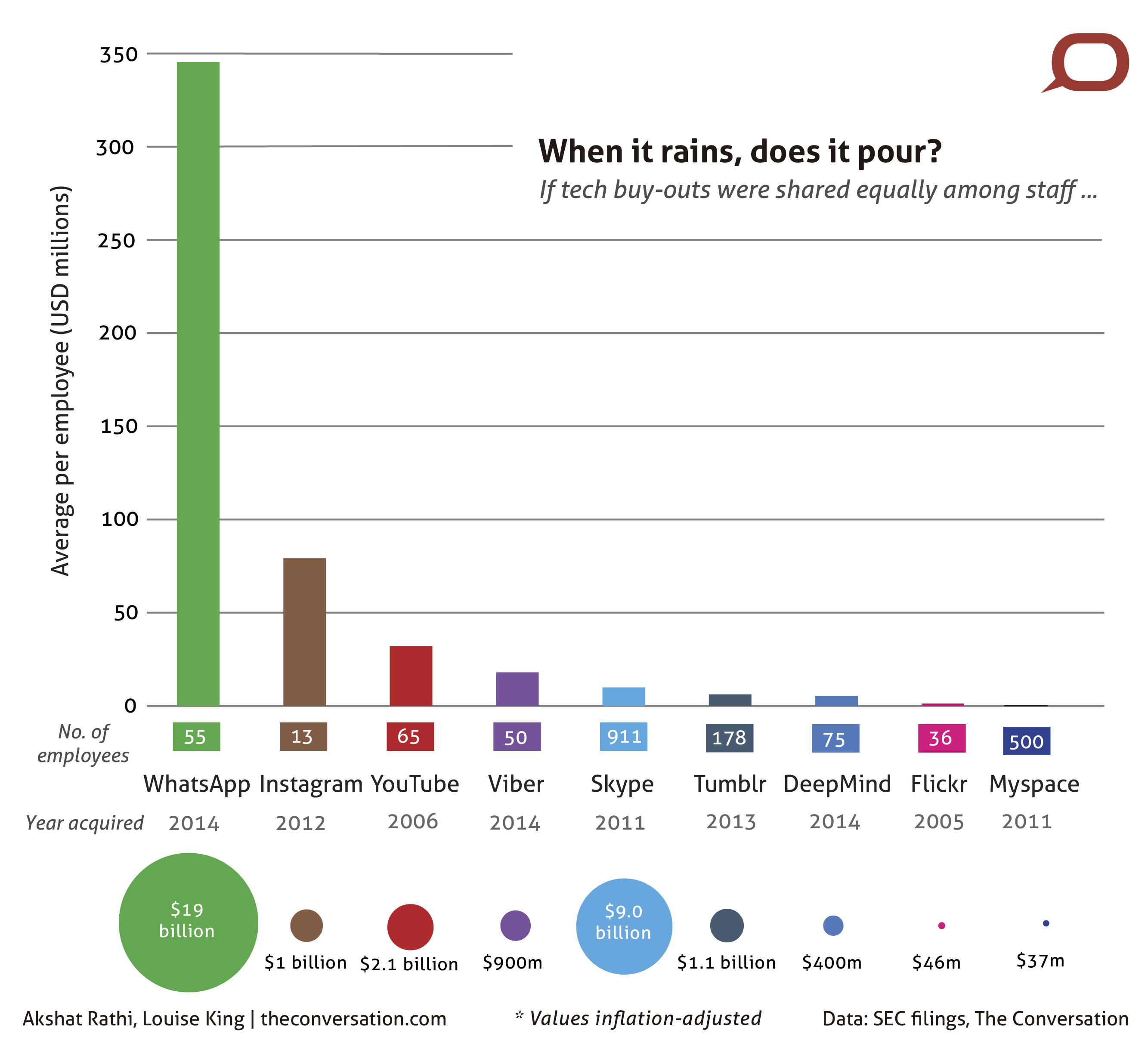
With only 55 employees, WhatsApp’s $19-billion valuation could, in an alternate universe where each employee was given an equal share, fetch US$350m per employee. This is nearly five times what employees of Instagram would have got when that company was bought out for US$1 billion in 2012.
While founders take away big chunks of the proceeds from such deals, with so few employees the windfall can still make many others rich. But in some cases, like that of Skype’s acquisition by Microsoft, the unequal distribution can leave employees with nothing. Worse still, Felix Salmon at Reuters points out that because of the way these deals are structured, employees can do little to fight back.
The works of the Greek polymath Plato have kept people busy for millennia. Mathematicians have long pondered Platonic solids, a collection of geometric forms that are highly regular and are frequently found in nature.
Platonic solids are generically termed equilateral convex polyhedra. In the millennia since Plato’s time, only two other collections of equilateral convex polyhedra have been found: Archimedean solids (including the truncated icosahedron) and Kepler solids (including rhombic polyhedra). Nearly 400 years after the last class was described, mathematicians claim that they may have now identified a new, fourth class, which they call Goldberg polyhedra. In the process of making this discovery, they think they’ve demonstrated that an infinite number of these solids could exist.
Platonic love for geometry
Equilateral convex polyhedra share a set of characteristics. First, each of the sides of the polyhedra needs to be the same length. Second, the shape must be completely solid—that is, it must have a well-defined inside and outside that is separated by the shape itself. Third, any point on a line that connects two points in the shape must never fall outside of it.
Platonic solids, the first class of such shapes, are well-known. They consist of five different shapes: tetrahedron, cube, octahedron, dodecahedron, and icosahedron. They have four, six, eight, twelve, and twenty faces, respectively.
Platonic solids in ascending order of number of faces. nasablueshift
These highly regular structures are not just mathematical constructs; they’re also found in nature. For instance, the carbon atoms in a diamond are arranged in a tetrahedral shape. Common salt and fool’s gold (iron sulfide) form cubic crystals, and calcium fluoride forms octahedral crystals.
The discovery of Goldberg solids comes from researchers who were inspired by finding interesting polyhedra in work that involved the human eye. Stan Schein at the University of California in Los Angeles was studying the retina when he became interested in the structure of protein called clathrin. Clathrin is involved in moving resources inside and outside cells, and in that process it forms structures that adopt a handful of shapes. These shapes intrigued Schein, who came up with a mathematical explanation for their formation.
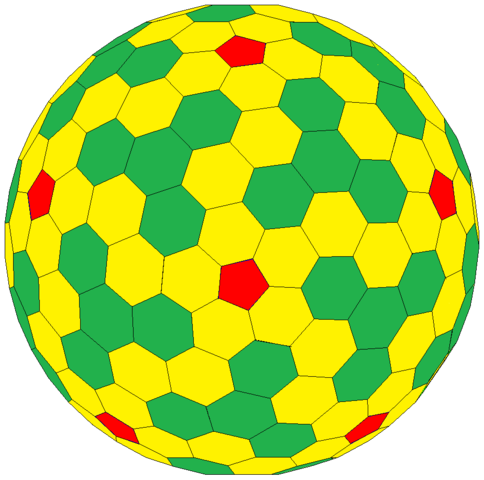
During this work, Schein came across the work of 20th century mathematician Michael Goldberg, who described a set of new shapes that have been named the Goldberg polyhedra. The easiest Goldberg polyhedron to envision looks like a blown-up soccer ball, as the shape is made of many pentagons and hexagons connected to each other in a symmetrical manner (see image to the left).
However, Schein thinks that Goldberg’s shapes—or cages, as geometers call them—are not polyhedra. “It may be confusing because Goldberg called them polyhedra, a perfectly sensible name to a graph theorist. But to a geometer, polyhedra require planar faces,” Schein said.
So Schein and his colleague James Gayed decided to examine whether Goldberg-like shapes could form actual polyhedra. A new paper in PNASdescribes a fourth class of convex polyhedra that they want to call Goldberg polyhedra, even if the name would confuse others.
A crude way to describe Schein and Gayed’s work, according to David Craven at the University of Birmingham, “is to take a cube and blow it up like a balloon”—which would make its faces bulge (see image to the right). The challenge for Schein and Gayed is to keep the inflation from causing the shape to break the third rule: no point on a line that connects two points in that shape can fall outside the shape.
Craven said, “There are two problems: the bulging of the faces, whether it creates a shape like a saddle, and how you turn those bulging faces into multi-faceted shapes. The first is relatively easy to solve. The second is the main problem. Here one can draw hexagons on the side of the bulge, but these hexagons won’t be flat. The question is whether you can push and pull all these hexagons around to make each and every one of them flat.”
During the bulging process, and when the bulges are replaced with multiple hexagons, Craven notes, the process will generate internal angles. One of these angles formed between lines of the same faces—referred to as dihedral angle discrepancies—will control whether or not the face is flat. Schein and Gayed claim to have found a way of making those angles zero, which makes all the faces flat. What is left is a true convex polyhedron. (It’s worth noting that in doing so, the hexagons lose their perfect shapes. They may appear warped, but at least they’re flat.)
Schein and Gayed claim that the rules they have developed to govern this process can be applied to develop other classes of convex polyhedra. These shapes will have more and more faces, and in that sense there should be an infinite variety of them.
Playing with shapes
Such mathematical discoveries generally don’t have immediate applications, although these are often found later. For example, dome-shaped buildings are never circular in shape; instead, they are built like half-cut Goldberg polyhedra, consisting of many regular shapes that give more strength to the structure.
In this case, however, there may be some immediate applications. The new rules create polyhedra that have structures similar to viruses and fullerenes, a carbon allotrope. If we are able to describe the structure of a virus more accurately, we could get a step closer to finding a way of fighting them.
If nothing else, Schein’s work may prod mathematicians to find other interesting geometric shapes, now that equilateral convex polyhedra have a new family.
This article was first published on The Conversation. Multiple image credits here.
Researchers in the US have overcome a key barrier to making nuclear fusion reactors a reality. In results published in Nature, scientists have shown that they can now produce more energy from fusion reactions than they put into nuclear fuel for an experiment. The use of fusion as a source of energy remains a long way off, but the latest development is an important step towards that goal.
Nuclear fusion is the process that powers the sun and billions of other stars in the universe. If mastered, it could provide an unlimited source of clean energy because the raw materials are plentiful and the operation produces no carbon emissions.
During the fusion process, smaller atoms fuse into larger ones releasing huge amounts of energy. To achieve this on Earth, scientists have to create conditions similar to those at the centre of the sun, which involves creating very high pressures and temperatures.
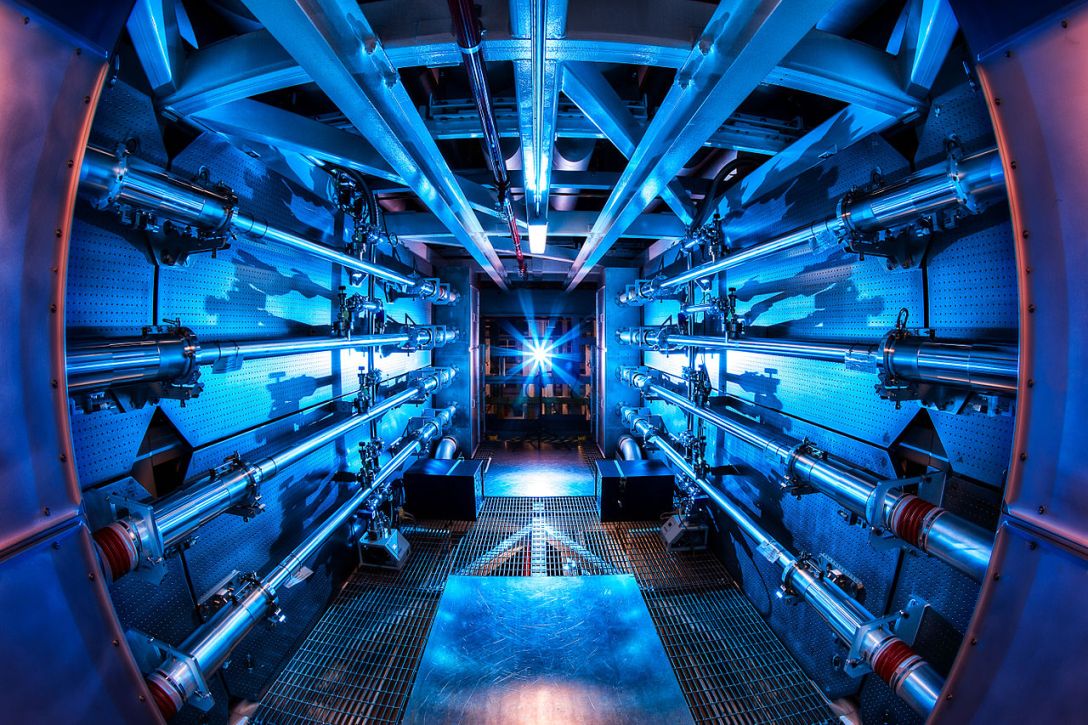
There are two ways to achieve this: one uses lasers and is called inertial confinement fusion (ICF), another deploys magnets and is called magnetic confinement fusion (MCF). Omar Hurricane and colleagues at the Lawrence Livermore National Laboratory opted for ICF with the help of 192 high-energy lasers at the National Ignition Facility in the US, which was designed specifically to boost fusion research.
A typical fusion reaction at the facility takes weeks of preparation. But the fusion reaction is completed in an instant (150 picoseconds, to be precise, which is less than a billionth of a second). In that moment, at the core of the reaction the pressure is 150 billion times atmospheric pressure. The density and temperature of the plasma created is nearly three times that at the centre of the sun.
The most critical part of the reaction, and one that had been a real concern for Hurricane’s team, is the shape of the fuel capsule. The capsule is made from a polymer and is about 2mm in diameter – about the size of a paper pinhead. On the inside it is coated with deuterium and tritium – isotopes of hydrogen – that are frozen to be in a solid state.
Hohlraum geometry with a capsule inside. Dr. Eddie Dewald/LLNL
This capsule is placed inside a gold cylinder, where the 192 lasers are fired. The lasers hit the gold container which emit X-rays, which heat the pellet and make it implode instantly, causing a fusion reaction. According to Debbie Callahan, a co-author of the study: “When the lasers are fired, the capsule is compressed 35 times. That is like compressing a basketball to the size of a pea.”
The compression produces immense pressure and temperature leading to a fusion reaction. Problems with the process were overcome last September, when, for the first time, Hurricane was able to produce more energy output from a fusion reaction than the fuel put into it. Since then he has been able to repeat the experiment.
Hurricane’s current output, although more than the hydrogen fuel put into the reaction, is still 100 times less than the total energy put into the system, most of which is in the form of lasers. Yet, this is a big achievement because reaching ignition just became easier.
Hurricane hasn’t yet reached the stated goal of the NIF that is to achieve “ignition”, where nuclear fusion generates as much energy as the lasers supply. At that point it would be possible to make a sustainable power plant based on the technology.
Scientists have been trying to tame fusion power for more than 50 years, but with little success. Although the National Ignition Facility, a US$3.5-billion operation, was built for classified government research, half of its laser time was devoted to fusion with an aim to accelerate research.
Zulfikar Najmudin, a plasma physicist at Imperial College London said: “These results will come as a huge relief to scientists at NIF, who were very sure they could have achieved this a few years ago.”
With laser-mediated ICF showing positive results, the obvious question is how does it compare with magnet-mediated fusion? According to Stephen Cowley, director of Culham Centre for Fusion Energy in Oxfordshire, “The different measures of success make it hard to compare NIF’s results with those of ‘magnetic confinement’ fusion devices.”
Culham works with magnetic confinement where, in 1997, the facility generated 16MW of power for 24MW put into the device. “We have waited 60 years to get close to controlled fusion. We are now close in both magnetic and inertial. The engineering milestone is when the whole plant produces more energy than it consumes,” Cowley said.
That may happen at the fusion reactor ITER, under construction in France, which is expected to be the first power plant that produces more energy than it consumes to sustain a fusion reaction.







 Akshat Rathi