Bill Gates on the world and things he cares about

Jeff Goodall of Rolling Stone magazine does a great job of interviewing one of the greatest men of our times. Gates falls in the five greatest thinkers I follow. As Goodall summarises, he is one of the most optimistic persons alive who thinks “the world is a giant operating system that can be debugged”. That is why a long interview with him is much welcome. Here I have snippets and some crystallised gems from it:

On comparison with Zuckerberg:

I start with architecture, and Mark Zuckerberg starts with products, and Steve Jobs started with aesthetics.

On Edward Snowden:

I think he broke the law, so I certainly wouldn’t characterize him as a hero.

On taxation:

In general, on taxation-type things, you’d think of me as a Democrat. That is, when tax rates are below, say, 50 percent, I believe there often is room for additional taxation.

On helping the poor:

Should the state be playing a greater role in helping people at the lowest end of the income scale? Poverty today looks very different than poverty in the past. The system’s ability to distinguish between somebody who has family that could take care of them versus someone who’s really out on their own is not very good, either. It’s a totally gameable system – not everybody games it, but lots of people do. Why aren’t the technocrats taking the poverty programs, looking at them as a whole, and then redesigning them?

On government’s ability to tackle big problems:

You have to have a certain realism that government is a pretty­ blunt instrument and without the constant attention of highly qualified people with the right metrics, it will fall into not doing things very well. If I could wave a wand and fix one thing, it’d be political deadlock, the education system or health care costs.

On money in politics:

I’m not sure you’d want money to be completely out of politics. We’ve got a system with a lot of checks and balances. When you get into a period of crisis where the overwhelming majority agrees on something, government can work amazingly well, like during World War II.

On innovation:

Innovation can actually be your enemy in health care if you are not careful. If you accelerate certain things but aren’t careful about whether you want to make those innovations available to everyone, then you’re intensifying the cost in such a way that you’ll overwhelm all the resources.

On prioritisation:

I want to focus on things where I think my experience working with innovation gives me an opportunity to do something unique. The majority of the foundation’s money goes to a finite number of things that focus on health inequity – why a person from a poor country is so much worse off than somebody from a country that’s well-off. It’s mostly infectious diseases.

On “no poor countries by 2050”:

Assuming there’s no war or anything, we ought to be able to take even the coastal African countries and get them up to a reasonable situation over the next 20 years. You get more leverage because the number of countries that need aid is going down, and countries like China and India will still have problems, but they’re self-sufficient. And over the next 20 years, you get better tools, new vaccines, a better understanding of diseases and, hopefully, cheaper ways of making energy.

On investment:

(Not a quote) Philanthropy has a better hit rate than venture capital. And yet, because of successes like Google, people give it more importance.

On climate change:

It’s a big challenge, but I’m not sure I would put it above everything. I think it’s a real test of the boundary of science and politics – and an acid test of people’s time horizons. I happen to think we should explore geo-engineering.­

On alternative power:

Intermittent energy sources like wind and solar . . . you can crank those up, depending on the quality of the grid and the nature of your demand. You can scale that up 20 percent, 30 percent and, in some cases, even 40 percent. But when it comes to climate change, that’s not interesting. You’re talking about needing factors of, like, 90 percent.

With so many problems, people feel pessimistic:

Really? That’s too bad. I think that’s overly focusing on the negatives. I think it’s a pretty bright picture, myself. But that doesn’t mean I think, because we’ve always gotten through problems in the past, “just chill out, relax, someone else will worry about it.” I don’t see it that way.

What is your biggest fear?

I understand how every healthy child, every new road, puts a country on a better path, but instability and war will arise from time to time, and I’m not an expert on how you get out of those things. I wish there was an invention or advance to fix that. There’ll be some really bad things that’ll happen in the next 50 or 100 years, but hopefully none of them on the scale of, say, a million people that you didn’t expect to die from a pandemic, or nuclear or bioterrorism.

On immigration:

US immigration laws are bad – really, really bad. I’d say treatment of immigrants is one of the greatest injustices done in our government’s name.

Do you believe in God?

I agree with people like Richard Dawkins that mankind felt the need for creation myths. Before we really began to understand disease and the weather and things like that, we sought false explanations for them. Now science has filled in some of the realm – not all – that religion used to fill. I think it makes sense to believe in God, but exactly what decision in your life you make differently because of it, I don’t know.

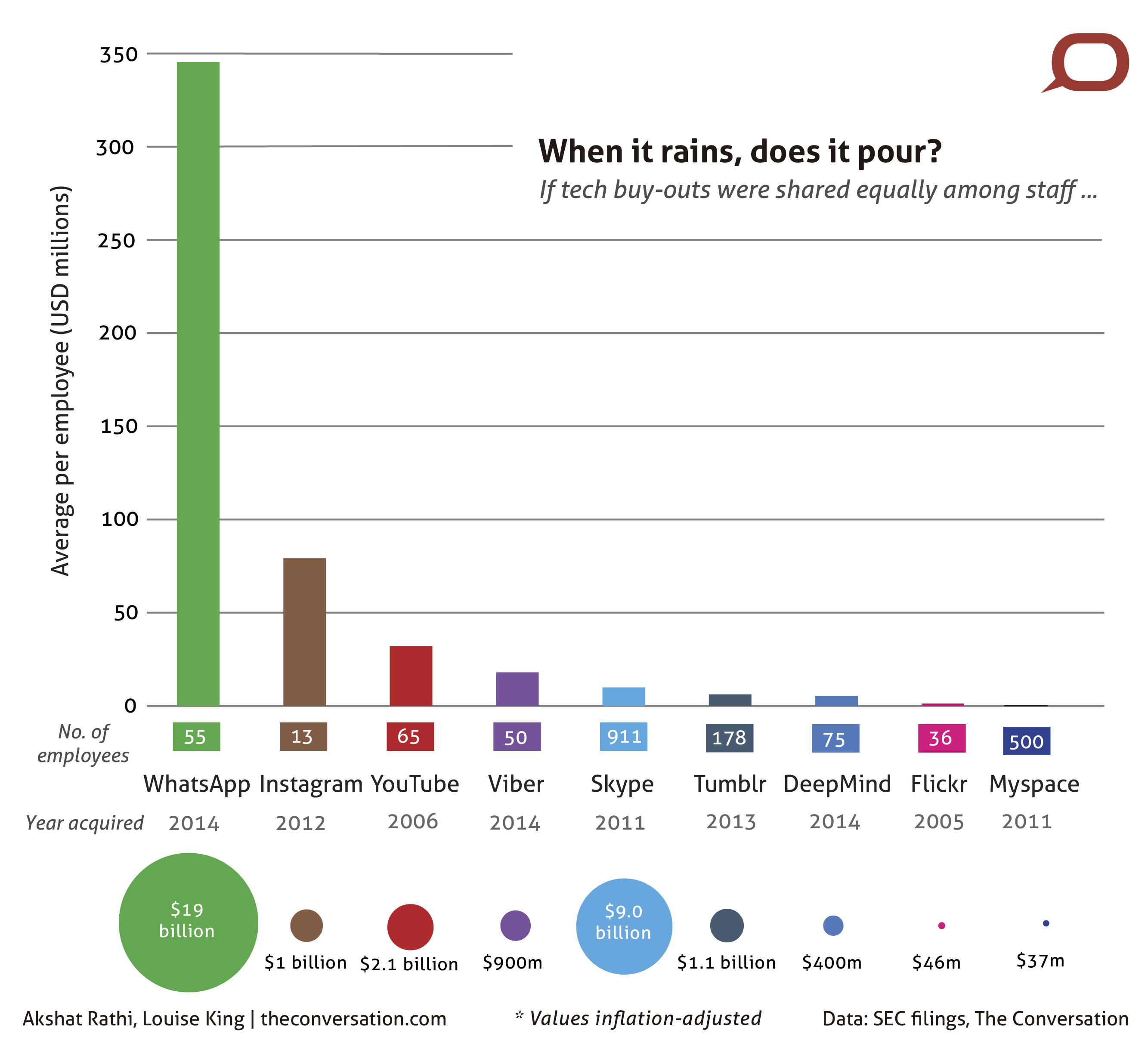
Are all of WhatsApp’s 55 employees millionaires now? Not just yet

Facebook has just acquired the mobile messenger service WhatsApp for US$19 billion. Launched in 2009 by two former Yahoo employees, in just over four years WhatsApp has grown to 420m monthly users.

Why is it so popular? Founder Jan Koum told the New York Times in 2012, “We are providing a richness of experience and an intimacy of communication that e-mail and phone calls simply can’t compare with.”

Facebook has been pushing its own messenger service to its users, but without much success. Markos Zachariadis at Warwick Business School, said, “Facebook’s purchase of WhatsApp is in many ways an admission of defeat.”

The explosion in the number of smartphones in recent years has also seen a boom in instant messaging services. Popular services such as WeChat, Line and Viber each have more than 100m users. WhatsApp tops that chart in not just number of users but also engagement. With the per-day volume at 19 billion messages sent and 34 billion received, the messaging service will soon trump the total global SMS volume.

According to Sotirios Paroutis, also at Warwick Business School, Mark Zuckerberg is out to make Facebook a truly mobile company with Instagram and WhatsApp. “In the past WhatsApp founders have been vocal in their objection to be acquired by a larger firm. So beyond their own reward package, the promise to keep WhatsApp as an independent service seems to have helped bring the two parties together,” he said.

Show me the money

With only 55 employees, WhatsApp’s $19-billion valuation could, in an alternate universe where each employee was given an equal share, fetch US$350m per employee. This is nearly five times what employees of Instagram would have got when that company was bought out for US$1 billion in 2012.

WhatsApp8-01

While founders take away big chunks of the proceeds from such deals, with so few employees the windfall can still make many others rich. But in some cases, like that of Skype’s acquisition by Microsoft, the unequal distribution can leave employees with nothing. Worse still, Felix Salmon at Reuters points out that because of the way these deals are structured, employees can do little to fight back.The Conversation

First published on The Conversation. Image credit: janpersiel.

After 400 years, mathematicians find a new class of shapes

The works of the Greek polymath Plato have kept people busy for millennia. Mathematicians have long pondered Platonic solids, a collection of geometric forms that are highly regular and are frequently found in nature.

Platonic solids are generically termed equilateral convex polyhedra. In the millennia since Plato’s time, only two other collections of equilateral convex polyhedra have been found: Archimedean solids (including the truncated icosahedron) and Kepler solids (including rhombic polyhedra). Nearly 400 years after the last class was described, mathematicians claim that they may have now identified a new, fourth class, which they call Goldberg polyhedra. In the process of making this discovery, they think they’ve demonstrated that an infinite number of these solids could exist.

Platonic love for geometry

Equilateral convex polyhedra share a set of characteristics. First, each of the sides of the polyhedra needs to be the same length. Second, the shape must be completely solid—that is, it must have a well-defined inside and outside that is separated by the shape itself. Third, any point on a line that connects two points in the shape must never fall outside of it.

Platonic solids, the first class of such shapes, are well-known. They consist of five different shapes: tetrahedron, cube, octahedron, dodecahedron, and icosahedron. They have four, six, eight, twelve, and twenty faces, respectively.

Platonic solids in ascending order of number of faces. nasablueshift

These highly regular structures are not just mathematical constructs; they’re also found in nature. For instance, the carbon atoms in a diamond are arranged in a tetrahedral shape. Common salt and fool’s gold (iron sulfide) form cubic crystals, and calcium fluoride forms octahedral crystals.

The discovery of Goldberg solids comes from researchers who were inspired by finding interesting polyhedra in work that involved the human eye. Stan Schein at the University of California in Los Angeles was studying the retina when he became interested in the structure of protein called clathrin. Clathrin is involved in moving resources inside and outside cells, and in that process it forms structures that adopt a handful of shapes. These shapes intrigued Schein, who came up with a mathematical explanation for their formation.

484px-Conway_polyhedron_Dk5k6st

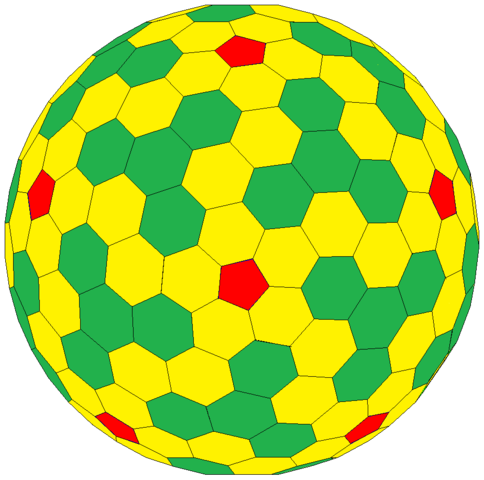
During this work, Schein came across the work of 20th century mathematician Michael Goldberg, who described a set of new shapes that have been named the Goldberg polyhedra. The easiest Goldberg polyhedron to envision looks like a blown-up soccer ball, as the shape is made of many pentagons and hexagons connected to each other in a symmetrical manner (see image to the left).

However, Schein thinks that Goldberg’s shapes—or cages, as geometers call them—are not polyhedra. “It may be confusing because Goldberg called them polyhedra, a perfectly sensible name to a graph theorist. But to a geometer, polyhedra require planar faces,” Schein said.

So Schein and his colleague James Gayed decided to examine whether Goldberg-like shapes could form actual polyhedra. A new paper in PNAS describes a fourth class of convex polyhedra that they want to call Goldberg polyhedra, even if the name would confuse others.

dzy7x8r4-1392312064

A crude way to describe Schein and Gayed’s work, according to David Craven at the University of Birmingham, “is to take a cube and blow it up like a balloon”—which would make its faces bulge (see image to the right). The challenge for Schein and Gayed is to keep the inflation from causing the shape to break the third rule: no point on a line that connects two points in that shape can fall outside the shape.

Craven said, “There are two problems: the bulging of the faces, whether it creates a shape like a saddle, and how you turn those bulging faces into multi-faceted shapes. The first is relatively easy to solve. The second is the main problem. Here one can draw hexagons on the side of the bulge, but these hexagons won’t be flat. The question is whether you can push and pull all these hexagons around to make each and every one of them flat.”

During the bulging process, and when the bulges are replaced with multiple hexagons, Craven notes, the process will generate internal angles. One of these angles formed between lines of the same faces—referred to as dihedral angle discrepancies—will control whether or not the face is flat. Schein and Gayed claim to have found a way of making those angles zero, which makes all the faces flat. What is left is a true convex polyhedron. (It’s worth noting that in doing so, the hexagons lose their perfect shapes. They may appear warped, but at least they’re flat.)

Schein and Gayed claim that the rules they have developed to govern this process can be applied to develop other classes of convex polyhedra. These shapes will have more and more faces, and in that sense there should be an infinite variety of them.

Playing with shapes

Such mathematical discoveries generally don’t have immediate applications, although these are often found later. For example, dome-shaped buildings are never circular in shape; instead, they are built like half-cut Goldberg polyhedra, consisting of many regular shapes that give more strength to the structure.

In this case, however, there may be some immediate applications. The new rules create polyhedra that have structures similar to viruses and fullerenes, a carbon allotrope. If we are able to describe the structure of a virus more accurately, we could get a step closer to finding a way of fighting them.

If nothing else, Schein’s work may prod mathematicians to find other interesting geometric shapes, now that equilateral convex polyhedra have a new family.The Conversation

This article was first published on The Conversation. Multiple image credits here.