Unemployment caused by the economic crisis set to worsen

While the rich countries were most affected by the global economic crisis, there are signs of recovery. Although India and China won’t go back to the days of double-digit growth, other emerging countries, especially in Sub-Saharan Africa, paint a more hopeful picture. But the scale of the recovery won’t help the unemployed much, whose numbers are only set to be growing.

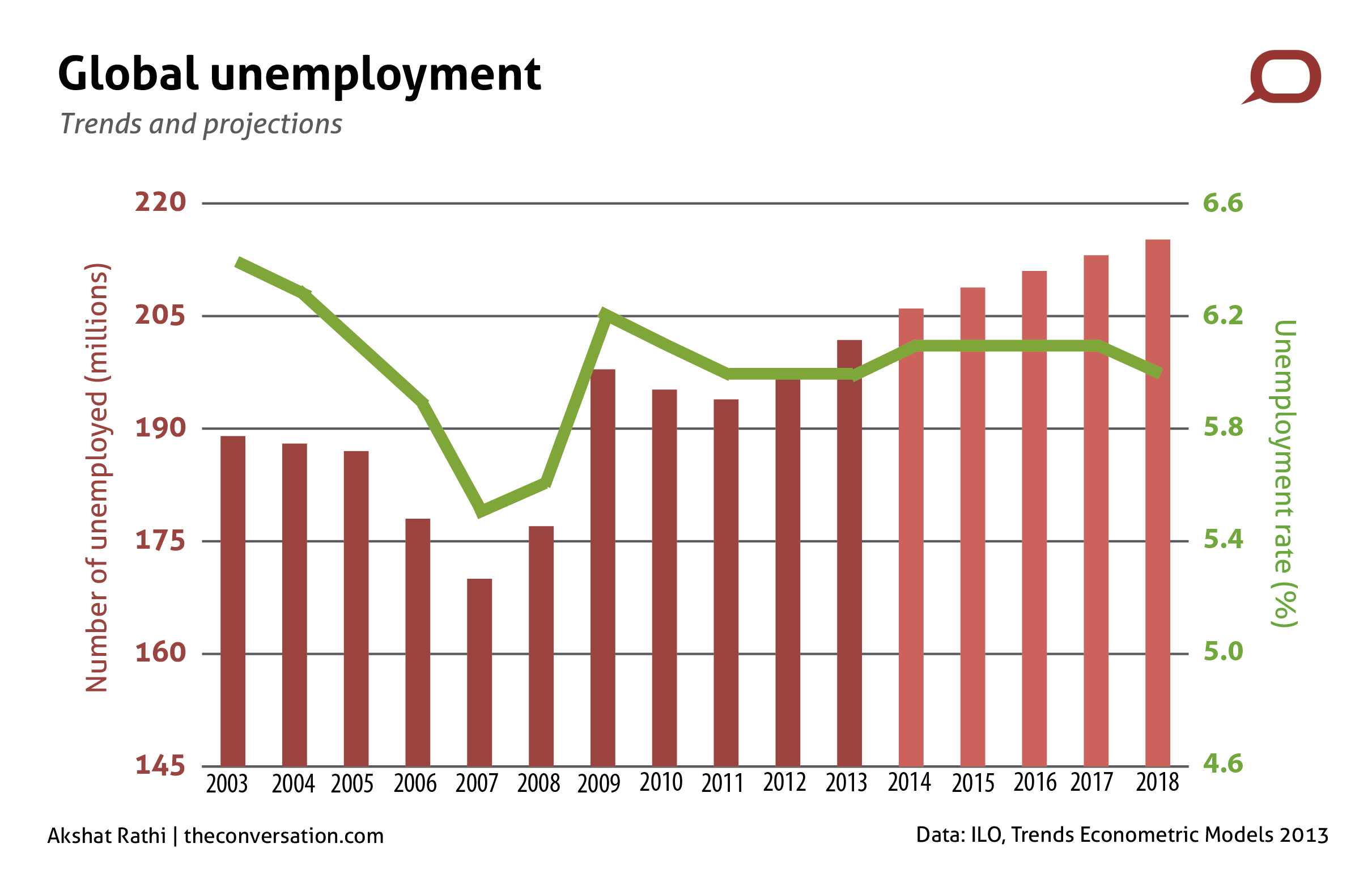
In 2013, the unemployed grew by 5m to 202m people globally. According to a new report published by the International Labour Organisation (ILO), this number is set to grow by a further 13m by 2018, even if the rate of underemployment remains same. In countries such as Greece and Spain, the average duration of unemployment has reached nearly nine months.
Unemployment-01

The ILO’s worries are threefold. First, the recovery is not strong enough to reduce the growing number of unemployed. Second, the fundamental causes of the global economic crisis are yet to be properly tackled. Third, the crisis has forced even those employed into more vulnerable jobs.

The young have suffered the most. About 74m people between the ages of 15 and 24 were unemployed in 2013, which is 1m more than 2012. The global youth unemployment rate has reached 13.9%, more than double the global average.

These numbers also mask the large number of underemployed people. In countries like India, where education has boomed in the last few decades, there are now more people with degrees than there are jobs for them.

According to Craig Jeffrey, professor of development geography at the University of Oxford, India has a whole class of educated people just “doing timepass” (passing the time). And, he writes on The Conversation, this is not just the case for India. Other Asian countries, Latin America, Africa and many Europen countries have such a group, too.

It seems whether you have a degree or not, that dream job might remain unreachable for a little longer.The Conversation

First published on The Conversation.

Image credit: truthout

Cyclists put pedestrians at risk, but it’s not their fault

Governments around the world are pushing to get their citizens to cycle more. Without necessary infrastructure, however, that is not good news for pedestrians or cyclists.

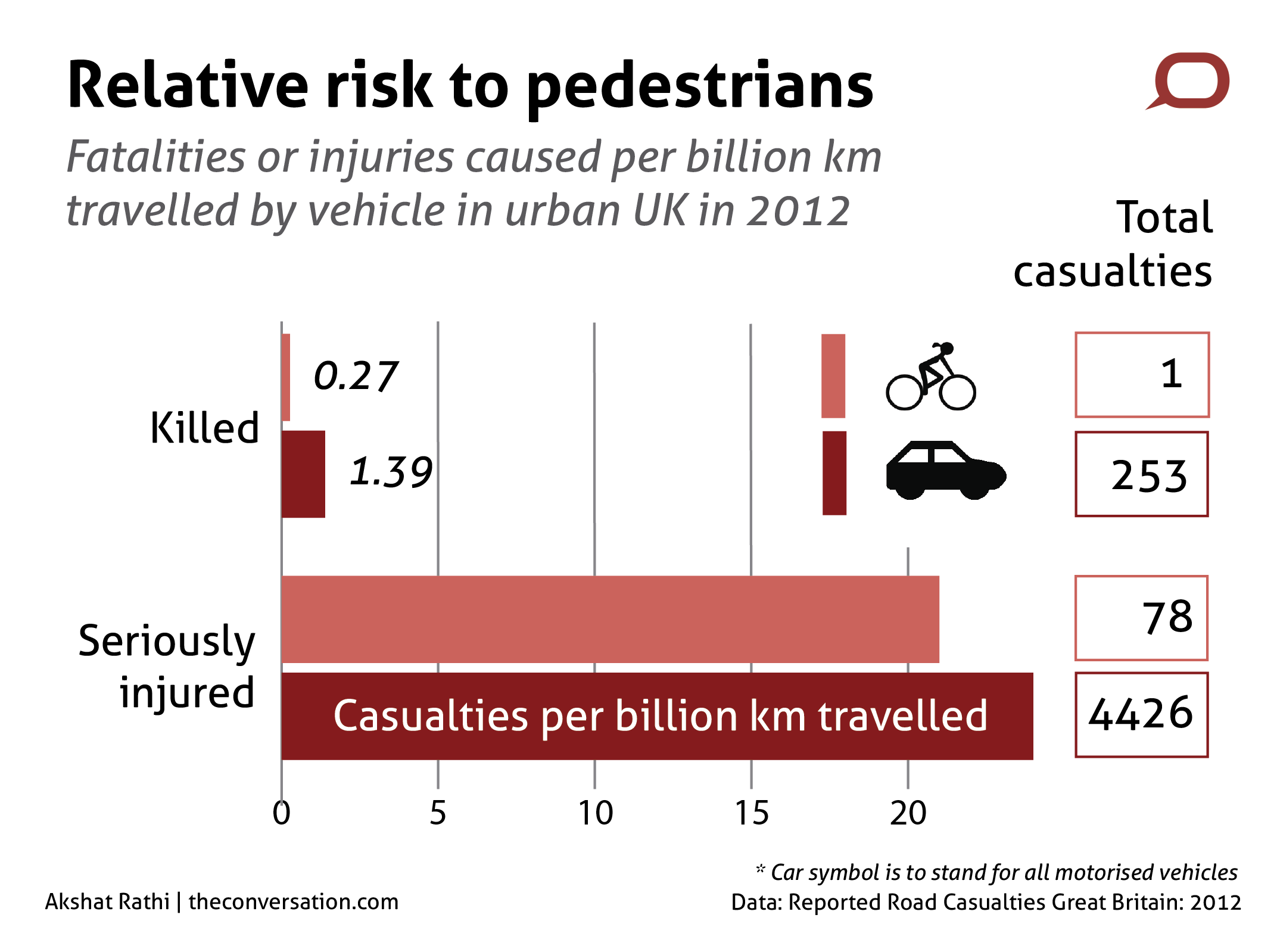
While on an evening stroll, no one likes a bike whizzing past on the same footpath. Many pedestrians worry about getting injured by cycles more than by cars, and their perception of risk in this case is not much off the mark. Data reveals that cyclists are nearly as likely to cause a serious injury to a pedestrian as motorists are—if you are a British pedestrian, that is.

The absolute number of people hurt by cyclists is quite small, but so is the corresponding distance travelled by cyclists. Thus the relative risk from cyclists and motorists is comparable.

According to the British government’s data, between 2003 and 2012, cyclists killed 23 pedestrians and injured 585, whereas motorists killed 4,894 and injured 45,496. But in 2012, motorists cover as much as 50 times the distance in urban areas as cyclists do. Using corresponding casualties data, the relative risk from motorists to pedestrians is five times as much as that from cyclists if the injury leads to death, but the risk of seriously injuring a pedestrian is about the same.

Cy4-01

The data is comparable to that acquired from Transport for London (TfL), the city’s authority for all matters vehicular, through a freedom of information request by the National Cycling Charity. The request was to find out how much cyclists hurt pedestrians on footways only. (In legalese footway is one that runs alongside a carriageway, whereas a footpath is located away from it.)

In the period from 1998 to 2007, cyclists killed none and caused some injury to 98 pedestrians on footways in London. For motorists, the corresponding numbers were 54 and 4,460. If the distance travelled by motorists is assumed to be about 50 times that of cyclists, like the 2012 national average, the relative risk of causing some injury to pedestrians is nearly the same from cyclists as it is from motorists.

However, John Parkin, professor of transport engineering at the University of West England, said, “Provisions for cyclists are so appalling that it is not surprising some find it easier and safer on the footway. If cyclists need to go on pedestrian routes, then the government needs to provide better infrastructure.”

According to Parkin, the last decade has seen improvement in cycling infrastructure, at least in cities like London, but much remains to be done.

One solution being backed by Network Rail, operator of most British rail infrastructure, and TfL is the development of SkyCycle—a 220km car-free route installed above London’s suburban rail network. But, as Steven Fleming and Angelina Russo write on The Conversation, cyclists are not too pleased with this initiative. For the price tag of £220m, many argue there are cheaper ways to improve matters. But more worrying is the fact that SkyCycle may mean that the streets will be given over to the car, which in some places is already a problem.

Compared to the rest of Europe, the UK has among the smallest proportion of people using cycles as their main means of transport. Only about two in 100 Britons fall in that category, which is marginally better than Bulgaria, Malta and Cyprus.

Politicians want to change that. An all-party inquiry is considering how best to get Britons cycling. Hopefully they will heed the advice of not just cyclists but also pedestrians.The Conversation

First published at The Conversation.

Why there may be fewer truly new drugs hitting the market

Developing new drugs is hard and expensive. The lengthy process from initial discovery to the market is some times compared to the difficulty of putting a person on the moon. Despite accusations that the pharma industry is evil, the real reason could be summarised pithily in what one scientist said: “Drugs are expensive because we are stupid.”

Even after studying some diseases for more than 100 years, we are not close to understanding them well enough. With so many unknown factors at play, the fact that we are able to still find relatively simple chemicals to effectively act as drugs is pretty amazing.

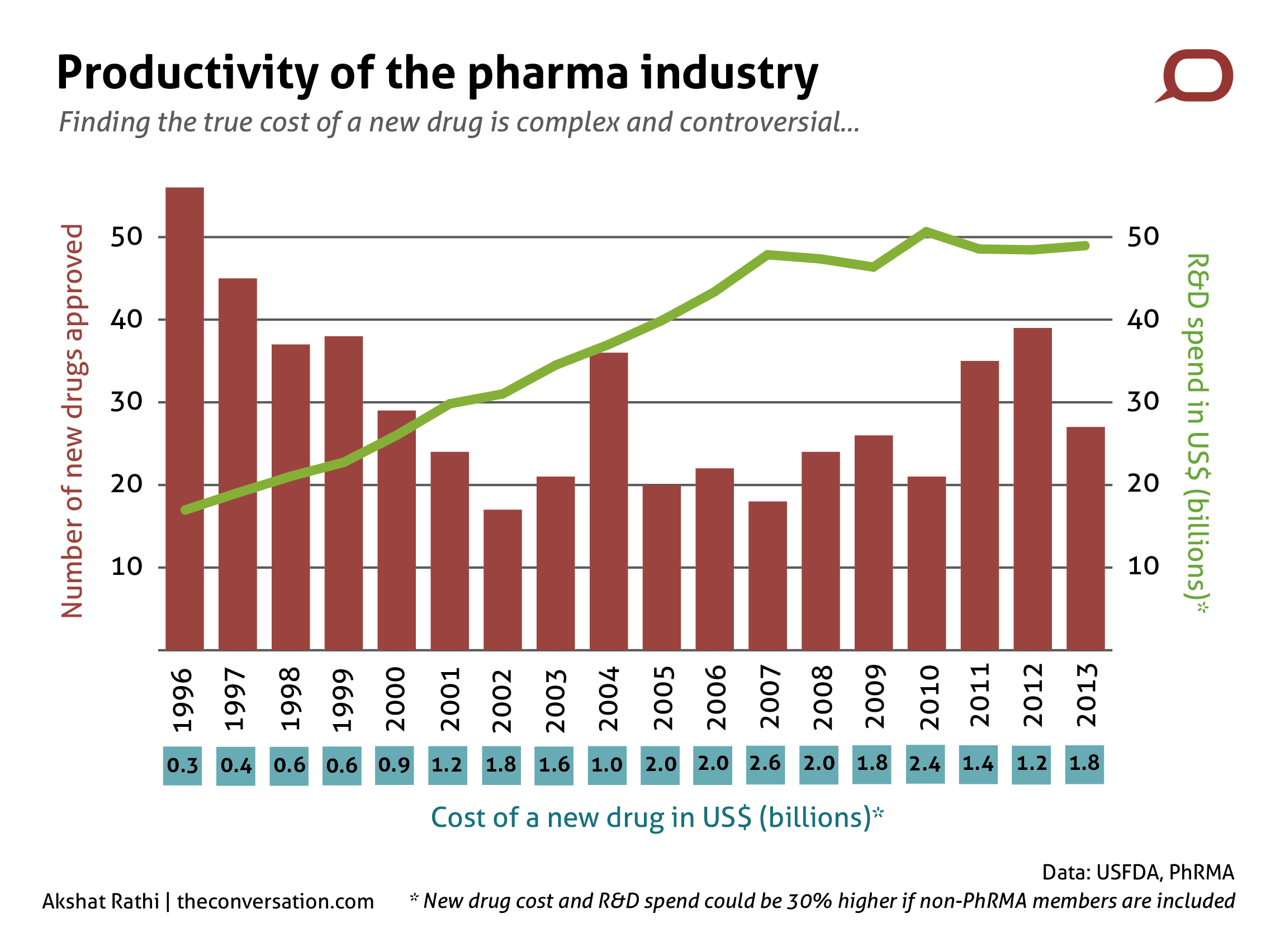
But with much initial success, the productivity of the pharma industry has been falling for many decades. According to John LaMattina, former president of global research and development at Pfizer, “30 is the new 50” in the drug industry. He is referring to the number of new drugs approved per year, which has been on average declining since the 1960s. This is happening at the same time as research and development (R&D) costs are going up.

Drugs4-01

Finding the true cost of a new drug is a complex and controversial exercise. However, one acceptable way to calculate it is to divide total R&D spend of pharma companies by the number of new drugs produced. Because of differences in agreeing what constitutes R&D spend, even this measure produces only a range – the cost of a new drug is somewhere between US$1 billion and US$5 billion.

However, many argue that simply looking at the rising costs does not give the true measure of the pharma industry’s productivity. New drugs don’t always mean effective new treatments. According to new studies just published in the Journal of the American Medical Association (JAMA), Efthimios Parasidis of Ohio State University writes on The Conversation that nearly half of the new drugs between 2005 and 2011 received an approval without the drug company needing to show that those drugs had any tangible benefit to a patient.

With rising costs and fewer new drugs, the pharma industry could do with a boost in the arm. That, however, seems to be a hard find.The Conversation

First published on The Conversation.