Animal Behaviour: The benefits of schooling

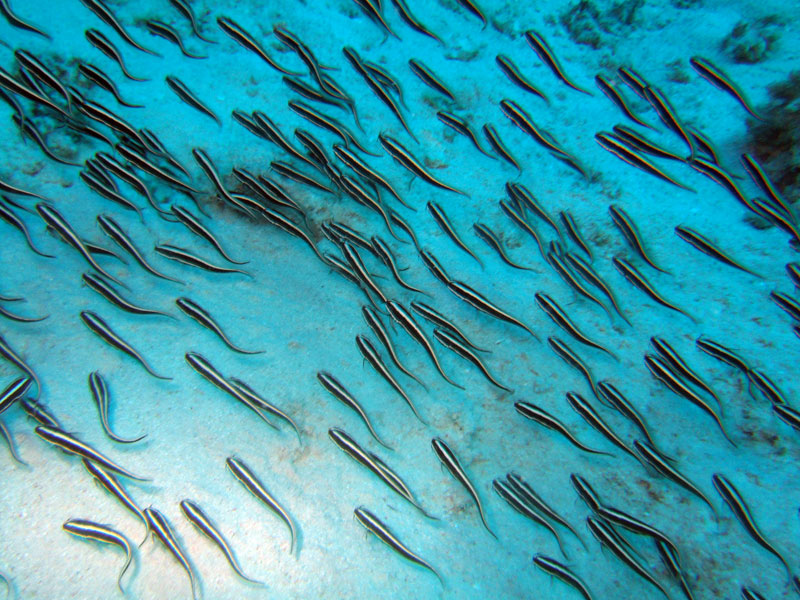
Nearly four-fifths of the 28,000 known species of fish swim in schools, harmoniously aligning their movements with others around them. Besides reducing drag for those not in the front of the pack, coming together makes it harder for a predator to single out just one prey; a mass change of direction by the entire school might act to confuse the attacker further.

That, at least, is the theory. The rub is that testing it requires manipulating the behaviour of real fish—trickier even than herding cats. Now, though, Christos Ioannou, from Bristol University, may have found a way around it. As the researchers report in Science, he and his colleagues have developed a video game for piscine predator to play.

They put their gamer, a hungry bluegill sunfish, into a tank and projected computer-generated prey on one of its walls. Each digital fish in the 16-strong school was programmed to maintain their speed and to move away to avoid collision if they get too close to each other. But each was also endowed with a mind of its own: some ignored what their neighbours did while others followed their every move.

It turns out that the real sunfish is indeed more likely to go after the lonely virtual minnows than the more gregarious ones. It seems, then, that there really is strength in numbers, though it be some time before Dr Ioannou manages to coax his bluegill into disclosing precisely why it prefers the loners.

Also published on economist.com.

Reference: Ioannou CC, Guttal V, & Couzin ID (2012). Predatory Fish Select for Coordinated Collective Motion in Virtual Prey. Science PMID: 22903520

Free image from stock.xchng.

Printing at the highest resolution possible

How high can you get? Resolutionwise, that is. In 2010, when launching the Apple iPhone 4, Steve Jobs claimed that the 326 dots per inch (dpi) resolution of that machine’s display would make it impossible to pick the pixels apart. His reason was that this density of dots is at the limit of the resolving power of the human eye when something is held at reading distance from it. This limit is not, however, the theoretical maximum resolution of an image. That is about 100,000 dpi, a figure imposed by the laws of physics. Place any more dots in an inch and the light waves coming from them start to interfere with each other, leading to a loss of clarity.

Printing at 100,000 dpi using either the inkjet technique (in which droplets of liquid ink are laid down side by side) or the laserjet technique (in which static electricity is used to direct bits of powdered ink onto paper, where a laser melts them) is impossible. Neither can manage more than about 10,000 dpi. But Karthik Kumar, a material scientist at Singapore’s Agency for Science, Technology and Research, thinks he can do better. As he and his colleagues report in Nature Nanotechnology, they have a prototype that can manage the full 100,000. The catch is that it uses “ink” made out of silver and gold.

Actually, that is not the only catch. For the image has to be created using an electron beam, rather than a laser or an inkjet, and such beams are rather hard to handle. But as a proof of principle it is interesting, and it might lead to cheaper and faster methods.

Dr Kumar and his team start with a plate of silicon. The electron beam carves bits of this away, leaving a pattern of cylindrical posts each about 140 nanometres (billionths of a metre) across and 50 nanometres apart. That “about” is important, though. The exact diameters of the posts and the distances between them are crucial. Varying them changes the colour that forms between the posts.

To create this colour, the plate is coated with a layer of silver and another of gold. The outer electrons of the atoms of these heavy metals often come loose, to form a cloud akin to an electronic gas. When light falls on this gas, it absorbs all frequencies bar one, which is reflected. Exactly which frequency is reflected depends on the resonant frequency at which the electron gas vibrates. And that, in turn, depends on how far apart the silicon posts (which constrain the gas’s movements) are.

A coloured image can thus be made by varying the size and spacing of the posts. This, the team did. Specifically, they recreated a widely used test image: that of Lenna, a pin-up girl from the 1970s whose picture is reckoned (ahem) a challenge to reproduce because of its wide range of tones. Dr Kumar’s version of Lenna was only 100 microns (about the thickness of a human hair) across, but matched the original with reasonable fidelity.

Carving images on silicon using electron beams, and then coating the result with precious metals, is unlikely ever to be a viable technology for the mass printing of images. It might, though, be a good way of storing data permanently—better, in terms of density, at least, than existing optical techniques such as CDs, DVDs and Blu-ray discs. It is also strangely reminiscent of the Daguerreotype, an early form of photography that formed images of silver on a copper plate. Bearing in mind the multi-billion dollar industry that Louis Daguerre’s idea eventually turned into, perhaps Dr Kumar’s version is not so strange, after all.

Also published on economist.com.

References:

  1. Kumar et al.Nature Nanotechnology, 2012
  2. Lenna Image
  3. Retina Display

Image from here.

Oceanic carbon sinks: That sinking feeling

Nature has her own way of dealing with excess carbon dioxide. When human activities spew CO2 into the atmosphere, plants absorb more of it than usual, leading to profuse growth. The ocean, too, swallows more than it otherwise would. Many scientists fret that these so-called carbon sinks risk getting clogged up. Some even suggest that this has already started happening.

Ashley Ballantyne, a geologist at the University of Colorado, and colleagues are less gloomy. In a paper published recently in Nature they show that over the past 50 years Earth’s absorption of CO2 has nearly doubled. Yet they see no evidence of a slowdown in the rate at which this takes place. If the climate models suggest otherwise, the researchers argue, then the modellers must have got their sums wrong.

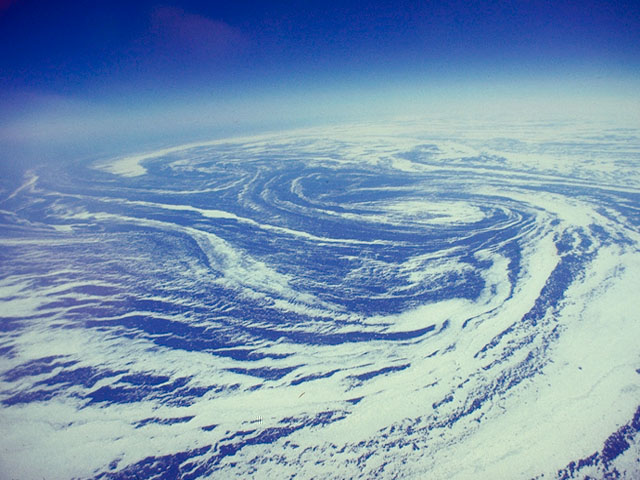
One reason, points out Jean-Baptiste Salée, an oceanographer with the British Antarctic Survey, might be that little is known about how exactly the CO2 is absorbed by the ocean, which quaffs more than half of the man-made stuff. There has been much speculation about this, but little hard evidence. Theory points to three main mechanisms: mixing the ocean’s surface layers (up to a few hundred metres) by wind; mixing of deeper layers by ocean currents; and eddies, swirls created when warm ocean currents meet cold ones, blending large swathes of the ocean 10-100km across. It had been assumed that most of the CO2 is captured by the surface layers, which would then be stirred by wind, distributing the carbon dioxide over a larger patch, and pulled down by ocean currents, freeing the surface layers to absorb yet more.

To test this hypothesis Dr Salée’s team examined a decade’s worth of data from thousands of robots and hundreds of ships spread across the southern hemisphere ocean, approximately between the southernmost tips of Africa, Australia and South America, and Antarctica, whose large, unbroken waters take in most of the world’s man-made CO2. Every nine days the robots dive to 2km and then slowly come up to the surface, recording the temperature, saltiness and speed of currents they encounter along the way. The robots are too small to carry the instruments needed to measure the quantity of dissolved carbon dioxide so this had to be done by researchers aboard ships.

As Dr Salée and colleagues report in in Nature Geoscience, eddies suck up as much carbon as the other two mechanisms do, something most current climate models fail to account for. Dr Salée is quick to urge that the fact that Earth’s carbon sinks seem to be running smoothly for now does not justify complacency. Just as the oceans gulp CO2, they might release vast quantities of it back into the atmosphere. More data delivered by global programmes like Argo, which operates the robot flotilla, and Climate Variability and Predictability, which runs the ships, will help researchers understand how this might occur—and make more accurate predictions about when it is likely to happen.

Also published on economist.com.

References:

  1. Ballantyne et al.Nature, 2012, 488, 70
  2. Salée et al.Nature Geoscience, 2012, ASAP
  3. Climate change: What lies beneath – The Economist
  4. Argo project, UK Met Office
  5. Climate Variability and Predictability (CLIVAR)

Image from here.