New dwarf planet found sneaking through the inner Oort cloud

A new, planet-like body has been found on the outer edges of the solar system. This object, called 2012VP113, is the second body of its class found since the identification of the dwarf planet Sedna in 2003. It joins an exclusive club composed of some of the strangest objects in the solar system.

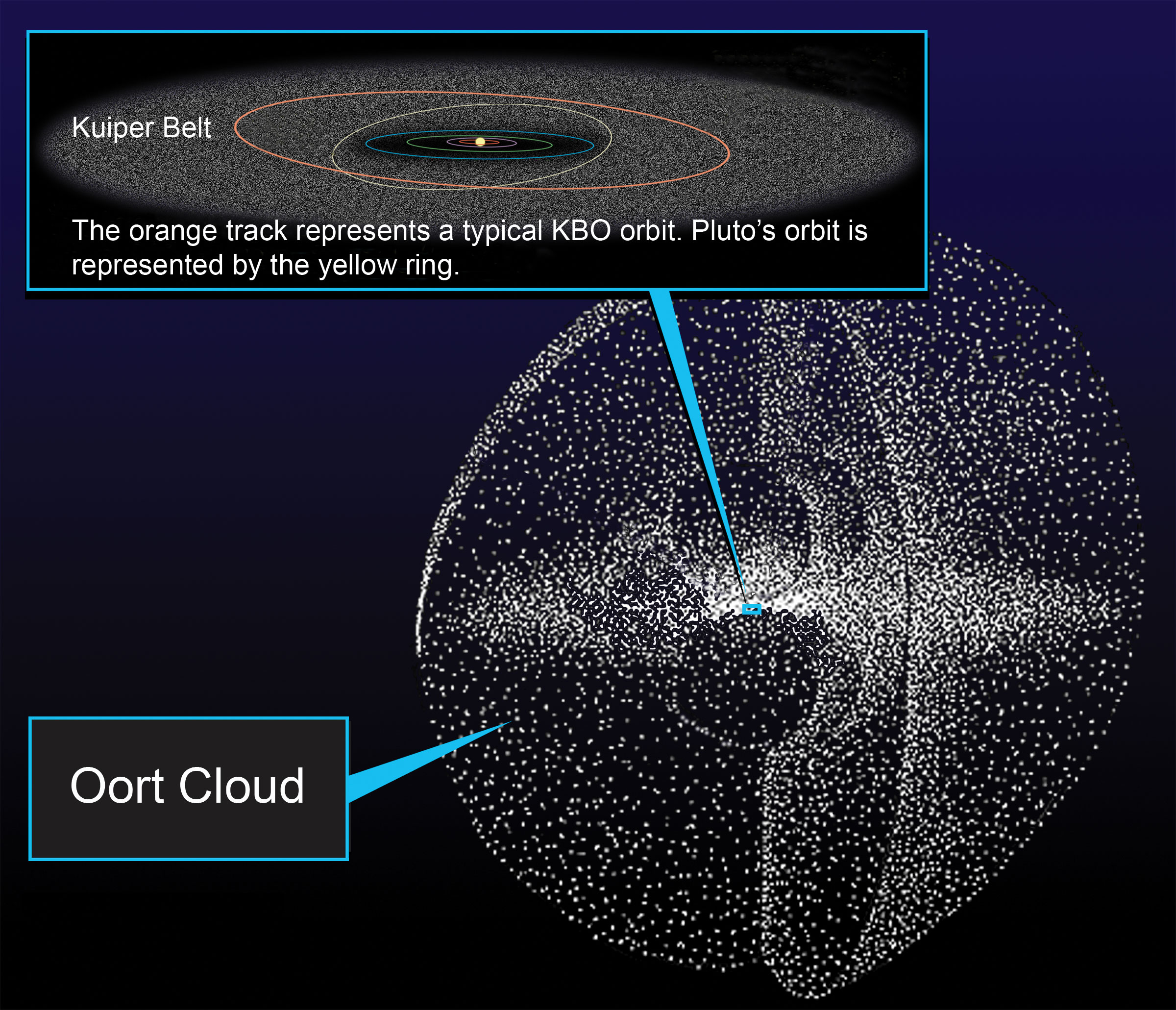
The observable solar system can be divided into three regions: the rocky planets including the Earth and asteroids of the inner solar system, the gas giant planets, and the icy Kuiper Belt objects, which include Pluto. The Kuiper belt stretches from beyond Neptune, which is at 30 astronomical units (one astronomical unit, AU, represents the distance between the Earth and the sun), to about 50AU.

Sedna and 2012VP113 are strange objects, because they reside in a region where there should be nothing, according to our theories of the solar system formation. Their orbit is well beyond that of Neptune, the last recognised planet of the solar system, and even beyond that of Pluto, which differs from planets because of its size, unusual orbit, and composition. (Pluto, once considered a planet, is now considered the lead object of a group of bodies called plutinos.)

The closest Sedna, which is 1000km-wide, gets to the sun is about 76AU and for 2012VP113, which is 450km-wide, that distance is 80AU. Their orbits are also at weird inclinations compared to most other solar system objects.

The results of the discovery have been published in Nature. Chadwick Trujillo of Gemini Observatory in Hawaii, who was also involved in finding Sedna, and Scott Shepherd of the Carnegie Institution for Science, who found 2012VP113 with Trujillo, propose that these objects are members of the inner Oort cloud.

The Oort cloud is a hypothetical region that is thought to stretch outwards beyond the Kuiper belt. Beyond 5000AU, the Oort cloud expands out into a sphere centred on the sun. We have no direct evidence that the Oort cloud exists, but indirect evidence comes in the form of comets with extremely elongated orbits.
Oort_Cloud

Stephen Lowry at the University of Kent said: “The orbital properties of these two objects are so very different from that of the Kuiper belt objects that it wouldn’t be wrong to suggest they may be part of the inner Oort cloud.”

The fact that these objects exist is remarkable, since they exist in a region where material is thought to have been too sparse for them to form. Current thinking is that they actually formed in the giant-planet region, and that their orbits may carry the signature of whatever events caused them to scatter to such distances. It is hoped that this discovery will lead efforts to find other objects.

David Rothery of Open University said: “This is a remarkable discovery, but it is not entirely surprising. When they found Sedna, there was hope that they would find others in that region.”

But the fact that it took Trujillo, who was involved in the original team that found Sedna, more than ten years to find Sedna’s neighbour speaks to the challenge of discovery. “The farther you get from the sun, the less sunlight falls on these objects, which makes the task of locating them harder,” Lowry said.

“Worse still,” Lowry continued, “the eccentric orbits of these objects means that there is very tiny window in which they can be observed from even the most powerful telescopes on Earth. What is needed to find these objects is not just technology but persistence.” For example, Sedna gets as close as 76AU away from the sun, but at its farthest it is nearly 1000AU. Its orbital period is about 11,400 years, which means it spends lots of time too far out to be detected.

While 2012VP113 and Sedna provide some information about the inner Oort cloud, to say any more, scientists are going to need more than two data points. Next generation instruments such as the Subaru telescope in Hawaii and Large Synoptic Survey Telescope in Chile may hold the answers.The Conversation

First published on The Conversation. Images by NASA.

Are all of WhatsApp’s 55 employees millionaires now? Not just yet

Facebook has just acquired the mobile messenger service WhatsApp for US$19 billion. Launched in 2009 by two former Yahoo employees, in just over four years WhatsApp has grown to 420m monthly users.

Why is it so popular? Founder Jan Koum told the New York Times in 2012, “We are providing a richness of experience and an intimacy of communication that e-mail and phone calls simply can’t compare with.”

Facebook has been pushing its own messenger service to its users, but without much success. Markos Zachariadis at Warwick Business School, said, “Facebook’s purchase of WhatsApp is in many ways an admission of defeat.”

The explosion in the number of smartphones in recent years has also seen a boom in instant messaging services. Popular services such as WeChat, Line and Viber each have more than 100m users. WhatsApp tops that chart in not just number of users but also engagement. With the per-day volume at 19 billion messages sent and 34 billion received, the messaging service will soon trump the total global SMS volume.

According to Sotirios Paroutis, also at Warwick Business School, Mark Zuckerberg is out to make Facebook a truly mobile company with Instagram and WhatsApp. “In the past WhatsApp founders have been vocal in their objection to be acquired by a larger firm. So beyond their own reward package, the promise to keep WhatsApp as an independent service seems to have helped bring the two parties together,” he said.

Show me the money

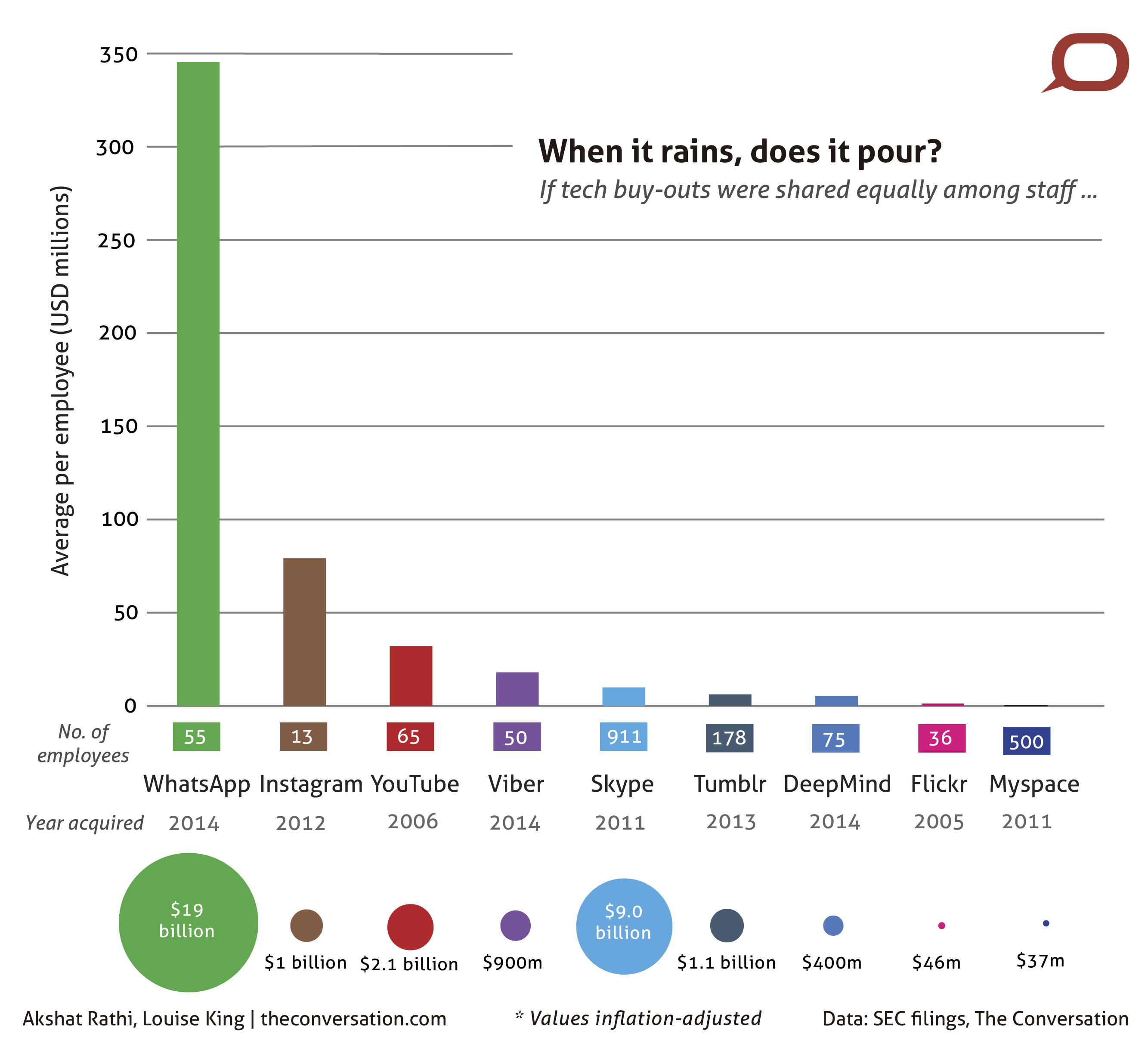
With only 55 employees, WhatsApp’s $19-billion valuation could, in an alternate universe where each employee was given an equal share, fetch US$350m per employee. This is nearly five times what employees of Instagram would have got when that company was bought out for US$1 billion in 2012.

WhatsApp8-01

While founders take away big chunks of the proceeds from such deals, with so few employees the windfall can still make many others rich. But in some cases, like that of Skype’s acquisition by Microsoft, the unequal distribution can leave employees with nothing. Worse still, Felix Salmon at Reuters points out that because of the way these deals are structured, employees can do little to fight back.The Conversation

First published on The Conversation. Image credit: janpersiel.

After 400 years, mathematicians find a new class of shapes

The works of the Greek polymath Plato have kept people busy for millennia. Mathematicians have long pondered Platonic solids, a collection of geometric forms that are highly regular and are frequently found in nature.

Platonic solids are generically termed equilateral convex polyhedra. In the millennia since Plato’s time, only two other collections of equilateral convex polyhedra have been found: Archimedean solids (including the truncated icosahedron) and Kepler solids (including rhombic polyhedra). Nearly 400 years after the last class was described, mathematicians claim that they may have now identified a new, fourth class, which they call Goldberg polyhedra. In the process of making this discovery, they think they’ve demonstrated that an infinite number of these solids could exist.

Platonic love for geometry

Equilateral convex polyhedra share a set of characteristics. First, each of the sides of the polyhedra needs to be the same length. Second, the shape must be completely solid—that is, it must have a well-defined inside and outside that is separated by the shape itself. Third, any point on a line that connects two points in the shape must never fall outside of it.

Platonic solids, the first class of such shapes, are well-known. They consist of five different shapes: tetrahedron, cube, octahedron, dodecahedron, and icosahedron. They have four, six, eight, twelve, and twenty faces, respectively.

Platonic solids in ascending order of number of faces. nasablueshift

These highly regular structures are not just mathematical constructs; they’re also found in nature. For instance, the carbon atoms in a diamond are arranged in a tetrahedral shape. Common salt and fool’s gold (iron sulfide) form cubic crystals, and calcium fluoride forms octahedral crystals.

The discovery of Goldberg solids comes from researchers who were inspired by finding interesting polyhedra in work that involved the human eye. Stan Schein at the University of California in Los Angeles was studying the retina when he became interested in the structure of protein called clathrin. Clathrin is involved in moving resources inside and outside cells, and in that process it forms structures that adopt a handful of shapes. These shapes intrigued Schein, who came up with a mathematical explanation for their formation.

484px-Conway_polyhedron_Dk5k6st

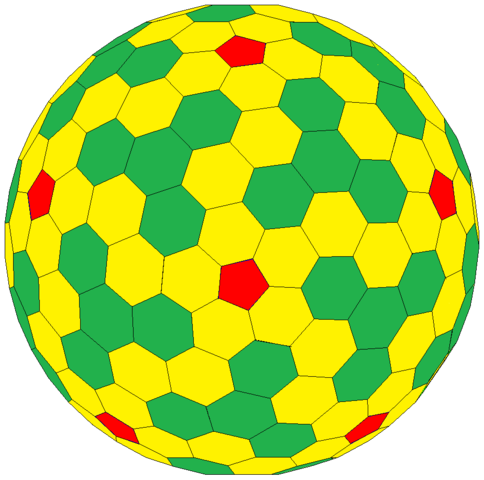
During this work, Schein came across the work of 20th century mathematician Michael Goldberg, who described a set of new shapes that have been named the Goldberg polyhedra. The easiest Goldberg polyhedron to envision looks like a blown-up soccer ball, as the shape is made of many pentagons and hexagons connected to each other in a symmetrical manner (see image to the left).

However, Schein thinks that Goldberg’s shapes—or cages, as geometers call them—are not polyhedra. “It may be confusing because Goldberg called them polyhedra, a perfectly sensible name to a graph theorist. But to a geometer, polyhedra require planar faces,” Schein said.

So Schein and his colleague James Gayed decided to examine whether Goldberg-like shapes could form actual polyhedra. A new paper in PNAS describes a fourth class of convex polyhedra that they want to call Goldberg polyhedra, even if the name would confuse others.

dzy7x8r4-1392312064

A crude way to describe Schein and Gayed’s work, according to David Craven at the University of Birmingham, “is to take a cube and blow it up like a balloon”—which would make its faces bulge (see image to the right). The challenge for Schein and Gayed is to keep the inflation from causing the shape to break the third rule: no point on a line that connects two points in that shape can fall outside the shape.

Craven said, “There are two problems: the bulging of the faces, whether it creates a shape like a saddle, and how you turn those bulging faces into multi-faceted shapes. The first is relatively easy to solve. The second is the main problem. Here one can draw hexagons on the side of the bulge, but these hexagons won’t be flat. The question is whether you can push and pull all these hexagons around to make each and every one of them flat.”

During the bulging process, and when the bulges are replaced with multiple hexagons, Craven notes, the process will generate internal angles. One of these angles formed between lines of the same faces—referred to as dihedral angle discrepancies—will control whether or not the face is flat. Schein and Gayed claim to have found a way of making those angles zero, which makes all the faces flat. What is left is a true convex polyhedron. (It’s worth noting that in doing so, the hexagons lose their perfect shapes. They may appear warped, but at least they’re flat.)

Schein and Gayed claim that the rules they have developed to govern this process can be applied to develop other classes of convex polyhedra. These shapes will have more and more faces, and in that sense there should be an infinite variety of them.

Playing with shapes

Such mathematical discoveries generally don’t have immediate applications, although these are often found later. For example, dome-shaped buildings are never circular in shape; instead, they are built like half-cut Goldberg polyhedra, consisting of many regular shapes that give more strength to the structure.

In this case, however, there may be some immediate applications. The new rules create polyhedra that have structures similar to viruses and fullerenes, a carbon allotrope. If we are able to describe the structure of a virus more accurately, we could get a step closer to finding a way of fighting them.

If nothing else, Schein’s work may prod mathematicians to find other interesting geometric shapes, now that equilateral convex polyhedra have a new family.The Conversation

This article was first published on The Conversation. Multiple image credits here.