Psychology holds the key to solving world’s problems

If you think hard, you’ll realise the problem lies in people’s thinking. Credit: Mutiara Karina (flickr)

We have reached, in terms of technical solutions, if not a plateau, at least a point of diminishing marginal returns. The technology for cutting carbon emissions, for storing nuclear waste, for supporting forays into Alzheimer’s disease research and for taking science education to students in the developing world already exists.

In a post for the Lindau blog, Ashutosh Jogalekar suggests that, at a meeting of Nobel Laureates meant to inspire the young, there should be a place for psychologists. That is because, as he explains,

…while technological solutions can be challenging enough, changing people’s minds is a truly herculean task, often spread over several generations and entire social movements.

And this thought has often troubled me. Technology has developed rapidly in the past few centuries, but human psychology has remained the same for thousands of years.

We know today that there are certain things that humans will be predictably doing wrong. These biases and heuristics affect us all and force us to make these mistakes. Two psychologists received the economics Nobel for their work in this area and that work has have also hinted at some solutions to these problems. After all, as Ashutosh puts it,

Science and technology can only take us so far. Ultimately nothing changes until people and politicians’ thought processes change, and no number of sound technical fixes will work if people refuse to believe in their benefits and change their behavior.

Dealing with climate change is a prime example of this. For many years, there has existed the technology to do something but not the political will. The trouble is, as many have said before, even after it is too late to do something about the climate, we will be seeking technological fixes. Of course we still need to improve the efficiency of solar cells and to understand the dangers of geoengineering, but all those tweaks and minor developments will happen if, say, the world adopts carbon-trading and rewards green solutions over polluting ones.

Psychology is often looked as a soft science. In recent years, it drew attention because of malpractice of a few scientists. At the moment, though, it seems to also be one of the most powerful weapons we have to deal with the world’s problems. Yet, few look at psychology from that perspective.

Shellfish and the human revolution

About 50,000 years ago, modern humans left Africa and began occupying the rest of the world. The common thought is that a sudden growth in population caused the so-called “human revolution”, which gave birth to language, art, and culture as we know it today. Now, based on something that’s not obviously related to human culture—the size of shellfish fossils—researchers have challenged that model.

Shellfish size may disprove cause of ‘human revolution’. The Conversation, 27 June 2013. Also published on Ars Technica.

Image credit: Breville

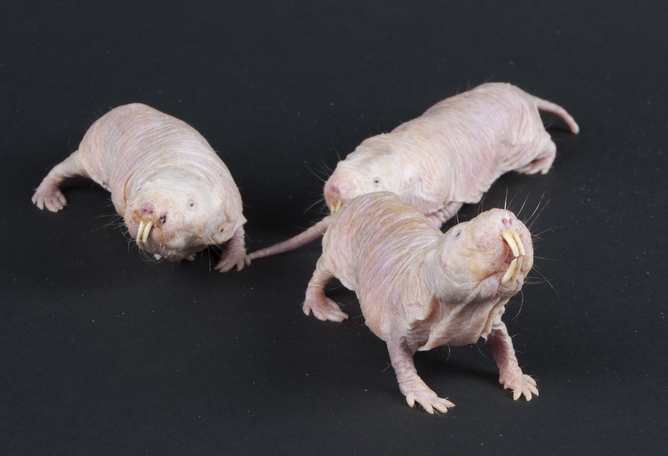
Cancer immunity of strange underground rat revealed

Researchers have discovered how one of the world’s oddest mammals developed resistance to cancer, and there is hope that their work could help fight the disease in humans.

Naked mole rats live underground, where environmental conditions are harsh but predators are few. They can live for more than 30 years, almost seven times longer than its close cousin the house mouse, which is particularly susceptible to cancer. They breathe slowly due to the limited supply of oxygen, survive on very little food, have poor sight and are largely indifferent to pain.

They are also the only mammals that do not regulate their body temperature. Because they live in colonies where the queen rat does the job of producing progeny and only a few males father the litters, their sperms become lazy.

For cancer researchers, mice and naked mole rats fall on two extremes of the disease spectrum. Mice are used as animal models of disease because of their short lives and high incidence of cancer. These help researchers study the mechanism of cancer occurrence and test drugs that fight the disease.

Naked mole rats, on the other hand, have never developed cancer in the years that they have been studied. In labs, researchers often don’t wait for their animal models to develop cancer. Instead they induce cancer by blasting the animals with gamma radiation, transplanting tumours or injecting cancer-causing agents. Do that to a naked mole rat, though, and nothing happens.

Now, Vera Gorbunova and Andrei Seluanov at the University of Rochester think that they may have found one mechanism by which naked mole rats defend themselves against cancer. Their results, reported today in the journal Nature, make for a strange tale.

While studying cells taken from the armpits and lungs of naked mole rats, they found an unusually thick chemical surrounding the cells. This turned out to be hyaluronan, a substance that is present in all animals, where its main job is to hold cells together. Beyond providing mechanical strength, it is also involved in controlling when cells grow in number.

Cancer relies on the unregulated growth of cells, so hyaluronan was thought to be involved in the progression of malignant tumours. According to Gorbunova, there are aspects of hyaluronan may regulate cell growth: as well as its amount and thickness. As a polymer, the greater the number of hyaluronan molecules in a single chain the thicker it becomes.

When the molecular mass is high, cells are “told” to stop increasing in number. When the molecular mass is low, they are “asked” to proliferate. In the case of the naked mole rat, Gorbunova found that the molecular mass was unusually high, as much as five times that of mice or humans.

To understand whether this unusual hyaluronan was responsible for cancer resistance in naked mole rats, Gorbunova increased the amount of enzyme that degrades the chemical, reducing its molecular weight. Soon after, she observed that the rat’s cells readily started growing in thick clusters, like cancerous mouse cells do.

In a separate experiment, she also tested this hypothesis by reducing the amount of hyaluronan by knocking out the genes that encode for its production. Then on injecting cancer-causing virus, instead of resisting, the naked mole rat’s cells became cancerous.

Gorbunova thinks that having thick hyaluronan might have helped increase the elasticity of the rat’s skin, allowing it to live in small tunnels underground. This trait might then have accidentally developed a new role of preventing cancer.

Rochelle Buffenstein, a physiologist at the University of Texas Health Science Center, who has studied naked mole rats for years was pleased to see that some light has been shed on this creature’s remarkable resistance to cancer. “As we learn more about these cancer-resistant mechanisms that are effective and can be directly pertinent to humans, we may find new cancer prevention strategies,” she said.The Conversation

First published at The Conversation.

Image credit: Smithsonian National Zoo