India and endosulfan: A bitter harvest

India’s response to the ill-effects of a toxic pesticide has been slow and inadequate

Endosulfan, a pesticide, has been poisoning villagers in India over the past two decades. Its use has caused physical and mental ailments among thousands of children and adults and deaths of many hundreds. In 2011 India agreed to ban endosulfan, and, more recently, it offered compensation to its victims. But now it is falling short to keep both those promises.

The pesticide, once commonly used, damages the central nervous system and causes hormonal changes in mothers and babies. It leads to many birth defects including cerebral palsy, a condition that causes physical disability. Worse still, it lingers in the environment without degradation, leading to its accumulation in the food chain and causing lasting ill-effects.

Commitment to ban?

In 2011 at the Stockholm Convention 128 countries, including India, added endosulfan to the list of pollutants that they agree to phase out of use. Following India’s commitment at Stockholm and after years of effort by the Democratic Youth Federation of India, a non-governmental organization, in May 2011 the Supreme Court banned the use of endosulfan in the country but allowed its exports to exhaust remaining stocks. At present India has 2000 tonnes of the pesticide and raw materials enough to make a further 4000 tonnes of it. As international demand for the pesticide has plummeted, the government has been forced to dispose this stash.

In July, because the Indian government was not ready to foot a $40 million bill for the disposal of endosulfan’s raw materials, it asked the Supreme Court to lift the ban on making the pesticide. In November the Supreme Court’s expert committee requested giving in to this demand. Citing that the treaty that Indian signed allows it up to six years to phase out endosulfan, so it could allow endosulfan’s manufacture and use without breaking its commitment. This recommendation was made even though the committee accepts that endosulfan is harmful to human health.

Sadly, endosulfan remains popular among farmers too. Manufacturing of the pesticide, if allowed, will be greeted with strong demand. Before the ban, India was the largest producer and consumer of endosulfan. It is cheap, easily available and curtails a variety of pests. For those unaware of its environmental consequences, there is little reason to not use it.

Studies show ill-effects of endosulfan use across the country. Kerala is the worst affected state. A 2012 state report linked the pesticide to 4000 afflicted and 700 deaths, many of whom suffered the fate because of aerial spraying over nearby cashew plantations. In some villages 50% homes have a child or an adult with severe disabilities.

In May the Kerela government, based on the recommendations of the National Human Rights Commission, agreed to pay compensation to the victims of endosulfan in Kerela. The amount varied from Rupees 300,000 ($5,500) to 500,000 ($9,500) depending on the victim’s suffering. But despite protests in September and December, the government has only paid 101 out of the 2453 victim families.

The request to allow manufacturing of endosulfan exposes the government’s inability to dispose the raw materials. If undisposed, the chemicals lie in poorly maintained warehouses. A task force setup to inspect one such warehouse in Periya, Kerala, after locals complained of foul smell, found endosulfan leaking from rusted steel drums. The warehouse also lacked storekeepers, fire safety equipment and first-aid kits, posing a serious threat to nearby villages and water bodies.

Endosulfan rehabilitation project, setup by Kerala last year to help the afflicted, started an operation to deal with such cases. Their first task was to contain the leaking drums. They are now hoping to get help from the government for disposal and detoxification, said Mohammed Asheel, the project officer.

Far too little, far too late

Pratibha Patil, former President of India, promised to double public spending on health care to 2.5% of the GDP by 2017. Among its first steps is a $5 billion free drugs plan, the implementation of which began in October. Surely then the Indian government can, apart from preserving the ban, also afford to stop poisoning its own people for a mere $40 million and also compensate those already poisoned.

Image from here.
Cancer drugs: Refusing to die

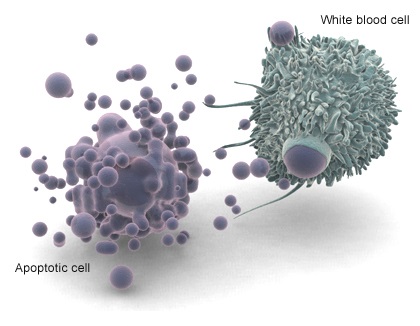
Suicide is a part of life. Whenever any of the 100 trillion or so cells that make up the human body malfunction, which happens all the time even in healthy tissue, they are programmed to provoke their own death. The mechanism hinges on a protein called TRAIL, which is produced by the damaged cell and binds to receptors on its surface, causing inflammation. That is a signal for the immune system to sweep in and, through a process called apoptosis, break down the damaged cell and recycle its parts to feed healthy ones. If this self-destruct is subverted, however, the result is a tumour.

When TRAIL’s tumour-suppressing ability was first discovered in 1995 researchers hoped that by discriminating between cancer cells and healthy ones, TRAIL would do away with the debilitating side-effects associated with traditional treatments like radio- and chemotherapy. These are good at destroying tumours but also cause lots of collateral damage. Unfortunately, it turned out that simply injecting a synthetic version of the molecule into the patient’s body provoked only a limited immune response in a handful of cancers.

That, says Joshua Allen from the Pennsylvania State Cancer Institute, was because people assumed that cancer’s subversion of TRAIL consisted merely in halting the molecule’s production within the cell. It turns out, however, that cancerous cells also suppress their TRAIL receptors, so no amount of synthetic TRAIL sloshing about would ever be enough. What you need, Dr Allen reasoned, is something to reboot the TRAIL-producing pathway within cells as well as to unblock their TRAIL receptors. Only then would the immune system be spurred into action.

So he and his colleagues sifted through a library of molecules maintained by America’s National Cancer Institute and found a molecule, called TIC10, whose biochemistry seemed to fit the bill. When enough of these molecules accumulate in a cancer cell, they activate a protein called FOXO3a. This binds to DNA and flips on many biological pathways, including those involved in the TRAIL mechanism that lead to the immune-system alerting inflammation.

As Dr Allen and his colleagues report in Science Translational Medicine, tests in mice with brain tumours confirmed the biochemical hunch. Murine subject given TIC10 lived twice as long as those that received no treatment. The drug also worked for lymphoma, as well as breast, colon and lung cancers. And it did not seem to cause the wasting side-effects typically associated with chemotherapy, suggesting that it can indeed tell cancer cells from healthy ones. As an added bonus, TIC10 is small compared to TRAIL, and cheaper to concoct than the complex protein is.

Last year Dr Allen secured a $1.3m grant from Pennsylvania’s department of health to begin clinical trials. These will be carried out in collaboration with Oncoceutics, a drug company. Nine out of ten promising molecules which work in mice fail in humans, so “Cure for cancer” headlines must wait. If TIC10 does live up to its promise, though, it would make one killer app.

First published on economist.com.

Image from here

The art and science of remembering things

Review of Joshua Foer’s Moonwalking with Einstein, as part of my #100bookschallenge.

Moonwalking with Einstein is the story of a journalist who went to cover the 2005 US Memory Championship as an assignment for an article, and then went on to win the 2006 event. He got so obsessed with the people and their achievements that he decided to try it out himself. In that one year he with trained by men which by normal standards would be called freaks of nature. They could memorise the order of a deck of cards in under 30 seconds or 800 random digits in 15 minutes (full list of records).

Foer interspaces his year with the history and science of memorising. He walks the reader through the time when poets committed to memory the works of other poets so that it could be passed down the generations. There is a record Socrates’s outrage on the use of writing and the amount of stress that was given on memory training during the time before the printing press. But Gutenberg’s invention was the final nail in the coffin for those memorisers, because common people could then start to rely on books as an external form of memory.

memory palaceSince Gutenberg there were some attempts at renewing this lost art, but it wasn’t until the likes of Tony Buzan in the late 20th century that it finally happened. Buzan built an industry around the tools and methods of increasing one’s memory, and even founded the World Memory Championship. He sold improving memory as being akin to increasing intelligence.

And although IQ scores do not depend on the use of one’s memory, there is still a good case to be made for putting in the effort to expand it. After all, new ideas are only mashed up versions of old ones. However much easy it has become to store our memories in external devices, without internalising them once again they are useless.

There is now a large community of people who use these age-old techniques (and comes up with new ones) like that of filling memory castles with outrageous images to help them commit to memory things like lists, random numbers, binary digit sequences, decks of cards, poems etc.

This is what Foer trained himself to be able to achieve, and eventually won the US competition for it. What Foer convincingly demonstrates through the book, based on scientific research and his own experience, is that expanding one’s memory is only a matter of deliberate practice.

What Foer achieved is no mean feat. But, at the end, despite being a great story, Foer’s increased memory does him little good in his daily life where paper, computers and cell phones can often handle the task better. Sure he can memorise many phone numbers, lists and even complete poems with relative ease, but he still carries with him his dictaphone and notebook. And although he doesn’t say this explicitly, it seems his memory expansion was only for things that are well-defined, clearly laid and can be written down in lists.

Image from here.