The big questions

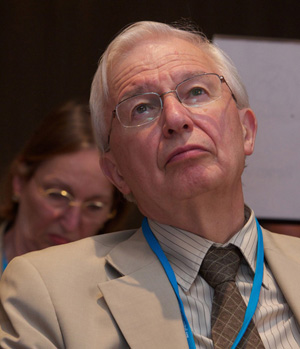
Jean-Marie Lehn shared the 1987 Nobel Prize in Chemistry with Donald Cram and Charles Pederson for their development and use of molecules with structure-specific interactions of high selectivity. He is more commonly known as the father of supramolecular chemistry. In the lecture that preceded this interview, he tried to explain the importance of supramolecular chemistry. “Chemistry is a bridge between Physics and Biology. It tries to explain how complexity arose from particulate matter”, he said with conviction.

Interview with Jean-Marie Lehn: Chemistry is trying to answer the biggest questions – Nature Lindau, 15 July 2010

Organocatalysis: A new era in chemical synthesis

Some time ago Oxford was host to a brilliant chemist, Prof. D.W.C. MacMillan of Princeton University. He delivered the Vertex Lecture at the Department of Chemistry speaking on ‘New concepts in Catalysis’. His research interests are in the area of Organocatalysis, or the use of small organic molecules to catalyze organic transformations, a new immerging field in enantioselective molecule synthesis. Simply put, it is the use of environmentally friendly and easily available chemicals to carry out reactions at normal conditions of room temperature and atmospheric pressure to create chemical bonds at a specific position and in a specific direction.

What is more special about this field apart from its scientific value and environmental friendliness is that in the period of 1998 to 2008 more than 1500 manuscripts described use of organocatalysis in more than 150 discrete reaction types. A remarkable number given that there were no reports of such catalysis in the year 1995 and on an average chemistry produces only a handful of new reaction types a decade. This field has taken the synthesis community by a storm.

It is interesting to look at these facts as they provide insight into how scientific communities can bypass an important research area for decades and then suddenly embrace it with fervent enthusiasm. MacMillan says in an essay in Nature, “It is hard to answer why a field was overlooked for so long. One perspective is that it is impossible to overlook a field that does not yet exist which is similar to the thought that scientists cannot work on a problem they haven’t found.”

And why was there such rapid growth in research in this area? Primarily, the field offered real advantages to researchers and industry and at an easy and low cost of carrying out such reactions in laboratory. Reactions were being discovered everyday which were able to replace use of organometallic systems which are expensive, toxic and sensitive to air or moisture. Organic molecules are generally insensitive to air or moisture, small chiral molecules can be derived from nature, thus are readily accessible and cheap to prepare, the by-products are non-toxic and environmental friendly. It is also widely recognized that during large scale production of chemicals the removal of toxic catalyst-related impurities from the waste stream can often have a large financial impact. All these factors led to rapid growth and increased competition in the area of organocatalysis, which in turn accelerated the pace of innovation and discovery.

Apart from MacMillan’s large contribution to the field in terms of new chemistry, there is one contribution which he particularly boasts of and that is, naming this field: Organocatalysis. So, what’s in a name? He answers, “Consider the success of the terms nanotechnology at globally shifting the visibility and perception of areas of research. Organocatalysis provided a strong identity and helped unify a fledgling field by attracting attention of the broader chemical synthesis community.” These reactions are similar in mechanism to the ones catalysed by enzymes, which are much more complex molecules than the one used under the term organocatalysis. These discoveries and innovations have brought chemists one step closer to be able to outwit nature. Very rarely in the history of science does a whole new field emerge that not only has the potential to change the way things are done today but also the ability to grow so quickly.

Reference: MacMillan, D. (2008). The advent and development of organocatalysis Nature, 455(7211), 304-308 DOI: 10.1038/nature07367

Further reading: ReviewReactionsNature Insight

A Chemist’s carbon footprint reduction

As a synthetic chemist, it is a very embarrassing question if asked about our personal carbon footprint. Frankly, it is much greater than normal citizens. We use flammable and non-flammable solvents very regularly. Most of the chemical reagents we use are of 99.9% purity requiring large amounts of energy to manufacture and purify. These chemicals are shipped from all over the world and require extra care in transportation. We often use rare metals in reactions, these require a great amount of energy to isolate. Yes, we are guilty of a larger carbon footprint than normal citizens. But no one asks how can we reduce it?

This question bugged me for quite sometime. We can do all those things that normal citizens do but as chemists can we do something more? One of our major contributions come from our use of solvents. I thought, looking into solvent disposal might give a hint into some simple steps that may be taken to reduce emissions. So I had a chat with our department‘s Safety Officer. He started the conversation with a very blunt question, “Why do you ask?”. May be he thought, I am one of those extreme climate change activist. After I explained to him what I wanted to know about it and that I meant no harm he said, “I was taken aback because no one wants to what happens to it after it’s dumped.” So he realised some people care and he was happy to answer any question I had.

One of the companies Oxford regularly uses for it’s waste disposal is Grundon. While we are in the lab, we separate our solvent waste in Hydrocarbons (Petrol, Diethyl Ether, Ethyl Acetate), Chlorinated (Dichloromethane, Cholroform) and Acetone (Wash acetone with lots of water). Chlorinated wastes needs to be disposed by incineration to avoid formation of dioxins where as hydrocarbon can be used for energy recovery. But what he thought is that the HC waste is used to create the high temperature furnace for the incineration of chlorinated waste. What about acetone? He said, “Most of it is taken by cement industry. If they see it’s dark in colour they won’t touch it, but otherwise they use it.” But is recycling not possible for any kind of waste? “No, I think it’s too energy intensive to get clean solvent than to just burn it off.”

He digressed and gave some interesting statistics, Oxford University produces a lot of waste. The only chemistry department that has comparable volume of waste is Cambridge. “Sure, but that’s because we are the biggest chemistry department in the UK, right?” Yes he says, “I talk to most Russell group universities about what they do about waste management. It turns out some universities don’t produce more than two barrels a month! And here we fill couple a day.”

Anyways, ending the talk I said, “So the best we can do is make sure we separate the different types of solvents with care?”. “I guess, but I don’t think that will make a big difference unless everyone does it.” From all this, the conclusion I could come up with is that we can do the following to help cut emission in someway.

  • Minimise use of chlorinated solvents. (even though DCM is my favourite, low-boiling and polar)
  • Try not to mix chlorinated and non-chlorinated solvents. (I often rinse column tubes with DCM even if I have done a hydrocarbons only column. I guess using ether is a better option but it is much more expensive than ethyl acetate. Thus, although acetone (not wash acetone) is high-boiling it is the best option or use ethyl acetate?).
  • Turn the temperature of the oven lower?
  • Do smaller scale reaction when one can (reduces a lot of things, smaller columns, less solvent and lesser time for same results, most of the times).
  • Spend time thinking which experiment to do, make sure you have a strong justification (saves time, saves waste!)

These are conclusions based on my experience and the very little data that I have gathered. I am hoping to look into it a bit further and try and collect some hard statistics on this issue. If anyone has anything to add to this, I would be really happy to hear from you.