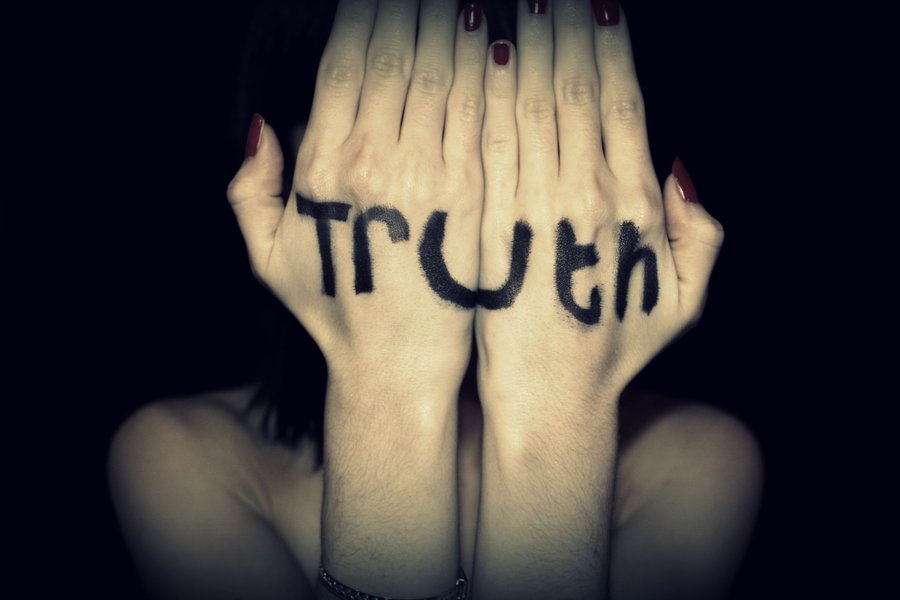
The trouble with self-deception

I recently argued that becoming a strategic self-deceiver is difficult but worth the effort. In the article that led me to this thought, David Brooks argued those who weren’t entirely honest when it came to self-narratives led impressive lives. My aim, as always, has been to understand how to use this knowledge to help us.

This idea of self-deception has in some form or the other been on my mind since I first wrote about it. To be frank, it has been a troubling thought. We can lead lives where we are able to successfully hide the truth from our own selves – isn’t that messed up?

As a scientist, my life is a pursuit to uncover truths about the world. It’s my day job and when one spends a large part of their life doing just that, it can be very troubling to realise that inside my own head I maybe tucking away truths that I am already aware of!
The self-deception paradox

Philosophers argue that one can not try to convince oneself of something being false when they know that it is true i.e. one cannot be successful at self-deception.

Here, of course, they are assuming that the person is trying to deceive themselves consciously. I argue that most self-deception occurs unconsciously and that’s why self-deceiving is not just possible but to a certain extent easy.

The helpers of self-deception

What aids self-deception is that we aren’t perfectly rational beings. Our thought process is flawed, of course, but beyond that even the machinery that runs it is far from perfect. We are the victims of our own biological shortcomings.

In the Seven Sins of Memory, Daniel Schacter shows that human beings have a remarkable ability to mess with their own memories. We don’t just forget things but are also able to create false memories and selectively block some memories. When so much of our lives are built on our past, I shudder to think that the memories that are the foundation of the building called me may not really be ‘true’ memories.

When both my rational self and the knowledge of the world that I hold are being questioned, it’s not hard to see why exploring self-deception has been a troubling experience.

Photo credit: Annek
Living under an illusion

Sure, I’d like to change the world. Expecting that I will is plain wrong though!

All my life I have had different things that motivated me to do what I have done. But for the past few years, a constant driving force for the choices I make and the work I do has been the impact that those choices and work have on the world. Unfortunately, I have been self-deceiving myself into believing that what I am doing has or is going to have a measurable impact on the world.

For past three years I have been working on synthesising a large chunk of an even larger molecule. The way I put it to ninth graders, recently, was that I am attempting to stitch  atoms together in a very restricted manner. I am using the technology that chemists have developed over the past two hundred years to produce something in the lab that nature took millions of years to do. Sounds cool and it is.

And yet, when I finish writing my thesis I am not sure if it will be read by more than a handful chemists in its lifetime. The paper that will eventually be published in a reputed journal may be read by a few hundred chemists around the world and a small percentage of them may even cite my work.

A total of ten man-years of work, including three years of my work, and ~£1 million of tax-payers money will have what impact on the world of chemistry or on the world in general? Maybe nothing and maybe a lot, I don’t know.

This blog is very shortly going to reach the 100,000-hits mark since it was brought back to life in June 2009. What impact my writing has had on the world? I don’t know.

Some people will bring a small stone to the building called science and some people will bring a big one, but nevertheless no one can take that stone away from you.” These words by the Nobel laureate Jean-Marie Lehn’s, may soothe my scientist soul and may be I can find such words to do the same for my writing soul. But I cannot deny that walking into something thinking it will make a measurable impact on the world is a little foolish.

Looking back at one’s activities one may be able to understand what is the ‘impact’ those activities have had, but looking forward it is incredibly hard to do be able to predict that impact. But such is human nature that, as someone venturing in to a new area of work, I find it hard to be able to convince and motivate myself to keep working hard if I can’t see the impact of that work.

I posed this as a question to someone who has been working in sustainability for the past 10 years after having switched from a successful career as an accountant. The answer I got was an obvious one, but I think I needed to be told. He said, “The world is incredibly complex. One may never really be able to understand the impact of one’s work and, in this case, the only piece of advice I can give to you is something that won’t be satisfying. Learn to let go off the expectations and you will find it simpler to deal with the world and keeping doing the incredible work that you are doing.”

Knowing this is one thing, applying it to my life is another.

Related: It should be about choices not goals

Learning from religion

Alain de Botton gave a very interesting talk at TED. He tried to do what few dare – mix religion and atheism. He called for Atheism 2.0. There’s lot of food for thought in his talk but I’ve decided to do something new with situations like this one. To the many ideas that got thrown at me, I am going to apply my two ideas deal. According to that deal, I am going to share one idea from the talk that I feel very convinced about and one idea that I felt completely repelled by.

Repetition is a necessity

Botton claims that in a secular world we are taught lessons once and are expected to remember them for a life time. Instead, religion understands that our minds are like sieves and they expect us to repeat important life lessons over and over again.

I feel convinced with this idea. Religious or not, people tend to make very similar mistakes in their lives over and over again. I am sure you’ve come across older people who seem to make the same common mistakes that we young people make. This phenomenon has made me wonder many times whether our ability to learn drops so sharply as we grow old that we need to make those mistakes again to remember the lesson we’ve learnt already before.

It seems that Botton’s claim holds a good explanation for this phenomenon and moreover, it also makes me think about a better way of keeping a track of life lessons. It seems to me that as an atheist and a rationalist, I would benefit from something like a self-written guide to good living. A document that I can keep tweaking as I go ahead in life but also something I can refer to on a regular basis to refresh the many important lessons that I’ve learnt.

I also believe that the key to better living is forming better habits. This ‘guide’ could be used to help form these key habits.

Bringing dogma to education

Botton’s thoughts on how university education should be restructured by learning from religion repel me. He claims that currently universities around the world treat us as rational adults who need information and data to be able to understand how to live a good life. Whereas, all major religions treat us as children. Religions believe that ‘we are only just holding it together’ and that we need help. He says that we should bring back sermon style teaching where words are meant for changing lives and not just for giving information.

This idea repels me because, in short, what he is requesting us to do is going to bring dogma to education. Universities are places where people come to learn from their own experience rather than get told what is that they should do. They face opposing ideas and must learn to be able to draw their own conclusions.

The world is a very complex place and not even the combined knowledge of all religion, philosophy and science can yet, accurately enough, set guidelines of how to live a good life. It is definitely much better to let people figure out whether they need help rather than overwhelm them with ‘help’ that Botton thinks is the right help for them.

Best of the two worlds

I am not against the notion that there are certain things that religion does well and that it may well be possible to have the best of the two worlds. Yet, I think that the best of two worlds will be different for different individuals. A one-size fits all isn’t the way forward, and Botton accepts that too.