The virtues of restlessness

As a kid I was infamous for my mischievousness and the ability to not get tired. More often than not my parents’ visits to friends or family ended with apologies for my pranks. I got told off many times, but it made little difference. There was just so much to do and so little time.

My mum tells me that there was a point where she didn’t know whether her love for me was making her too soft. That she feared that wasn’t doing a good enough job in making sure that I behaved as most kids of my age did. That by then she should have been successful at instilling some civility in my actions. But it hadn’t happened. My restlessness was baffling my parents.

I don’t think I have changed much since then. Of course, I am lot more civil now. But I am still very restless. The only thing that has changed is that I have become aware of what it means to be restless. After realising that I could do little to reduce my restlessness, I started thinking of ways in which I could harness the power in someway. Now I think I’ve managed to do that, at least to a certain extent.

Today my restlessness helps me achieve many things. The simplest one is when I know I should stop doing something. In any activity there comes a point beyond which being involved in it is usually a waste of time. It is a tricky thing to know when that point comes. But somehow, over many years, I have found that when I notice my mind getting restless, it is probably the time to take notice of whether what I am doing is useful or not

Restlessness also forms the very basis of the creative process for me. For instance, when writing an article there are three stages: spark, research, writing. The spark usually occurs when I come across an idea that seems too cool to ignore. Then, if the idea hasn’t already been used by someone else, I spend time researching. It involves reading papers, gaining background knowledge, interviewing relevant people and feeding my brain with more ideas. Now before I start writing, I need to form a plan of how I am going to write that article. This is where my restlessness helps me. In my head I have this primordial soup of ideas, each struggling to make it to the top. This period is a very cumbersome yet enjoyable experience. My restlessness pushes me, and hopefully before I get exhausted I have picked out the relevant ideas and started writing the article.

One other thing that features on this blog quite often is finding sources of motivation. My restlessness, it turns out, is definitely one such source. I am rarely at peace with myself if I don’t have something that I am working on. It could be a long-term project like finding a job, or a short one like understanding a scientific phenomenon. My restlessness makes sure I have something to care for all the time and that helps me wake up every morning to go out and do something I can be proud of.

Vipassana center in Igatpuri

There are limitations too, though. Before I understood how to tame this beast, it has put me in trouble many times. Even today there are times when I can’t do anything about my restlessness and I end up being utterly exhausted. Another thing I’ve had to battle is balancing my restlessness with giving up. In someway it has made me become a lot more determined at finishing things than I remember ever being.

Something that helped me learn how to maneuver my restless mind, and it won’t come as a surprise to many, was learning how to meditate. I went to a ‘vipassana shibir’, Marathi words for meditation camp, when I was about 12 years old. It happened in Igatpuri, one of the most underrated hillstations in Maharashtra, at a beautiful monastery. For three days no one at the camp spoke a single word. No writing or reading either. Everyday we spent hours meditating or thinking. Any form of communication was restricted to gestures, including living in a dorm with many kids of the same age (boys at that age end up fighting quite a lot and these fights had to be without words, too). To me it opened doors to a new world, one where my mind could be made to focus on a single point on the horizon.  (For adults they do a 10-day course of this kind. Whenever I get 10 days of free time to spend in India, this is going to be on the top of my list of things to do.)

Because being restless isn’t always a joyful experience, it forces me to seek moments of peace. For example, one of the best things about writing non-fiction is the time I spend researching. I have this freedom to dive as deep as I like into something and stay there for as long as my curiosity drives me for. I can jump from one pool to the other, and even connect them if that’s what I want to do.

Restlessness gets a bad rap. It is a double-edged sword, and, rather than fearing it, we must learn to wield it in battle. It has done wonders for me, and I am sure I am not alone.

Photo credit: wargecko

A better writer and a better thinker

This week I started my internship at The Economist. I had been looking forward to this since the day I got the offer, and it was one my strongest motivations to submit my DPhil thesis. A number of reasons made it so. But mainly it was because I knew that the few months at The Economist are going to be an exercise in becoming a better writer and a better thinker.

Becoming a better writer may be obvious. The Economist is a very well-written newspaper, and, if I am to write for it every week, I have to better my game. But a better thinker?

Yes and here’s an analogy to explain it: When I first came to Oxford, I had just finished four years in the Institute of Chemical Technology, Mumbai. Coming to Oxford was a shock to my system in many ways. I was in a foreign country, surrounded by people from all over the world, I was moving from a taught course into research, I was going to live in a house with three girls rather than a hostel full of boys, etc. But one of things that most stood out in all those new things was that all the students at Oxford did not study chemical engineering. Actually, they studied more subjects than I could keep a count.

Exeter college, which is a very welcoming place, made sure that in the first week we had as many social engagements as were physically possible. It forced me, pleasantly so, to mix with students from many subject areas. Over the next four years, a lot of my thinking was shaped by interacting with these students.

I expect my time at The Economist to do the same for me all over again, and do it better. Even though it is only a few months, because the paper (as it is referred to in-house) writes with a single voice (if you aren’t aware, The Economist has no byline), it will force me to confront my views a lot more than I had to at Oxford. When I say ‘single voice’, I do not mean that all the writers have the same opinion, but that they arrive at one through a lot of debate. If I am to write about something, I need to be prepared to defend my stance or find something that I can defend.

Here’s what I learnt:

The start of a new week at the paper is on a Friday because that week’s paper goes to print on a Thursday afternoon. The first Friday-morning meeting is one where people float ideas for the next week to their section editors (Business, Finance, Britain, etc.), but mainly the aim that day is to think about leaders (opinion pieces) for next week. The section editors then take those ideas to the next meeting, which happens in the Editor-in-chief’s office.

Both these meetings go on for quite sometime. Especially, the second one. Leader ideas are thrown on the table and then dissected. Although most of the talking happens in between the section editors, the deputy editor and the editor-in-chief, many other people contribute. I got told on the very first day, “If you have an opinion, at The Economist you will have plenty of opportunity to air it.” It’s true. Even those writing for the science section question a finance leader and those writing for the Britain section question a leader about the Libyan election.

After a quiet weekend, Monday starts with longer versions of the Friday meetings. More discussions follow but this time they are more concrete. After all, the deadline to wrap-up the paper is only two days away i.e. Wednesday night. People use Monday afternoon and Tuesday to do the research, interviews, reporting, and on Wednesday there is a lot of back and forth between writers and editors as they polish their stories.

The working hours are very flexible, the people are very warm and the 12th floor office has a great view of the city. I got told more than once that The Economist is a weekly newspaper, which means that the stories have to have more than just ‘news value’. Not just well-written, but it also needs to be a well-analysed and entertaining story.

The week

For me, it was an unusual week. Monday through Wednesday, the science and technology team was working from home, in what was an experiment. And as it happened, I ended up being at a conference on Thursday and Friday. So although I didn’t get to interact very much with the team I am going to be working in, I got to meet a lot of other writers.

This is not to say that I did not work. Apart from attending the conference, I attended the ‘Welcome to The Economist‘ talk, ‘How to be a journalist’ talk, got trained on the necessary software, made new friends and wrote two articles, which depending on what the editors think may or may not get published (PS: I will be posting what gets published here).

Finally, I won’t be boring you with what happened at The Economist every week (for that you should read the paper). But, as always, I will write whenever I have something worthy to share. Like the ad below:

The humble lexicographer

I’ve previously written about my opinion on seeking work with the aim of making an impact on the world. I believe that, while considering career options, that criterion must be given weight, but not too much. This struck me when I realised that, in my own search for a career, I had been focusing on making an impact more than I should have, and it was causing me distress.

Any attempt to change one’s belief systems, even if the change is minuscule, requires a certain amount of persistence. Changing one’s perspective, although not quite as drastic as learning the rules of physics all over again, needs sustained efforts. To be able to bring about the change, as my maths teacher once said while teaching calculus, requires that the idea to be drilled into your head.

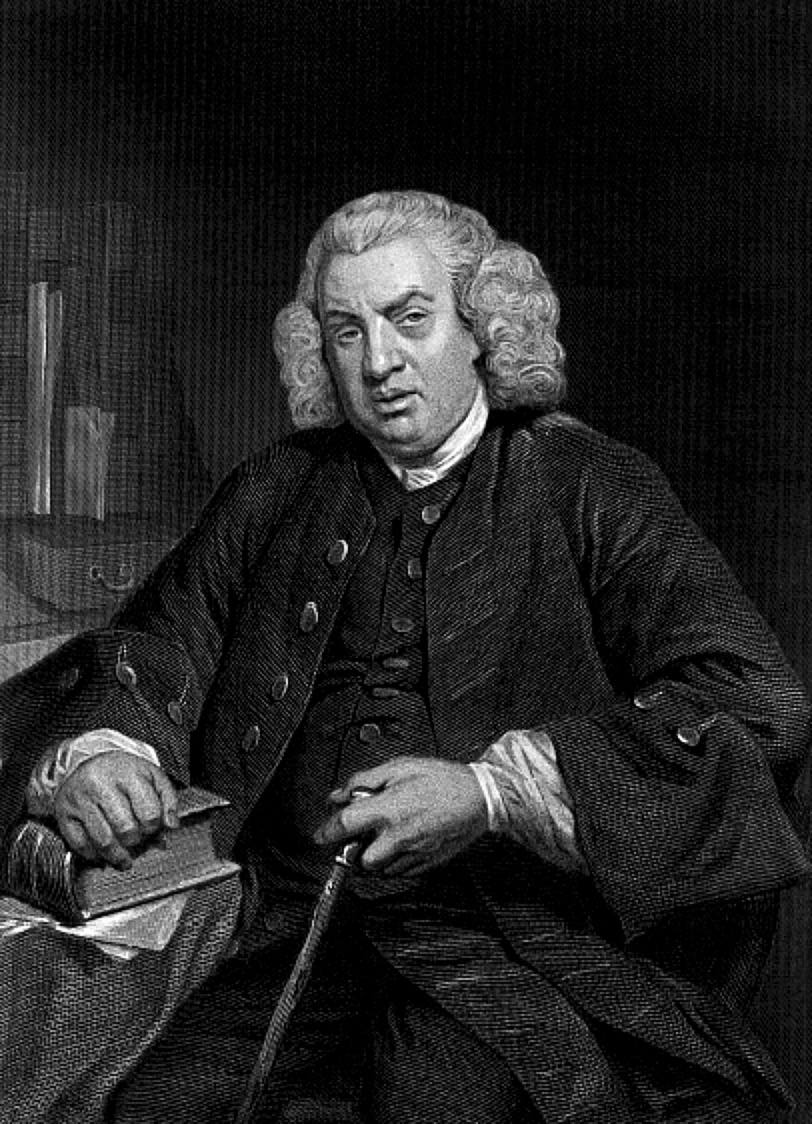
Samuel Johnson

In an attempt to do that, I am going to try and share some stories from the past about people who believed in doing the work, regardless of the impact it would eventually have on the world. The first story is that of Samuel Johnson, who produced the first reliable dictionary of the English language.

The first dictionary of the English language was written by an English schoolteacher in 1604, with 2500 words in it. But in 1741, David Hume lamented that the language has been neglected by scholars, and there is no ‘Dictionary of our Language’, probably because what was was published till then was merely a ‘word-book’, not a dictionary in the true sense of the word.

Oxford English Dictionary says a dictionary is: A book which explains or translates, usually in alphabetical order, the words of a language, giving for each word its typical spelling, an explanation of its meaning or meanings, and often other information, such as pronunciation, etymology, synonyms, equivalents in other languages, and illustrative examples.

In the early 18th century, there seemed to be a number of dictionaries, but none that could set as the ‘standard of our language‘. In 1746, Johnson was contracted to write a dictionary. Despite not having completed his formal education at Oxford (because of lack of funds), he had proved himself to be a master of the English language and to be proficient at many others. He promised to complete the project in three years, which was a promising a little too much, given that the French, who had recently completed a dictionary of their language, had forty scholars working on it for forty years.

Such was the importance of the dictionary at the time that Oxford University awarded Johnson a Master of Arts degree in anticipation of the work. He worked tirelessly with only a few assistants, who were employed for mechanical work, and completed the task in nine years to produce the Dictionary.

Although Johnson was aware of the importance of his work, in his preface to the dictionary, he wrote:

Of the event of this work, for which, having laboured it with so much application, I cannot but have some degree of parental fondness, it is natural to form conjectures. Those who have been persuaded to think well of my design , require that it should fix our language, and put a stop to those alterations which time and chance have hitherto been suffered to make in it without opposition. With this consequence I will confess that I flattered myself for a while; but now begin to fear that I have indulged expectation which neither reason nor experience can justify. When we see men grow old and die at a certain time one after another, from century to century, we laugh at the elixir that promises to prolong life to a thousand years; and with equal justice may the lexicographer be derided, who being able to produce no example of a nation that has preserved their words and phrases from mutability, shall imagine that his dictionary can embalm his language, and secure it from corruption and decay, that it is in his power to change sublunary nature, or clear the world at once from folly, vanity, and affectation.

He died in 1784, less than 30 years after the publication of the Dictionary, and would not have known that, for the next 150 years, his dictionary would remain the English-language standard.