A bigger bang

A new hybrid explosive is safer to handle but still powerful

Modern warfare involves plenty of new technology, from pilotless drones to powerful computer networks and satellite sensors. But the explosives which are used in battle were invented a long time ago. The two most commonly deployed belong to a class of organic chemicals called nitramines. One, RDX, is also widely used in industrial applications like mining and demolishing buildings. Its use as an explosive began in the 1920s. HMX, a related compound and one of the most powerful explosives, dates back to the second world war. Both are sometimes used with trinitrotoluene, a different type of compound more commonly known as TNT. It is over 100 years old.

A good explosive needs to be extremely powerful but not too sensitive to avoid its being detonated accidentally, such as by dropping it. These can be conflicting properties. As Alex Contini of the Centre for Defence Chemistry at Cranfield University in Britain points out, explosives developed in recent years are either too sensitive or too expensive for large-scale use.

One such explosive is CL-20. This was developed by the American navy as a rocket propellant, a substance which involves the sudden release of energy by rapid oxidisation, in effect a controlled explosion. CL-20 is more powerful than RDX and HMX, but its higher sensitivity means that it also explodes more easily.

The most common way to desensitise an explosive is by mixing it with a non-explosive material, such as wax or paper. Although that works, it also reduces the amount of bang you get. What if the desensitising material is itself an explosive of lower sensitivity? The problem is that the resulting material is as sensitive as its most sensitive component.

Adam Matzger of the University of Michigan and his colleagues have discovered a way around that problem by using a process called co-crystallisation, which is commonly used by drugmakers to modify the physical properties of a pharmaceutical. They report in Crystal Growth & Design that by mixing CL-20 in such a way they have been able to lower its sensitivity but retain most of its explosive power.

At the heart of the process is the formation of crystals, an ability endowed to some materials by nature. Crystals are the result of molecules arranging themselves in a regular pattern extending in all three dimensions. Sometimes two crystalline materials that do not react with each other can be mixed to form a so-called co-crystal. To do that they are both dissolved in a common solvent, then left alone to crystallise together. Because the arrangement of molecules within the co-crystal is very different from the original crystal, it modifies the physical properties of the material—in this case CL-20’s sensitivity.

Dr Matzger made a co-crystal consisting of two parts of CL-20 and one part HMX. The hybrid explosive has nearly the same explosive power as CL-20 but the lower sensitivity of HMX. Because the process of crystallisation can be scaled up relatively easily, Dr Matzger, whose work was funded by America’s Defence Threat Reduction Agency, thinks this new explosive could make a bigger bang soon.

First published in The Economist. Also available in audio here.

References:

  1. Matzger et alCrystal Growth & Design, 2012
  2. Matzger et alAngew Chem Int Ed, 2009

List of references here. Free image from stock.xchng.
Medical technology: A silent healer

Researchers have developed novel ways to tap the pharmacological potential of an infamous and deadly gas

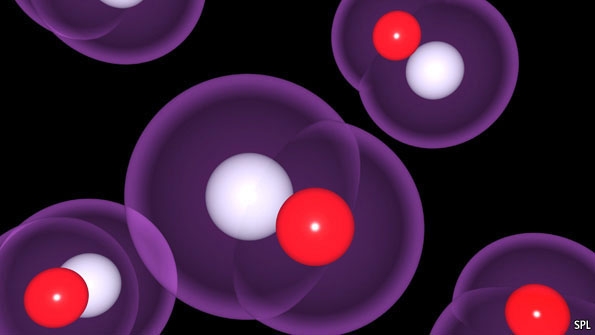
Carbon monoxide gets a bad rap. The gas, produced by incomplete combustion of hydrocarbons, causes hundreds of deaths every year by poisoning and sends many thousands to hospital. Most of these are the result of leaking cooking and heating equipment, but the colourless, odourless and tasteless substance, known to chemists as CO, has also aided many a suicide. Most horrifically, Nazis used it in gas chambers.

But there is more to the “silent killer”, as CO is sometimes called. It is produced by many cells in the human body, where its molecules play a crucial role in activating enzymes involved in controlling the dilation of blood vessels, and thus blood flow. Mice in which the gene for producing the compound has been knocked out develop faulty organs and die young.

Exploiting this insight, researchers have successfully used CO to treat a number of ailments in lab animals. These include pulmonary hypertension, an otherwise incurable disease in which thickened arteries obstruct the flow of blood, leading to heart failure. The gas can also keep inflammation in check, in particular after organ transplants.

Frederick Montgomery and Duncan Bathe think they have come up with a way to hit the sweet spot. Their Coke-can-sized gizmo, which they devised while working at Ikaria, an American drug firm that both have since left, contains a cartridge of pressurised CO, a tube to deliver the gas to the patient’s nose, and a few buttons to set the required dose. A sensor connected to a nozzle at the end of the tube constantly measures the patient’s breathing rate and adjusts the amount of CO dispensed with each breath. Safety features, including automatic shutdown if anything seems amiss, are meant to eliminate the risk of CO overdose and ensure that none leaks out, endangering others.

Scientists at another American pharmaceutical company, Sangart, meanwhile, have been encasing the gas—or, strictly speaking, CO-ferrying haemoglobin—in a polymer pouch. Kim Vandegriff and her colleagues have been using polymer wrappers a mere nanometre (a billionth of a metre) across. These can be designed to break open only where their payload is needed. Early trials have shown promise in treating sickle-cell anaemia, a disease caused by a faulty haemoglobin gene.

Unlike most drugs, CO is not broken down by the body. Instead, once its job is done, it is transported to the lungs and exhaled. As a result, it produces no side-effects. Given the right dose, then, it can heal silently, too.

First published on economist.com. Also appeared in The Economist. Also available in audio here.

A list of main references is here. Image credit: The Economist

Chemical warfare: Gas-guzzling paint

New kinds of paint for military vehicles can detect, absorb and neutralise gases in a chemical-weapon attack

Although there has been no large-scale use of chemical weapons since the Iran-Iraq war in the 1980s, armies need to be prepared for the threat. Part of that preparation means being able to decontaminate people and equipment that have been subject to attack.

The suits and masks worn by soldiers can, if necessary, be thrown away once used, but heavier and more expensive equipment, such as vehicles, cannot be treated in such a cavalier fashion. It needs to be cleaned. At the moment, that is usually done by sloshing it with a solution of hydrogen peroxide. This works, but lugging the stuff around is a nuisance—and so is disposing of it once it has been used. Instead, Britain’s Defence Science and Technology Laboratory, working in collaboration with AkzoNobel, a paints company, proposes to do the job with special paint.

As is often the case with paint jobs, the new anti-chemical-weapon paint needs an undercoat and a top coat. The top coat contains silica gel, an absorbent material that can suck up nerve gas and stop it getting inside a vehicle. This upper layer is available in standard camouflage colours, such as yellow (for deserts) and green (for jungles). The undercoat is made of a polymer that acts like the glue on a Post-it note. It is, in other words, sticky enough to hold the top coat in place, but easily peeled away when that is desirable. If a vehicle gets contaminated its paint can thus be scraped off and dumped by a bunch of squaddies. It can then be repainted without difficulty.

The next stage, currently still in the laboratory, is to develop coatings that change colour when they absorb toxic chemicals, thus alerting soldiers in the area that they are under chemical attack. The details are secret, but a system which responds to mustard gas has been devised, and others are under development. After that, the plan is to modify the coating so that it not only absorbs noxious chemicals, but neutralises them. A group of researchers at the University of Vermont, led by Christopher Landry, have already managed to combine silica gel with a vanadium catalyst to produce a mixture that oxidises mustard gas, rendering it harmless.

In the future, then, military paint will not only hide vehicles from prying eyes, it will also help protect them from one of the most feared forms of attack. The ecstasy of fumbling that follows the cry of “Gas!” may thus become a little less panic-stricken.

First published on economist.com. Also appeared in The Economist. Also available in audio here.

References:

  1. Halabja gas attack in 1988 – BBC
  2. AkzoNobel and DSTL patent
  3. Christopher Landry’s paper – J. Am. Chem. Soc.

Image credit: The Economist