Solar wind and space dust create new source of water

Water ice is the most abundant solid material in the universe. Much of it was created as the byproduct of star formation, but not all. John Bradley of Lawrence Livermore National Laboratory and his team may have discovered a new source of water in our solar system. His lab experiments reveal that the solar wind may be creating water on interplanetary dust.

The sun ejects high-speed charged particles in all directions. Bodies in the inner solar system get bombarded by this wind of particles, which continuously varies in intensity.

Small bodies, such as dust particles or tiny asteroids, can be eroded by these harsh winds. Larger bodies that do not have an atmosphere, such as the Moon, are bombarded by both the solar wind and tiny meteorites. This form of bombardment causes a phenomenon called space weathering. (Atmospheres protect planets from tiny meteorites, while a magnetic field can deflect solar winds.)

The lunar dust brought back by the Apollo missions showed for the first time the result of space weathering—though not immediately. A careful examination of the dust returned from the lunar surface had to wait until the 1990s when scientific instruments became good enough. When finally observed under sufficiently powerful microscopes, the dust particles revealed what have been called “rims.”

These dust particles are usually made of silicates—compounds of silicon, oxygen, hydrogen and few metallic elements. The rims are the result of chemical modification of the surface of the particle, caused by high energy impacts and the continuous bombardment of the solar wind.

The modification leads to an imbalance in the chemical structure of the particle, sometimes loosening the bonds holding oxygen and hydrogen atoms in the silicates. This made scientists speculate that there is a chance that water could be formed somewhere in these rims .

Water needs two atoms of hydrogen and one of oxygen. If silicates provide one atom of each element, then only one more hydrogen atom is needed. Conveniently, hydrogen atoms are available in abundance in the solar wind, where they are found as high-energy protons (hydrogen atoms stripped off their electrons). If the conditions are right, this charged hydrogen atom can react on a dust particle’s rim to form water.

Plausible as this seems, past attempts to find water on these rims gave mixed results. The problem was that the reactions were happening at such tiny scales, and instruments weren’t good enough to unambiguously detect water.

That’s where Bradley’s work comes in. The team attempted to locate water using a highly-sensitive method of analysis called valence electron energy-loss spectroscopy. The method involves exposing a sample to a beam of electrons that, on hitting the material, will get deflected at different speeds. The deflection and the speeds can reveal how much energy was lost by the electrons in the process, which is based on the type of atom it hits. The instrument can identify the composition of a material at very small scales, just enough for Bradley to analyse silicate rims.

The best way to determine whether water forms on silicate rims is to do these experiments on the types of silicate material that exist in space. Bradley did this by using three types of these minerals: olivine, clinopyroxene, and anorthine. These were exposed to charged hydrogen and helium particles, which were a proxy for the solar wind.

If water is formed by the solar wind, it would only be found in the samples that were exposed to hydrogen—not in those exposed to helium. And that is what happened. As reported in PNAS, Bradley’s sensitive tests repeatedly found water, but only in the samples that were bombarded by hydrogen.

Martin McCoustra at Heriot-Watt University in Edinburgh finds the work convincing. He said: “I am not very surprised that water could be formed on silicates. However, now that they have shown that it can, it could be an important source of water.”

Bradley’s work implies that water molecules must have been forming for billions of years on interplanetary dust particles, on the Moon, and possibly on asteroids. However, McCoustra warns that “This source of water, albeit new, won’t be able to account for a large proportion of water in the solar system. Most of that water was formed during the process of star formation that our sun went through.”

Some have argued that water-rich comets planted water on our planet. But McCoustra reckons that a single-source is unlikely. And this study provides another potential source for the material that helps make our planet habitable.The Conversation

PNAS, 2013. DOI: 10.1073/pnas.1320115111First published at The Conversation.

Ten tiny places that have their own domain names

Claiming to be a country is an easy task. But to make others accept your claim is a lot harder. Aspiring states need favours from great powers, or sometimes even celebrities, to establish their legitimacy. In the digital age, this starts with wanting a top-level domain name, such as the “.in” suffix for India.

The Scottish National Party, which is rooting for Scotland’s separation from the UK in a referendum to be held this year, launched a campaign in 2008 to get Scotland its own top-level domain name. After five years, the International Corporation for Assigned Names and Numbers (ICANN), a consortium that controls these suffixes, agreed to setup the “.scot” suffix.

As Nina Caspersen, who studies the politics of unrecognised states at the University of York, wrote on The Conversation this week, states such as Somaliland and Transnistria start by setting up websites where they claim to be “independent and democratic”. However, with websites ending in “.com” or “.org”, respectively, their claims look weak.

These countries would have had better luck had they been dependent regions to start with, because ICANN assigns domain names to dependent regions if they apply. That is why, although there are the 206 sovereign states (of which 11 are not recognised by the United Nations), there are 255 country-code domain names.

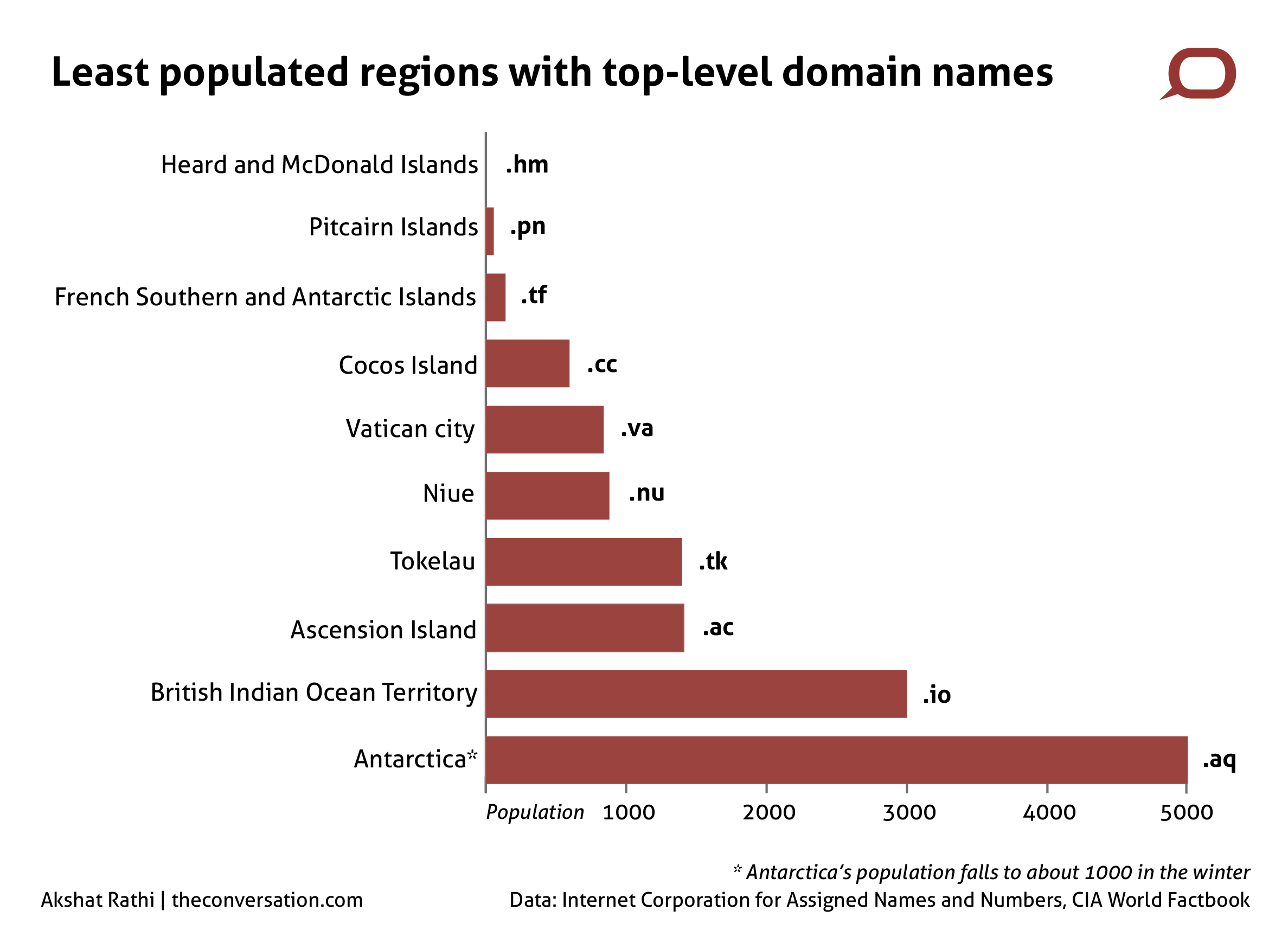
This can go too far. For example, Heard and McDonald Islands, a dependency of Australia in the Indian Ocean, has its own top-level domain name, “.hm”, even though its population is zero, and its official website uses Antarctica’s top-level domain name, “.aq”. And it’s not alone.

Here is a list of the ten least populated regions with their own top-level domain name:

Bar chart-01

First published at The Conversation.The Conversation

New cyber-attack model helps hackers time the next Stuxnet

Of the many tricks used by the world’s greatest military strategists, one usually works well—taking the enemy by surprise. It is an approach that goes back to the horse that brought down Troy. But surprise can only be achieved if you get the timing right. Timing which, researchers at the University of Michigan argue, can be calculated using a mathematical model—at least in the case of cyber-wars.

James Clapper, the director of US National Security, said cybersecurity is “first among threats facing America today,” and that’s true for other world powers as well. In many ways, it is even more threatening than conventional weapons, since attacks can take place in the absence of open conflict. And attacks are waged not just to cause damage to the enemy, but often to steal secrets.

Timing is key for these attacks, as the name of a common vulnerability—the zero-day attack—makes apparent. A zero-day attack refers to exploiting a vulnerability in a computer system on the same day that the vulnerability is recognized (aka when there are zero days to prepare for or defend against the attack). That is why cyber-attacks are usually carried out before an opponent has the time to fix its vulnerabilities.

As Robert Axelrod and Rumen Iliev at the University of Michigan write in a paper just published in the Proceedings of the National Academy of Sciences, “The question of timing is analogous to the question of when to use a double agent to mislead the enemy, where it may be worth waiting for an important event but waiting too long may mean the double agent has been discovered.”

Equations are as good as weapons

Axelrod and Iliev decided the best way to answer the question of timing would be through the use of a simple mathematical model. They built the model using four variables:

  1. Cyber-weapons exploit a specific vulnerability.
  2. Stealth of the weapon measures the chance that an enemy may find out the use of the weapon and take necessary steps to stop its reuse.
  3. Persistence of the weapon measures the chance that a weapon can still be used in the future, if not used now. Or, put another way, the chance that the enemy finds out their own vulnerability and fixes it, which renders the weapon useless.
  4. Threshold defines the time when the stakes are high enough to risk the use of a weapon. Beyond the threshold you will gain more than you will lose.

Using their model, it is possible to calculate the optimum time of a cyber-attack:

When the persistence of a weapon increases, the optimal threshold increases—that is, the longer a vulnerability exists, the longer one can wait before using it.

When the stealth of a weapon increases, the optimal threshold decreases—the longer a weapon can avoid detection, the better it is to use it quickly.

Based on the stakes of the outcome, a weapon must be used soon (if stakes are constant) or later (if the stakes are uneven). In other words, when the gain from an attack is fixed and ramifications are low, it is best to attack as quickly as possible. When the gain is high or low and ramifications are high, it is best to be patient before attacking.

How to plan the next Stuxnet

Axelrod and Iliev’s model deserves merit, according to Allan Woodward, a cybersecurity expert at the University of Surrey, because it fits past examples well. Their model perfectly predicts timing of both the Stuxnet attack and Iran’s counter to it.

Stuxnet was a worm aimed at interfering with Iran’s attempts to enrich uranium to build nuclear weapons. So, from an American perspective, the stakes were very high. The worm itself remained hidden for nearly 17 months, which means its stealth was high and persistence was low. According to the model, US and Israel should have attacked as soon as Stuxnet was ready. And indeed that is what seems to have happened.

Iran may have responded to this attack by targeting the workstations of Aramco, an oil company in Saudi Arabia that supplied oil to the US. Although the US called this the “most destructive cyber-assault the private sector has seen to date,” it achieved little. However, for Iran, the result mattered less than the speed of the response. In a high stakes case, the model predicts immediate use of a cyber-weapon, which is what happened in this case, too.

Although the model has been developed for cyber-attacks, it can be equally effective in modeling cyber-defense. Also, the model need not be limited to cyber-weapons; small changes in the variables can be made so that the model can be used to consider other military actions or economic sanctions.

Just like the atomic bomb

Eerke Boiten, a computer scientist at the University of Kent, said: “These models are a good start, but they are far too simplistic. The Stuxnet worm, for example, attacked four vulnerabilities in Iran’s nuclear enrichment facility. Had even one been fixed, the attack would have failed. The model doesn’t take that into account.”

In their book Cyber War: The Next Threat to National Security and What to Do About It, Richard Clarke and Robert Knake write:

It took a decade and a half after nuclear weapons were first used before a complex strategy for employing them, and better yet, for not using them, was articulated and implemented.

That transition period is what current cyber-weapons are going through. In that light, the simplicity of Axelrod and Iliev’s model may be more a strength than a weakness for now.The Conversation

First published at The Conversation. Image credit: usairforce