It’s ok if the Spirit dies

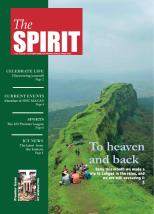
The very first issue: October 2006

As a student in the third-year of my undergraduate degree, with a few friends, we brought to our Institute a bi-monthly newsletter called The Spirit. It was an attempt to give a platform to the students to voice their opinions, explore their interests, develop good writing and editing skills but most of all it was an attempt to have fun doing something interesting. If the newsletter were still in print it would have been in its sixth year of publication. But like everything that is born, it will die…

While I worked on the newsletter, we spent many many hours putting little things in place. There used to be some special kind of energy that I derived from working on it. Not just while I was there but even after having left the Institute. Believe it or not, I followed up on the progress of the newsletter till last year, its fifth year. Whenever I had a chance, I used to speak to the team working on it. Of course, all the work was done by the particular team but it gave me tremendous pleasure that our baby was still being looked after and I was always ready to do what I could to help them in some way. But the signs of it’s ‘death’ were visible.

Things had started to change as soon as I had left. The teams that came did not seem as motivated as the teams I had the pleasure to work with. They had new ideas which was great but implementation of those great ideas, more often than not, did not happen. The co-ordination amongst the teams fell quite rapidly and it was not hard to see why the number of issues being printed kept falling till finally in its fifth year the students decided to make it an online-only publication.

One of the reasons that I was very keen to keep it going was because we had made a promise that we will ensure that it will go on. We weren’t allowed by our faculty members to start a newsletter until we had thought of how we would be able to sustain students’ efforts to keep it going in the future. We were also told that we had to find our own money to get it printed. For the first two years, we managed alright. It was hard work but the enthusiasm of the team and the response we got from the readers made the effort worthwhile.

I don’t know what went wrong. I wasn’t there to watch what happened. Sure I spoke to people but there wasn’t a clear reason. Money was a concern but it wasn’t a big enough worry because one way (Institute’s backing) or the other (contributions from alumni) it could be tackled. The lack of motivation might have been the biggest reason. Looking back I think our team was so motivated because we had made public commitments and also because we were the guys who started it. The responsibility combined with the thrill allowed to us to go that extra-mile.

Amongst the other reasons, of course, could be what has been one of the most difficult questions that the print media faces today. People spend more and more time reading online than in print. (I probably pick up a newspaper once in a month!) When we started the Spirit, it was the time when internet was becoming cheap enough to afford a personal connection in your own room in the hostel. I imagine that now everyone has their own in the Institute. Of course, the move to making it an online-only publication should have worked then, no? But it hasn’t. Or so it seems.

Moreover, the Spirit unlike Manzar or Sportsaga (both inter-collegiate events of ICT which I believe are still going strong) was not a one-off ‘event’. So a team of ten people had to work round the year to sustain the newsletter as opposed to a team of fifty or more people who worked for a few months to make the events happen (I am not trying to undermine the work put in to make the events happen but merely commenting on the sustained efforts needed for the newsletter).

I suppose once the team that had started these things had left, the main motivation for students to keep doing anything would be the value they get out of doing it. Value in learning new skills, in having fun while doing it, in making new relationships and, of course, adding to the CV fancy titles that come with doing these things. In that respect, all these activities taught people how to manage people and relationships, how to market/sell what you are doing, how to be responsible for your actions, etc. But one unique advantage of working on the Spirit as opposed to other activities was that the students would develop the critical skill of writing and editing.

Many of those at this esteemed Institute will one day be leaders in their own fields and one way or the other will have to learn how to communicate effectively using written words. In my opinion, the sooner that skill is developed the better it is. But may be that isn’t a priority for the students in the Institute anymore.

You may be wondering where am I going with this. Well, I brought up this issue today because of two reasons. First, I wanted to put down in words my experience of working on the Spirit so that if by chance in the future someone decides to bring it back to life (even under a different name) there will be something that they can read about and may be do it better than we did.

Second, I am now ready to close this chapter of my life and wanted to do it justice by giving it the respect that it deserved. The Spirit meant a lot to me (as it must to the teams that worked on it), I learnt a lot of time on it during those days. Whatever little writing that I do today, I know that the Spirit played a key role in making that happen. As such, I feel a little hurt that I am closing the chapter much sooner than I wanted to. In our days while working on an issue of the Spirit, we used to talk about coming back to the 10th anniversary celebrations of our graduation and still finding copies of the Spirit. I don’t think that will happen but I hope I am proved wrong.

***

Don’t believe a word I say. See for yourself what people had to say about The Spirit:

M Sriram: Hope you and your team are able to come up with the second issue rising to the higher expectations which your first issue has triggered.

Raghavendra Ravi: I saw “The Spirit” It is very nice.. UDCT has changed a lot. In our times ( sorry to sound old – 1975-78 ) such thing were not easy. Though the notice board journalism was on.

Prashant Mullick: Surprisingly fresh! It was interesting that H(B)ollywood figured in a substantial number of stories. Overall a nostalgic eclectic mix of UICT news and social topics. I enjoyed it. Hope to see you guys continue putting this together.

Smita Lele: UD – UG = Body – Spirit!!!!

In other words UG’s are the fire, the electricity in the UD environment
and the knowledge pool created by PGs and research will loose its charm
without bright UGs who are the star personalities at this young age.
Let me share a secret of UD’s research story — why most of the UD
teachers want to combine teaching and research and do not want to be only
full time researcher in any National or International Research lab? The Undergraduate teaching charges the battery of the researcher’s mind
and intellect and keeps him (her) young at heart!

That is why I feel, UD – UG = Body – Spirit!!!! Best wishes to “spirit”.

Asmita Atre: The issue 3 has come up really well. The presentation is very attractive and I am certain that you people will continue working the same way.

Anil Nair (the guy who motivated us to start this newsletter): More than anything, it is your verve and the enthusiasm which brought Spirit to such levels. As in case of any magazine the passion tells the story. I don’t know if it is inappropriate to tell this — the first day when Akshat sat with me through the night skipping a date with his girl-friend to design Spirit, I knew where the magazine will reach. Most often, when I got the magazine I read it cover to cover. Everyone’s contribution was excellent. I am not surprised by all the accolades for Spirit. At the risk of sounding patronising I should add that the new team should keep the good thing going. Also, all of you should try to touch base with your friends in the pretext of Spirit. Friendship is more important than anything.


The problem with paper

I was browsing through the archives of this blog when it struck me that very soon I am going to be completing the 5th anniversary of Contemplation and thus, 5 years of being a blogger. It has been a pleasure to share my musings-in-solitude with the world while, in the process,  I learnt some very important lessons in the art of writing and thinking.

This little realisation took me on a new train of thoughts. I started mentally browsing the history of events that have shaped this blog: I’ve moved countries, refined my idealogies, improved my writing and made many new friends. Each of these have affected me in ways which this blog reflects quite well.

There was one more realisation though. Perhaps not a very insightful one. Over the time of these years, I realised, more and more of my writing happens on the computer screen rather than on paper. So much so that, now days, I find paper an inconvenient medium for writing.

When I first started blogging, I was still an undergraduate student. Most hours in the day were spent attending lectures where I jotted down important bits in hardbound notebooks and in the labs procedures, observations and conclusions were all noted in a lab-book. Our examination answer sheets were made of paper (!). Sure I spent a few hours in the evenings in front of the computer screen but most of those hours I either played computer games or watched some movies (social networking was yet to take over the world). So paper remained the primary raw material for writing.

My foray into writing began with this blog and the first serious venture that shaped my writing was my undergraduate institute’s newsletter The Spirit. For both the publications, I wrote on my computer using Microsoft Word and published either through the web or through a designing software (QuarkXpress). Although, the smell of the freshly printed (paper) copies of the Spirit was enchanting, paper had lost it’s place as a serious requirement for writing.

The last time I wrote over a few 100 words on paper was when I wrote a letter to my mum last week. Not because she does not do email but because I felt that writing in my own handwriting will make a stronger impact on her than sending her an email. After finishing the letter I re-read it just to make sure that it was all coherent. It was coherent and I seemed to convey the message that I intended to. But I was dissatisfied with the inability to be able to edit my own writing.

Usually, when I write, I tend to re-arrange the words, change the phrases, organise the paragraphs, expand on some idea, cut out some unnecessary flab and most of the times I do all this together. Writing on paper made that much harder. I felt my abilities were limited. And moreover, writing at the pace of thought made my handwriting look terrible.

It is not just writing though. For me paper seems to have also lost the title of the most preferred medium of reading too.

During my days in Mumbai, newspapers were cheap enough to subscribe even with the limited money that I got from my parents. I received a copy of the Times of India and Hindustan Times delivered to my doorstep in the hostel every morning. Only rarely did a day pass when the copy received in the morning wasn’t read. Someone flipped through the sports section without fail.

All the textbooks I had were big fat hardbound kilos of paper. Other non-academic reading was also in the form of cheap paperbacks or pirated copies of classics that circulated from one room to the other. Social networking hadn’t pervaded our lives as much and thus I did not read things only because it was recommended by someone (which is what I do now!).

After coming to Oxford, although we still have big fat textbooks, most of the research papers are read online. I print an article only if I am desperate. As for the non-academic reading, I rely on my twitter feed, google reader and facebook feed to give me my reading dose (and by the way, newspapers in the UK are just too expensive to buy!). Since I’ve got the Kindle, I don’t carry paperbacks any more. Actually, the Kindle has enhanced my reading pleasure, especially with its text-to-speech option. Now I prefer a Kindle book over a paperback anytime.

These days the use of paper sometimes surprises me. For example, I came across an academic in Oxford who doesn’t do email. He prefers communicating on paper by passing information through pigeon-holes (University’s internal post). No surprise he has a good handwriting because of all that practice.

Of course, paper still holds some value. I like to receive a hand-written letter or greeting card. It is still a good note-taking tool but I think EverNote is going to replace even that functionality of paper for me. And although I can’t see a future where it will be extinct, paper just seems to have too many problems.

Photo credits: rjhaffke.com

Academic writing v/s popular writing

When scientists write journal articles their main purpose is to inform the readers about the new discovery or invention that they have made. But that is not all, to be able to communicate their results they often weave a ‘story’. Journal articles consist of not just data and its interpretation but also a ‘narrative’.

General structure of a journal article:

  • Introduction: Brief background, limitations of current state of the art
  • Discussion of how the authors dealt with the problem
  • Results of their work and discussion of why they think things worked or why things were better in their research
  • Conclusion: short description of what was achieved and raise challenges for the future

Essentially, an academic paper is a lot of facts tied together in a coherent narrative. The purpose of such narrative being not to entertain the readers but to inform them effectively.

In comparison, popular non-fiction books are also a lot of facts tied together in a coherent narrative but the narrative is meant to be entertaining and compelling. The writer develops his theory by drawing on examples that the reader can either relate to or feel wowed on reading. There is a structure to the book but it is never as rigid as the structure of an academic article. The books are written in active voice as against the passive voice used in academic writing. The illustrations used are carefully chosen such that they can appeal to a large audience.

The result of such differences in the two types of writing is that non-fiction books seem to hold on to your attention for a longer time (without you feeling exhausted) than academic papers seem to achieve. In the process of informing the reader in a succinct and yet coherent manner, academics end up condensing many ideas in fewer words and causing too much information to flow in a reader’s mind.

The one idea per paragraph rule doesn’t exist in academic writing. Actually, I am surprised at how irrelevant does the idea of paragraphs seem to some academics. Many a times authors seem to create paragraphs for no good reason and also not create paragraphs when actually they should have.

There are many lessons that academic writing can take from good non-fiction authors. And similarly, there are many lessons that academic publishers can learn from book publishers but I am not here to share those ideas. Instead, today I want to talk about how can you improve your effectiveness at reading technical documents.

Note taking: Because academic papers are essentially so ‘fact-heavy’, it is a good idea to note down the important facts as you read through a paper. This essentially means that you are sifting through the facts and choosing the important ones. And even without taking notes, in your mind you are doing that sifting. Note taking only helps you further by helping you unload the brain from sifting and also remembering.

Pausing: When I am reading many papers at a time or reading about a subject in which I have to refer to many sources, I tend to take many breaks. These breaks are more a necessity than just for fun. They are necessary because I tend to feel overwhelmed by the amount of data I am taking in. The breaks aren’t like a tea break but more like short pauses. In those short pauses, I stop reading and review what I have read till now in my head (or using my notes if necessary). I try to understand if I have a coherent idea in my head yet and if not, then I try to understand what is lacking.

Ideas: More often than not, while reading an academic paper, I come across some ideas related to the subject matter that I am reading. Most of those ideas may be useless but I have found that if I note them down, irrespective of their quality, it helps me understand things faster. Note taking becomes even more important.

I think this happens because those ideas may be born out of my incomplete understanding of what I am reading. It might be that I missed out on an important factor that has caused me to think about something new. Putting those ideas on paper and then getting back to them after I have finished reading helps me understand what I was missing.

And of course, there are those rare times when the ideas are actually useful! So even if there is very little chance of coming up with a brilliant idea, it is worth noting all of them down.

Hopefully, these three points might make the whole process of reading a lot of academic papers a lot more easier than it is now and in the meantime, there is no harm in dreaming about that time when all academics will write papers like good non-fiction authors do!