Cancer drugs: Refusing to die

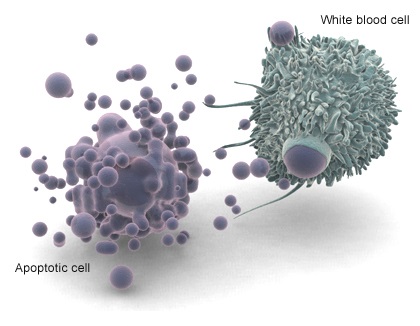
Suicide is a part of life. Whenever any of the 100 trillion or so cells that make up the human body malfunction, which happens all the time even in healthy tissue, they are programmed to provoke their own death. The mechanism hinges on a protein called TRAIL, which is produced by the damaged cell and binds to receptors on its surface, causing inflammation. That is a signal for the immune system to sweep in and, through a process called apoptosis, break down the damaged cell and recycle its parts to feed healthy ones. If this self-destruct is subverted, however, the result is a tumour.

When TRAIL’s tumour-suppressing ability was first discovered in 1995 researchers hoped that by discriminating between cancer cells and healthy ones, TRAIL would do away with the debilitating side-effects associated with traditional treatments like radio- and chemotherapy. These are good at destroying tumours but also cause lots of collateral damage. Unfortunately, it turned out that simply injecting a synthetic version of the molecule into the patient’s body provoked only a limited immune response in a handful of cancers.

That, says Joshua Allen from the Pennsylvania State Cancer Institute, was because people assumed that cancer’s subversion of TRAIL consisted merely in halting the molecule’s production within the cell. It turns out, however, that cancerous cells also suppress their TRAIL receptors, so no amount of synthetic TRAIL sloshing about would ever be enough. What you need, Dr Allen reasoned, is something to reboot the TRAIL-producing pathway within cells as well as to unblock their TRAIL receptors. Only then would the immune system be spurred into action.

So he and his colleagues sifted through a library of molecules maintained by America’s National Cancer Institute and found a molecule, called TIC10, whose biochemistry seemed to fit the bill. When enough of these molecules accumulate in a cancer cell, they activate a protein called FOXO3a. This binds to DNA and flips on many biological pathways, including those involved in the TRAIL mechanism that lead to the immune-system alerting inflammation.

As Dr Allen and his colleagues report in Science Translational Medicine, tests in mice with brain tumours confirmed the biochemical hunch. Murine subject given TIC10 lived twice as long as those that received no treatment. The drug also worked for lymphoma, as well as breast, colon and lung cancers. And it did not seem to cause the wasting side-effects typically associated with chemotherapy, suggesting that it can indeed tell cancer cells from healthy ones. As an added bonus, TIC10 is small compared to TRAIL, and cheaper to concoct than the complex protein is.

Last year Dr Allen secured a $1.3m grant from Pennsylvania’s department of health to begin clinical trials. These will be carried out in collaboration with Oncoceutics, a drug company. Nine out of ten promising molecules which work in mice fail in humans, so “Cure for cancer” headlines must wait. If TIC10 does live up to its promise, though, it would make one killer app.

First published on economist.com.

Image from here

The scale of our universe

Here is how John Cassidy explains the scale of our universe.

He instructs us to find a large open space and place a soccer ball in the center to represent the sun. He then directs us to walk 10 paces in a straight line, stick a common pin in the ground. The head of the pin stands for the planet Mercury. Then take another 9 paces beyond Mercury and put down a peppercorn to represent Venus. Step 7 more paces and drop another peppercorn for Earth. One inch away from Earth, another pinhead represents the Moon. Take 14 more paces and place a peppercorn for Mars, then 95 paces to Jupiter, and place a ping-pong ball. Take 112 paces further and place a marble to represent Saturn.

He then inquires, “How far would you have to walk to reach the nearest star, Proxima Centauri?” He instructs you to pick up another soccer ball to represent it and set off for a walk of 4,200 miles. As for the nearest other galaxy, Andromeda, he suggests, don’t even consider it!

Why memorising matters and what I’m doing about it

I hate rote learning as much as anyone can. My high school exams were a nightmare to prepare for. I detested the process of memorising facts, just so to vomit them out on an exam paper. So much so that I did not feature in the top few of my class till class 10. My teachers’ regular complain to my mum on open days at school was: “He has so much potential. He just needs to put in some efforts.”

The Indian education system made the words memorising and learning synonyms. Even during my days at one of the best engineering schools in India, I found that there were many who did much better than me because of their sheer ability to “maro ratta” (commit to memory). Ask them a critical question, one that doesn’t usually feature in an exam paper, and they would be clueless.

The UK school system is much less focused on memorising. A good portion of assessment is based on assignments done through the year. The US system, I get the impression from reading Moonwalking with Einstein, is quite opposed to memorising. I know that open-book university exams are quite common there. In the age of the Internet, it makes sense that rote learning is given as little attention as possible.

But memorising facts has an important role to play in almost all professions. For instance the more writing I do, the more I feel the need to be able to remember all the wonderful things that I read, just so that I am able to either cite them or use their ideas to develop new ones. Invention is a product of inventorying, as Joshua Foer explains.

To that end, I’ve decided that I need to take memorising seriously. So far I’ve been committing to memory without paying attention to how I do it. But as we know, to get good at something requires deliberate practice. So here is how I plan to do it henceforth.

Conceptopedia 

I’ve created my own private version of Wikipedia. It’s a google doc where I store all the information that I know related to a thing or an idea. I call it conceptopedia because, even though it’s mostly full of facts, it is a place where I externalise the memories that helped me understand a concept (hoping of course that in time I will internalise them enough to delete them from there). Example of how an entry looks: 

GM

– Science writer Mark Lynas delivered a speech in which he admitted that he made a mistake by starting the anti-GM movement. Apparently he had changed his mind much prior to the speech. He even wrote a book called The God Species praising GM in 2010.
– 1st traceable genetic modification is that from 10,000 years ago when Turkish farmers mutated the Q gene on chromosome 5A of wheat. (Ridley, WSJ, 2013)
– 50 years ago scientists irradiated the barley to create a high-yielding, low-sodium variety called “Golden Promise”. (Ridley, WSJ, 2013)
– 20 years ago scientists inserted specific sequences into rice plants to create a version that synthesises more vitamin A. They knew what letters to insert but no idea where they went. (Ridley, WSJ, 2013)
– Now precise, multiple editing of DNA is here claims Ridley. And it is being done by a private enterprise. (Ridley, WSJ, 2013)

Wherever possible, they are hyperlinked to where I got that piece of information from if I need to refer to it again. I know that this is going to be an exercise that might take quite a bit of my time, and I’m trying to build tools to make it easy. One way is to use Evernote’s Clipper add-on in Chrome (there is even an iPhone app, EverClip) to save important pieces of information with the right tags. Then once a week or so I go through the clipped bits and add them to the conceptopedia.

Mind maps

I chose to read Moonwalking with Einstein early on in my #100bookschallenge for a good reason. I want to ensure that I retain a lot more than I usually do from reading these fantastic 100 books. Normally, after a few months, I only have a vague idea of what the book was about. This time it has to be better than that.

As I wrote in the review of the book, the book gave me tools on how to remember to-do lists, phone numbers and the order in cards in a deck. Whereas what I was looking for was how to remember ideas. Foer subtly mentions that things that you often remember are things that you paid really careful attention to. If some fact blew your hat off, then you will remember it. You will also want to share it with someone which will only reinforce that memory.

mindmap

But not all facts are that amazing. So the alternative is to build mind maps. These can really work if done well, and I plan to find ways of making the most effective mind maps. The plan is to make a mind map of every article I write before writing it and of every book as I go along reading it. And of course I am planning to review each one, so that should help me synthesise that information in my head too.

What do you think about memorising? Are there any techniques you use to commit things to memory? Are there any tools for managing your notes that you would recommend?

Image from here.