Precision strike

In the last 100 years antibiotics have saved millions of lives. However, they are indiscriminate weapons: they kill useful bacteria, such as those in the human gut which extract nutrients, as efficiently as they kill the nasty disease-causing sort. Ben Feringa, of the University of Groningen, in the Netherlands, and his colleagues have devised a method to make antibiotics more selective.

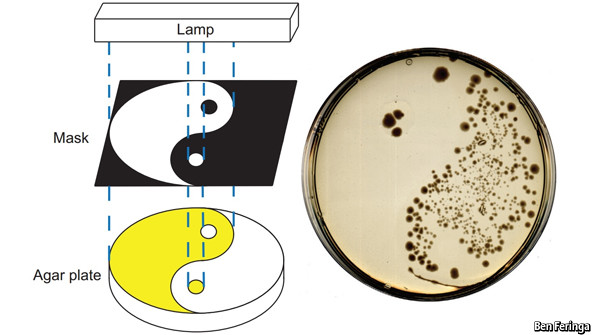
As they report in Nature Chemistry, this was achieved by slapping chemical structures called diazo compounds to a class of antibiotic called quinolones, developed to treat urinary tract infections. Different diazo compounds absorb particular wavelengths of light (it is these structures which give dyes their distinctive colour). They then added the mixture to a Petri dish containing the bacterium E. coli, shielded part of the dish and irradiated the uncovered parts with ultraviolet light. Two of the nine compounds they tested worked as hoped: whereas E. coli remained abundant in the covered parts of the Petri dish, the sections exposed to the light were almost entirely cleared of bacteria.

Crucially, in the half hour or so after exposure to the light, the diazo groups lose energy and revert to their original structure. This, in turn, switches the antibiotic off again. That way, when the antibiotic travels to other parts of the body or is excreted, it does so in its inactive form, and thus remains harmless to the friendly bacteria living in the gut. (And beyond: excreted antibiotics that make their way into sewers have been blamed for spurring the development of drug-resistant bacteria in the wild.)

The brief active window does, however, mean that Dr Feringa’s drug would only be useful in fighting localised infections, where a half-hour antibiotic raid is plenty, rather than more general ones which require a sustained onslaught. And though light can, in principle, be delivered deep inside the body using an endoscope (as happens in some cancer treatments), this is finicky and expensive in practice. As a result, light-activated antibiotics would probably be limited to easily accessible infections on the skin (in wounds, for instance) or in the mouth, ears or nose.

At least for now, that is, for Dr Feringa is working on flipping his chemical switch using sources of energy found inside the body, such as heat or certain energy-rich enzymes. If he succeeds, incidents of antibiotic friendly fire may be consigned to the history of antibacterial warfare.

First published on economist.com.

Image credit: Ben Feringa

The backtrackers

“Viewed as a geometric figure, the ant’s path is irregular, complex, and hard to describe,” wrote Herbert Simon, an American psychologist. But, he added, this is really down to a “complexity in the surface of the beach, not the complexity in the ant”. Or is it?

Ants have the animal kingdom’s biggest brains, relative to their bodies. Brains account for up to 15% of an ant’s total mass in some species (humans weigh in at a meagre 2%). This goes some way to explaining their uncanny knack for finding their way back home from foraging forays. But entomologists have, like Simon, long believed that this apparently complex behaviour is the result of sticking to a handful of simple rules. Ants keep track of distance (for example with an internal pedometer) and direction (based on the position of the sun or scent, of pheromones, for example). If they lose it, they switch to a second startegy and move in a spiral around a centre they think is the nest. If the nest is not found in the first one, then the ant increases the radius and tries another.

Now Antoine Wystrach, of the University of Sussex, proposes that there is more to ants than mindless adherence to simple instincts. As he and his colleagues report in the Proceedings of the Royal Society, at least one species of ant appears to display some hallmarks of intelligence: the ability to integrate different strategies based on experience.

Dr Wystrach captured Melophorus bagoti ants just before they reached their nests after a foraging trip and shunted them into straight tubes which led to random spots about 50 metres away. On exiting the tube, the ants invariably turned around and headed straight back in the direction of the nest. They could not be following the pheromone trail, as that was enclosed in the tube. Nor were they using visual cues: they appeared to backtrack just as well with with their eyes closed. (Cruel as it may sound, the researchers used an opaque paint to cover ants’ eyes.) In other words, the ants appeared to have some sort of internal compass.

Oddly, ants do not always use this device. When Dr Wystrach put ants into the tube when they were farther than two metres away from their nest, however, they used the two basic methods to find home. But when he repeated the procedure, but dropped the ants close to the nest for a few seconds before setting them down the tube, they backtracked just as they had in the first experiment. Backtracking, in other words, appeared to be triggered only when ants possessed a recent memory of their nest. Complexity in the ant, it seems, is a tad greater than Simon would have allowed.

First published on economist.com.

Image credit: Reverend Barry

Fathers and testicles

Father’s involvement in raising a child, on average, brings good news. It leads to lower child mortality and better social, psychological and educational outcomes. So why do some men choose not to invest in their children? According to a new study, at least part of the reason may be related to testicle size and testosterone levels.

According to evolutionary biologists, animals evolve to deal with a trade-off between mating and parenting efforts. Given finite amount of energy and time, males will spend it either searching for more mates or nurturing children. James Rilling, an anthropologist at Emory University, wanted to test whether this claim has a biological basis in humans.

Testosterone, the male sex hormone, affects behaviour. Lower levels of the hormone are associated with reduced libidos, but also with better relationships and lower risks of divorce. Reduced testosterone may suppress impulsive aggression and promote empathic response.

Testicles produce testosterone, but their main role is to make sperm. And testicle size has previously been associated with reproductive success and prediction of mating strategies. Thus, according to Rilling, testicle size could give more information about parenting behaviour than testosterone alone.

For his study, Rilling recruited 70 families to undergo an experiment. These families had a father, a mother and a child less than three years old. Mothers were asked to fill out a questionnaire about the father’s parenting skills and involvement. While recording the answers, Rilling’s team took pictures of children to show happy, sad and neutral states.

Then, the fathers were asked to give a sample of their blood to measure testosterone levels and get their brains scanned in an MRI (magnetic resonance imaging) machine while their kid’s picture was showed to them. This was to measure how much nurturing-related activity was seen in the brain when the pictures were shown. Rilling also made one more measurement using an MRI scan – the volume of the men’s testicles.

On crunching the data, as reported in the Proceedings of the National Academy of Sciences, Rilling found that lower testosterone levels and smaller testicles are correlated with better parenting and more nurturing-related brain activity among those tested.

The result is not entirely surprising. Among primates, testicle size has been positively correlated with promiscuous behaviour. Chimpanzees, for instance, are especially promiscuous and sport testicles twices as big as humans. But gorillas, known to take extra care of their young, have relatively smaller testicles.

Also before we can draw concrete conclusions in humans, a number of caveats need to be considered. “First,” Rilling said, “we are assuming that testicle size is driving parenting behaviour. It may instead be that testicles become smaller as a father pays more attention to the child.”

“Second,” Rilling continued, “testicle size may be related to genetic factors or environmental factors that we are not aware of. For example, may be boys whose fathers are absent may grow to have bigger testicles. We don’t know.”

There are other caveats. The study involved volunteers who were all married and currently in a relationship. Those who volunteered for the study may in general be more enthusiastic fathers. Peter Gray, an anthropologist at the University of Nevada, Las Vegas, also pointed out that “This is a culturally limited sample – about 70 fathers from the Atlanta area. Paternal behaviour can be quite variable around the globe.”

Nevertheless knowing how testosterone and testicle size affect parenting will help improve our understanding of how evolution affects human behaviour. It could also help develop medicinal treatments for dealing with extreme cases, say, of abusive fathers.The Conversation

First published on The Conversation.

Image credit: Gladskikh Tatiana