Quick Fix Recipe 2: Potato + Onion + Yogurt

This is part of a series on recipes that I use to fix myself a quick meal with as little number of ingredients as possible.

Ingredients:

  • 2 tbsp vegetable oil
  • 1/2 small onion
  • 300 g potatoes
  • 100 g yogurt
  • salt, Indian Spice box (red chilli, turmeric, garam masala, cumin seeds, mustard seeds)

Method:

  1. In a pan, pour 1tbsp olive oil and sauté chopped onions till they are nice and brown.
  2. In the meantime, take the potatoes and put it in a carry bag. Microwave the potatoes for 12 mins at 850W and check if they are cooked. If not, run for a few more minutes. This is probably the fastest way in which I have ever cooked potatoes. Simple, hassle-free and good results. PS: Potatoes put in without carry bag dry up and are not cooked evenly.
  3. Peel and chop the potatoes as you like. Add some salt here and mix the potatoes well.
  4. In the pan, add the salt & spices to taste (chilli first, followed by turmeric, garam masala & cumin seeds). Mix onions evenly and then add yogurt and about 50 mL water. Mix well. Add the potatoes to this mixture and stir again. Leave the preparation on medium flame for 5-10 mins.
  5. Pour in a bowl and enjoy with nan bread or khakra.

Overall cooking time: 35 mins

Hope you enjoy this recipe and if you do then don’t forget to subscribe to this blog by email.

World’s Longest Lasting Tomato

Researchers in Delhi at the National Institute of Plant Genome Research have developed a tomato that has a shelf-life of 45 days. A. Datta and S. Chakraborty with co-workers report in the paper published in the Proceedings of the National Academy of Sciences that they identified the ripening-specifics enzymes and silenced those genes through RNA interference.

India is the second largest producer of fruits and vegetables in the world and about 40% of the produce is lost because of excessive softening. This is particularly important problem in India because of poor infrastructure such as bad roads and lack of refrigeration which exacerbates the damage due to shipping and handling. The results of this research may be applied to mangoes, papayas and bananas and thus be of great significance to the agriculture industry which forms the backbone of the Indian economy.

During a time when genetically modified vegetables such as BT brinjal, are at the forefront of national consciousness, these researchers believe that there will be no objects to these tomatoes because there is no alien gene that has been introduced in the vegetable. The review process could be completed in as little as two years.

ResearchBlogging.org Meli, V., Ghosh, S., Prabha, T., Chakraborty, N., Chakraborty, S., & Datta, A. (2010). Enhancement of fruit shelf life by suppressing N-glycan processing enzymes Proceedings of the National Academy of Sciences, 107 (6), 2413-2418 DOI: 10.1073/pnas.0909329107

Stronger than ceramic yet supple as metals

Strong materials like ceramic are brittle while ductile materials like metals are weak. Researchers at the California Institute of Technology have developed a material that has ceramic-like strength and metal-like ductility. They have achieved this feat through the use of zirconium based metallic glasses and nano-sized pillared structure.

Metallic glass is by no means a new concept, it was first reported in 1960 and has since attracted a lot of attention owing to their superior mechanical properties like high strength and large elastic strain. Amorphous metal, more commonly known as metallic glass, are non-crystalline metallic materials. They are generally produced by rapid cooling of an alloy that has three or more components in it. These alloys achieve their advantages by using atoms of significantly different sizes which results in low free volume, thus higher viscosity. Although they are have poorer electrical and thermal conductivity than metals, the non-crystalline structure avoids crystal defects like grain boundaries and dislocations thus increasing resistance to erosion and corrosion.

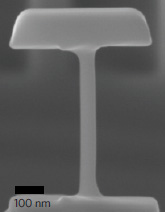
Scanning Electron Microscope image of a typical nanopillar

Jang and Greer fabricated nano-sized pillars (see image) from a bulk metallic glass (Zr35Ti30Co6Be29) using an ion beam to etch the material into its final form. They were able to achieve superior strength of 2.25 GPa (which is equivalent to an elephant standing on 1 sq.cm of that material) and plastic deformability of ~25% by reducing the size to ~500 nm diameter nano pillared structure. At a size reduction to 100 nm, the strength remained same and plasticity was homogeneous. Such high strength has never been reported without sacrificing on the ductility of the material.

With such strength and resistance to erosion, these materials can find application in nanoimprint lithography making nanomolds which are currently silicon-based, expensive and get very easily damaged. Amorphous materials have previously also found use as biomaterials typically as implants in bones. It  is possible to control their rate of dissolution by varying the contents of the alloy and thus become implants which eventually get replaced by bone tissue.

ResearchBlogging.org

Jang, D., & Greer, J. (2010). Transition from a strong-yet-brittle to a stronger-and-ductile state by size reduction of metallic glasses Nature Materials DOI: 10.1038/nmat2622

You can subscribe to this blog by email.