Sexual strategies: The numbers game

In 1948 Angus John Bateman, an English geneticist, proposed that females invest more in producing and caring for their offspring than males because sperm are cheaper than eggs. Since then, however, many species, in particular egg-laying ones, have been found to violate what became known as Bateman’s principle. Such role reversal has left evolutionary biologists baffled.

Some suggeseted that species in which females lay eggs that are big compared to their bodies may need more time to recover after laying eggs and males perform nest chores to compensate. Others fingered high levels of nest predation, which prompts females to seek more males to mate with, in order to produce more offspring, and leave nests untended; again, males pick up the slack. Neither hypothesis had robust data to back it up.

In 2000 Tamas Szekely, an ornithologist at the University of Bath, put forward an alternative explanation. What determines the role adopted by each sex, Dr Szekely contends, is the ratio of males to females. Typically, females outnumber males. This means a male mates with a female once and goes off in search of another willing partner, leaving the mother to tend the nest. Where the ratio favours males, however, the fathers might care for the young rather than face stiff competition to woo another female. Since the supply of males is low, females compete for them instead.

This idea remained untested, however, mainly because finding reliable data on animal sex ratios is tricky. But Andras Liker, Dr Szekely’s colleague at the University of Sheffield, believes he has found some. For over 20 years researchers around the world have been painstakingly collecting data on waders. Studies by Dr Liker and Dr Szekely showed that the data were good enough to test the sex ratio hypothesis.

As they report in Nature Communications, wading birds’ sex roles are indeed correlated with the sex ratio in 16 of the 18 species they tested. In the five species in which females outnumber males (ruffs and northern lapwings, for instance) mothers care for their brood. In the 11 male-dominant species, including Jesus birds and greater painted snipes, by contrast, it is the fathers who look after the nestlings.

Sex ratios are, of course, in part determined by precisely the sort of behavioural traits Drs Szekely and Liker strive to explain. The reason this does not lead to a chicken-and-egg problem, as it were, is that sex ratios are also a function of other factors, like different mortality rates among adult males and females, themselves the result of things like body size.

Dr Szekely’s idea may help explain why sex-role reversal seldom happens in mammals, where sex ratios tend to favour females (though mammalian males also lack females’ ability to produce milk). It might even, Dr Liker speculates, shed light on other social behaviour in animals, such as homosexual pairing, possibly triggered byof a shortage of available partners of the opposite sex.

First published on economist.com.

Image from Greg Schneider

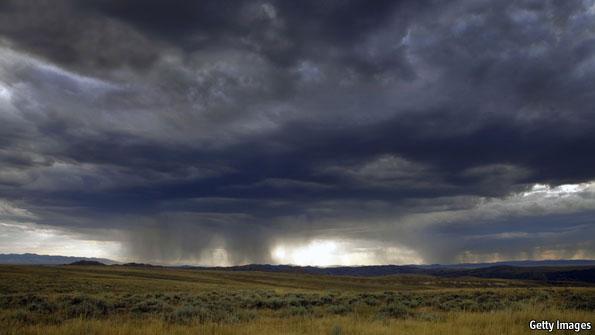
Rain clouds: From dust to lawn

Clouds turn to rain when water droplets and ice crystals that make them up get too big to resist the pull of Earth’s gravity. This is often caused by particles that disturb the maelstrom of droplets and crystals to become seeds around which cloud matter coalesces. Once this happens, the seeds grow rapidly and eventually fall to the ground.

The seeds can be caused by the passage of exotic things like cosmic rays. More often, though, they are dust particles lofted high into the air. A study in 2009 showed that dust from Taklimakan desert in China, whisked above 5,000 metres, circumnavigated the globe in just 13 days. Because dust needs large horizontal distances to attain sufficient altitude, it might then cause rainfall half-way across the world.

For example, the Rocky Mountains in America push water vapour to higher altitudes that help form clouds. At that point, the theory goes, the clouds run into particles swept in from Africa and Asia. To find if that is indeed what happens Kaitlyn Suski and her colleagues at the University of California, San Diego, examined dust and clouds in Californian skies, to the Rockies’ west. They report their findings in Science.

Ms Suski needed to confirm that dust particles reached heights of about 3,000 metres or more to be able to intercept rain clouds. She also had to verify that they originated in Asia and Africa. She collected samples in an aeroplane equipped with a mass spectrometer, which can accurately determine the dust’s chemical composition. These chemical signatures were then compared with those found in Asian and African deserts. As a cross-check, Ms Suski used data from satellites like CALIPSO, which tracks dust particles’ atmospheric peregrinations.

Perhaps more interesting, Ms Suski also found that rain clouds contained bacteria, though it proved impossible to pin down their origins. Tiny living organisms can float in the atmosphere for a long time, feeding on trace carbon and any other nutrients they bump into. They can also act as cloud seeds.

In 2010 researchers in Norway concluded that bacteria are not as important to rainfall as dust is. But calculations by Ms Suski and her colleagues suggest that their rainmaking powers are amplified when they mingle with desert dust. Deserts may be some of the harshest places on the planet to live, but, if Ms Suski is right, they may be the enablers of life everywhere else.

First published on economist.com.

Reference: Creamean et al. Science 2013. Dust and Biological Aerosols from the Sahara and Asia Influence Precipitation in the Western U.S. http://dx.doi.org/10.1126/science.1227279

Image credit: The Economist

Marine biology: Flea market

A newly discovered virus may be the most abundant organism on the planet

What is the commonest living thing on Earth? Until now, those in the know would probably have answered Pelagibacter ubique, the most successful member of a group of bacteria, called SAR11, that jointly constitute about a third of the single-celled organisms in the ocean. But this is not P. ubique’s only claim to fame, for unlike almost every other known cellular creature, it and its relatives have seemed to be untroubled by viruses.

As Jonathan Swift put it in a much-misquoted poem, “So, naturalists observe, a flea/Hath smaller fleas that on him prey”. Parasites, in other words, are everywhere. They are also, usually, more abundant than their hosts. An astute observer might therefore have suspected that the actual most-common species on Earth would be a “flea” that parasitised P. ubique, rather than the bacterium itself. The absence of such fleas (in the form of viruses called bacteriophages, that attack bacteria) has puzzled virologists since 1990, when the SAR11 group was identified. Some thought the advantage this absence conferred explained the group’s abundance. But no. As they report in this week’s Nature, Stephen Giovannoni of Oregon State University and his colleagues have discovered the elusive phages. Swift’s wisdom, it seems, still holds good.

Tracking down a particular virus in the ocean makes finding a needle in a haystack look a trivial task. A litre of seawater has billions of viruses in it. Modern genetic techniques can obtain DNA sequences from these viruses, but that cannot tie a particular virus to a particular host.

To do so, Dr Giovannoni (pictured) borrowed a technique from homeopathy: he diluted some seawater to such an extent that, statistically speaking, he expected a 100-microlitre-sized aliquot to contain only one or two viruses. The difference between his approach and a homeopath’s was that what homeopathy dilutes almost to nothing are chemicals, and thus cannot breed. A virus can, given a suitable host. So he mixed each of several hundred aliquots into tubes of water containing P. ubique. Then he waited.

The race is to the Swift

After 60 hours, he looked to see what had happened. In most cases the bacteria had thrived. In a few, though, they had been killed by what looked like viral infection. It was these samples that he ran through the DNA-sequencing machine, in the knowledge that the only viral DNA present would be from whatever it was had killed the bacteria.

His reward was to find not one, but four viruses that parasitise P. ubique. He then compared their DNA with databases of DNA found in seawater from around the world, to find out how abundant each is. The upshot was that a virus dubbed HTVC010P was the commonest. It thus displaces its host as the likely winner of the most-common-living-thing prize.

That does depend, of course, on your definition of “living thing”. Some biologists count viruses as organisms. Some do not. The reason is that a virus relies for its growth and reproduction on the metabolic processes of the cell it infects. This means viruses themselves are hard to parasitise, since they do no work on which another organism can free-ride. Which is why the next two lines of Swift’s poem, “And these have smaller fleas to bite ’em/And so proceed ad infinitum”, are wrong—and why, because HTVC010P itself can have no parasites, it probably really is the commonest organism on the planet.

First published in The Economist.  Also available in audio here.

References:

  1. Zhao et al., Abundant SAR11 viruses in the ocean, Nature2013.
  2. Brown et al., Global biogeography of SAR11 marine bacteria, Mol Syst Biol2012.
  3. Swift, Poetry: A Rhapsody, 1733.

Image credit: Lynn Ketchum