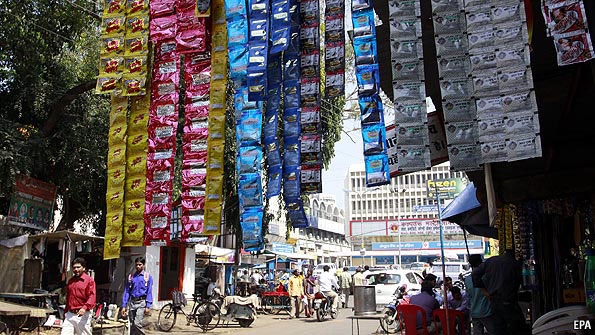
Oral cancer in India: Chewed out

Many poor Indians addicted to nicotine are likely to indulge their habit by chewing gutka. In 2010 a survey by the National Cancer Registry Programme (NCRP) found that one in three inhabitants of the state of Madhya Pradesh aged 15 and older—or some 15m people—use the stuff, a preparation of crushed betel nut, tobacco and an acacia extract called catechu. Even more worryingly, a report in 2008 estimated that 5m Indian children were addicted. It is not uncommon for tykes as young as eight to be users. Gutka is also popular among women, in part because smoking among the fairer sex remains frowned upon in much of India. Add cheapness—1 rupee, or 2 cents, buys a sachet, whereas a cigarette costs at least twice as much—and it is little wonder that two-thirds of Indian tobacco users get their fix in chewable form.

As a result, however, India has one of the highest rates of oral cancer in the world. More than 80,000 new cases are reported every year across the country. The NCRP study reported 35,000 cases of oral cancer in Madhya Pradesh alone, equivalent to four times the national average of around 13 cases per 100,000 people—and almost eight times the world’s. The state’s government has now taken a drastic step. On April 1st it introduced a complete ban on the sale of all chewing-tobacco products.

Bhavna Mukopadhyay, who heads the Voluntary Health Association of India (VHAI), an advocacy, has praised the move. Speaking after it was announced in March, she called for a country-wide gutka ban under the rules introduced in August 2011 by India’s Food Safety and Standard Authority. These followed a ruling by the Supreme Court in February that year, banning the use of plastic in gutka sachets and calling the gutka habit a menace to public health. Because it could not ban the sale of gutka without the government’s backing, the court chose to make the manufacturers’ life difficult by prohibiting the use of plastic in packaging. This forces producers to package it in paper instead, making transportation of large quantities trickier.

However, the VHAI has found that many were brazenly flouting the ruling. Others have simply decamped to towns in Nepal and continue to use plastic sachets which are then smuggled into India. There are also troubling reports that some gutka contains waste from perfumeries and tanneries as flavouring, making it even more noxious. The government lacks the labs needed to ascertain adulteration of this kind, Ms Mukhopadhyay laments. It may also be reluctant to enforce its own rules, wary of antagonising a $10 billion industry.

According to a recent paper in the Lancet, 5.6m Indians die of cancer each year. Many live in the countryside; most never seek medical attention. Tobacco, the paper’s authors write, is responsible for a third of those deaths. Getting Indians to spit it out might save millions of lives.

Also published at economist.com.

References:

  1. Most cancer patients in India die without medical attention: studyDown to Earth, March 29, 2012
  2. Madhya Pradesh bans gutkha and other chewing tobacco productsDown to Earth, April 3, 2012
  3. SC bans plastic gutka sachets from March 1Times of India, December 8, 2010
  4. Global Adult Tobacco Survey: IndiaWorld Health Organization, October 19, 2010
  5. Gutka still sold in plastic sachetsThe Hindu, March 13, 2011
  6. 2011 Census Data: Madhya PradeshGovernment of India

 Image credit: The Economist

The truth about antioxidants and its coverage in Indian newspapers

Times of India (TOI) published an article today which claimed that guava is the healthiest fruit and pineapple is the least! 

The claim is based on a study that evaluated ‘the amount of natural antioxidants level of [sic] 14 fresh fruits commonly consumed in India’. The article cited the study that was published in Food Research International, an Elsevier journal. But surprisingly when I looked up the paper it appeared that the results of the study were published in May 2010!

Antioxidants have been featured as a healthy choice for a long time. An article in Slate mentions that the story began in the 1940s when Denham Harman proposed that ‘the same free radicals that were cutting into petroleum industry profits could also simply and completely explain the phenomenon of aging. Better yet, he said, their effects could be ameliorated by something called antioxidants’.

As tempting as the theory seems, unfortunately as the same article points out, there is no evidence of antioxidants inducing any health benefits. Instead, a meta-analysis of studies that assess the effect of antioxidant supplements on mortality showed that ‘treatment with beta carotene, vitamin A and vitamin E may increase mortality. The potential roles of vitamin C and selenium on mortality needs further study.’

Having previously read the article in Slate, when I came across the article in TOI it struck me as odd that a 18-month old research paper suddenly seemed to surfaces in not only Indian newspapers but also in a British and a Malaysian newspaper within 24 hours. I got in touch with the lead researcher on the paper, Dr. Sreeramulu, congratulating him and expressing my surprise. He responded quickly and said, “Yesterday they contacted me about the work (and) today (the) article appeared in Times of India. (In the) morning my friend informed me about this.” I also, asked him who funded his research, to which he said, “I am a regular staff member of NIN (National Institute of Nutrition), Hyderabad. Our Institute funded the work as (an) intramural project.”

I asked him about the funding of the project given that the antioxidant market worldwide is pretty big. According to a report it has been growing at ~4% annually with reported sales of $3.7 billion in 2007 (the slate article calls it a $23 billion industry but I couldn’t find the source for that). Having not got any satisfactory answer to the reason why TOI showed sudden interest, I thought it might be worth looking at what the coverage of antioxidants in top Indian newspapers.

Here are the search results for ‘antioxidants’ on TOIHindustan Times & The Hindu websites.

Sure enough I got plenty of articles mentioning the many studies that show antioxidants do wonderful things and many that reported the extraordinary antioxidant content in some foods. But amongst all that noise I found only three articles that mentioned studies showing adverse effects or no effects (here,here & here).

The lack of coverage of the studies showing adverse effects or no effects can be attributed to the fact that may be fewer such studies are reported but that would be a mistake. That alone cannot account for the dismal numbers. The answer then may be lies in the fact that the media has a bias towards publishing ‘feel-good’ stories, especially in the health section. But it might also be equally due to some media houses doing favours for big supplements manufacturers.

I wouldn’t lament about all this much if only next time when an article about antioxidants is written they give the reader a balanced view. A simple sentence such as, ‘conventional wisdom claims the positive effects of antioxidants but many studies have shown no-effect and in some cases, harmful effects in the use of antioxidants’ can be included to that effect.

Alas! I cannot expect such things from Indian newspapers, can I? And, of course, the mystery of why world media suddenly showed in the story also remains unsolved.

Deaths due to terrorism

‘Terror kills, but panic later not proportional to actual danger’ read the headline of an article in the Times of India after the 2008 Mumbai terror attacks. The statistics displayed at the bottom of the article sparked a conversation amongst my friends and some questions were raised.

“Jeepers, lightning kills nearly 3000 people per year? Wow!”

“I think comparison criteria are wrong. Why don’t they compare victims of terrorism in different countries? That would be an interesting study”

Of course, I had to get to the bottom of this. So here’s what my research shows:

Let’s deal with the easy one first. The US government says that about 100 people die every year by lightning. But the National Crime Bureau in India says that about 2553 and 2113 were killed by lightning in 2008 and 2009, respectively. [See reference. PS: Alex… Jeepers!!]

By comparison, deaths by traffic accidents were 144,587 and  152,689 in 2008 and 2009, respectively and 127,151 deaths were committed by suicide. [See reference] So Times of India did get it right this time.

As for the deaths by terrorist attacks, let’s look at the global figures. The US does most of the research, of course. In 2006, 14000 attacks took place mostly in Iraq and Afghanistan killing 20,000 people. [See reference] In 2005, 11000 attacks took place killing 14,600 people. [See reference, it verifies the figures mentioned in the MSNBC report]. FBI reports 15,765 deaths in 2008 due to terror attacks [See reference, report goes into a lot of details.]  For data before 2005, see this (The numbers are so much lower!).

I couldn’t find numbers for 2010 but from the above we can imagine that the number is in the 20,000s or less. Now compare this to the 1.2 million deaths that occur annually due to traffic accidents around the world. The article had a good point to make.