A better writer and a better thinker

This week I started my internship at The Economist. I had been looking forward to this since the day I got the offer, and it was one my strongest motivations to submit my DPhil thesis. A number of reasons made it so. But mainly it was because I knew that the few months at The Economist are going to be an exercise in becoming a better writer and a better thinker.

Becoming a better writer may be obvious. The Economist is a very well-written newspaper, and, if I am to write for it every week, I have to better my game. But a better thinker?

Yes and here’s an analogy to explain it: When I first came to Oxford, I had just finished four years in the Institute of Chemical Technology, Mumbai. Coming to Oxford was a shock to my system in many ways. I was in a foreign country, surrounded by people from all over the world, I was moving from a taught course into research, I was going to live in a house with three girls rather than a hostel full of boys, etc. But one of things that most stood out in all those new things was that all the students at Oxford did not study chemical engineering. Actually, they studied more subjects than I could keep a count.

Exeter college, which is a very welcoming place, made sure that in the first week we had as many social engagements as were physically possible. It forced me, pleasantly so, to mix with students from many subject areas. Over the next four years, a lot of my thinking was shaped by interacting with these students.

I expect my time at The Economist to do the same for me all over again, and do it better. Even though it is only a few months, because the paper (as it is referred to in-house) writes with a single voice (if you aren’t aware, The Economist has no byline), it will force me to confront my views a lot more than I had to at Oxford. When I say ‘single voice’, I do not mean that all the writers have the same opinion, but that they arrive at one through a lot of debate. If I am to write about something, I need to be prepared to defend my stance or find something that I can defend.

Here’s what I learnt:

The start of a new week at the paper is on a Friday because that week’s paper goes to print on a Thursday afternoon. The first Friday-morning meeting is one where people float ideas for the next week to their section editors (Business, Finance, Britain, etc.), but mainly the aim that day is to think about leaders (opinion pieces) for next week. The section editors then take those ideas to the next meeting, which happens in the Editor-in-chief’s office.

Both these meetings go on for quite sometime. Especially, the second one. Leader ideas are thrown on the table and then dissected. Although most of the talking happens in between the section editors, the deputy editor and the editor-in-chief, many other people contribute. I got told on the very first day, “If you have an opinion, at The Economist you will have plenty of opportunity to air it.” It’s true. Even those writing for the science section question a finance leader and those writing for the Britain section question a leader about the Libyan election.

After a quiet weekend, Monday starts with longer versions of the Friday meetings. More discussions follow but this time they are more concrete. After all, the deadline to wrap-up the paper is only two days away i.e. Wednesday night. People use Monday afternoon and Tuesday to do the research, interviews, reporting, and on Wednesday there is a lot of back and forth between writers and editors as they polish their stories.

The working hours are very flexible, the people are very warm and the 12th floor office has a great view of the city. I got told more than once that The Economist is a weekly newspaper, which means that the stories have to have more than just ‘news value’. Not just well-written, but it also needs to be a well-analysed and entertaining story.

The week

For me, it was an unusual week. Monday through Wednesday, the science and technology team was working from home, in what was an experiment. And as it happened, I ended up being at a conference on Thursday and Friday. So although I didn’t get to interact very much with the team I am going to be working in, I got to meet a lot of other writers.

This is not to say that I did not work. Apart from attending the conference, I attended the ‘Welcome to The Economist‘ talk, ‘How to be a journalist’ talk, got trained on the necessary software, made new friends and wrote two articles, which depending on what the editors think may or may not get published (PS: I will be posting what gets published here).

Finally, I won’t be boring you with what happened at The Economist every week (for that you should read the paper). But, as always, I will write whenever I have something worthy to share. Like the ad below:

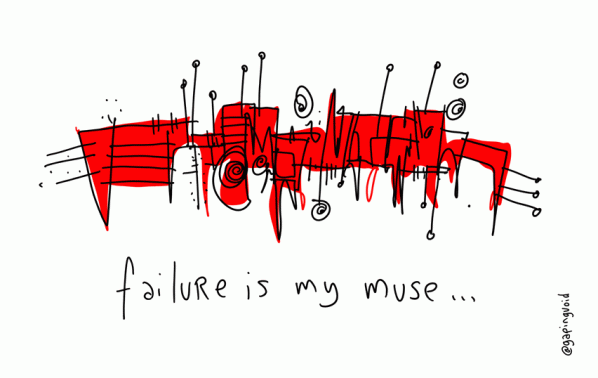
Failing again and again

Hugh McLeod never gets it wrong

There was some frustration in the undergraduate labs yesterday. A particular experiment has been failing to give the desired product more number of times than we’d like. When it happens a few times, we have no qualms in blaming students’ poor skills. But when it happens too many times, it is usually a sign that we need to revisit the procedure.

When one of the student doing that experiment left us with a fallen face yesterday, my senior remarked, “After a long day in the lab, it’s not nice to leave with nothing.”

My immediate response to that was, “What will happen to them if they think of doing organic synthesis for their PhDs!”

As I write my thesis I realise that it’s mostly a narrative of what did not work. A long list of negative results with some positive spikes. Yet, at the end of three and a half years, I feel I have done something – placing a handful of atoms together to make something that no one has made before. In the process, I have learnt from my failures and added a few bricks to this large construction called science.

One thing they don’t tell those who are thinking of going to grad school is that you need patience, a lot of it. The undergraduate’s frustration reminds me of my own. But in the name of science, I failed, got up, and failed again. I persevered.

As I look to enter one of the toughest markets for a graduate student (science journalism), I realise that I will need patience and perseverance in large doses. The stories of science writers aren’t those of indulgence, fortune, and success but those of moderation, hardship, and failures. Yet those stories are inspirational because whatever little fame and success came their way was worth it’s weight in gold.

When (and not if) I fail, I will need to be reminded of all these stories. Failure will have to become my muse, again.

Picture credit: gapingvoid

The Idiotic Sensationalism

My congratulations to Aamir Khan, Rajkumar Hirani and Vidhu Vinod Chopra on making a great movie. I also extend my sympathies to Chetan Bhagat and believe that the author should have been duly credited. But there’s a lot more to the controversy than that, after all the world has been talking about it for 3 days now!

I must confess that when the world started tweeting about the controversy, I thought it’s one of those ‘get-publicity-while-you-can’ stunt. The debate on who should be given the credit, the man behind the original idea or the man who put the efforts to make it a much better idea, should not last very long. Both deserve enough credit, right? Even though I thought it would be a waste of time to spend time keeping up with tweets, I hung around just to be amused by the fakingnews tweets. To my surprise I found the whole exercise quite worth the time investment as it was a learning experience.

From a third person perspective, I am in complete agreement with Vir Sanghvi that Vidhu Vinod Chopra lacked grace in handling the situation. But looking at the nitty-gritty of the story and seeing Chetan Bhagat flip completely on the issue made me think that maybe there is more to the issue than just this. After reading quite a bit about it and seeing the news channels do what they do best, make such a sensation out of a controversial issue, I believe that Chetan Bhagat’s perfectly reasonable solution should be honoured.

I don’t think that this marks the end of this sensation. While everyone is in awe of the movie, IBN Live Journalist Sagarika Ghose has a written a negative take on the movie. She thinks that movie ‘legitimises scorn and hatred of education, sanctions wilful dumbing down’ and will make us a ‘nation of idiots’. When does Aamir Khan say that leave schools and stop studying? All he says is that dare to follow your passion, get the right education and skills to fulfill your dream. And when has it been shown in the movie that the students have been able to get away after committing serious offenses? They have had to make up for it every time by doing something worthy of keeping them in the institute.

The movie is based on Five Point Someone which was written by Chetan Bhagat with some reference to his own experiences of the IITs in the 1990s. After 20 years, if the 3 Idiots has struck chord with the sentiments of the current students, then not much has changed in the education system since then, has it? We must realise that the same evils still exist in the education system and it is time we do something concrete about them and that is what the message of the movie is. It is not a movie that ‘trivializes our higher education system’ instead it speaks of the importance of higher education in developing a person.

The movie is not going to stop students from appearing for the IIT-JEE or CAT and is in no way going to ‘allow standards in our centers of excellence to be lowered’. Instead, what it might do to is help students take up the scholarship only if they have the true passion for it. Yes, we may need more doctors and engineers in the coming decade to keep up the pace of our development, but we certainly don’t want angry doctors and frustrated engineers doing jobs they do not enjoy doing.

Ms Ghose seems to forget that she (and I) is part of the 1% of students who represent the whole country. They are the students who have got education from these centers of excellence. 99% students who graduate don’t get quality education and do not have the employability skills that a graduate student must have. There is far too much to do about the system and the movie tries to highlight that. I don’t think that it is going to affect the mindset of rational people and make them ‘engage in an escapist fantasy and convince ourselves that education does not matter’. If one movie can cause such a tide then Munnabhai’s show of Gandhigiri should have stopped all crime in India.

It is a movie after all. It is meant to give a message masked in light-hearted entertainment. If I know anything about entertainment, I know that people don’t get entertained by normal things. They need something extra-ordinary and for that exaggeration needs to be used skillfully. I think 3 Idiots has a done a fantastic job at that and has managed to put across an important message to the Indian society.

First published at YouthkiAwaaz.com