Here is a podcast I did for The Economist on August 22, 2012. We discuss interplanetary networking, gas-guzzling paint and new approaches to web publishing and social media.
Author: Akshat Rathi
Akshat Rathi is a senior reporter for Bloomberg News. He has previously worked at Quartz, The Economist and The Conversation. His writing has appeared in Nature, The Guardian and The Hindu. He has a PhD in chemistry from Oxford University and a BTech in chemical engineering from the Institute of Chemical Technology, Mumbai.
Animal Behaviour: The benefits of schooling
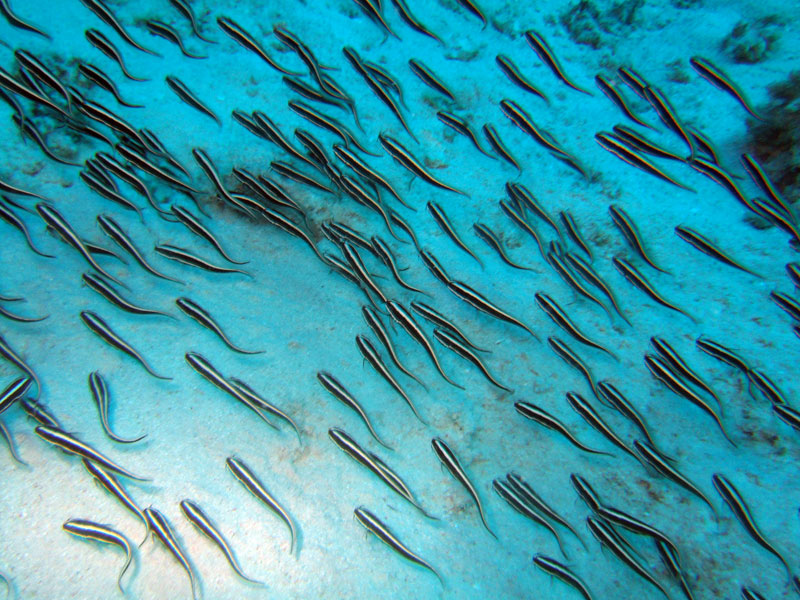
Nearly four-fifths of the 28,000 known species of fish swim in schools, harmoniously aligning their movements with others around them. Besides reducing drag for those not in the front of the pack, coming together makes it harder for a predator to single out just one prey; a mass change of direction by the entire school might act to confuse the attacker further.
That, at least, is the theory. The rub is that testing it requires manipulating the behaviour of real fish—trickier even than herding cats. Now, though, Christos Ioannou, from Bristol University, may have found a way around it. As the researchers report in Science, he and his colleagues have developed a video game for piscine predator to play.
They put their gamer, a hungry bluegill sunfish, into a tank and projected computer-generated prey on one of its walls. Each digital fish in the 16-strong school was programmed to maintain their speed and to move away to avoid collision if they get too close to each other. But each was also endowed with a mind of its own: some ignored what their neighbours did while others followed their every move.
It turns out that the real sunfish is indeed more likely to go after the lonely virtual minnows than the more gregarious ones. It seems, then, that there really is strength in numbers, though it be some time before Dr Ioannou manages to coax his bluegill into disclosing precisely why it prefers the loners.
Also published on economist.com.
Reference: Ioannou CC, Guttal V, & Couzin ID (2012). Predatory Fish Select for Coordinated Collective Motion in Virtual Prey. Science PMID: 22903520
Free image from stock.xchng.
Why would someone read your story
With a flood of news available to every reader today, why would someone want to read what you write?
William Blundell in The Art and Craft of Feature Writing has, what he calls, the laws of progressive reader involvement. Or as I call it, why would I read your crap:
- Tease me, you devil: Intrigue me a little. Give me a reason for going on with your story instead of doing something else. Remember, I have no investment in you at all.
- Tell me what you’re up to: Enough teasing. What is your story really about? Please, no windy explanations, no details – just what’s going on here.
- Oh yeah? You’ll have to prove what you just said. Let’s see your logic. Let’s see your evidence. I’ve invested time in you by now, so I’ll be patient – but you better be convincing
- I’ll buy it. Help me remember it. Make it clear. Make it forceful. And put an ending on it that will nail it into my memory.

