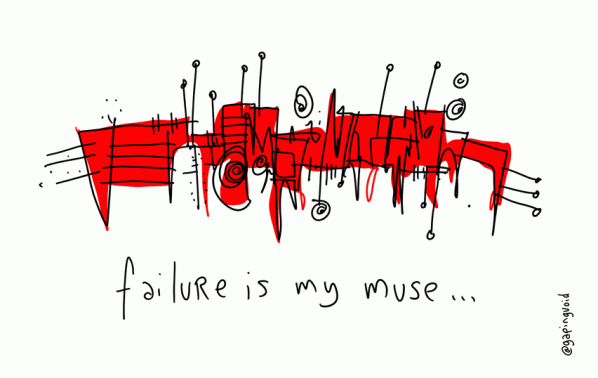
Failing again and again

Hugh McLeod never gets it wrong

There was some frustration in the undergraduate labs yesterday. A particular experiment has been failing to give the desired product more number of times than we’d like. When it happens a few times, we have no qualms in blaming students’ poor skills. But when it happens too many times, it is usually a sign that we need to revisit the procedure.

When one of the student doing that experiment left us with a fallen face yesterday, my senior remarked, “After a long day in the lab, it’s not nice to leave with nothing.”

My immediate response to that was, “What will happen to them if they think of doing organic synthesis for their PhDs!”

As I write my thesis I realise that it’s mostly a narrative of what did not work. A long list of negative results with some positive spikes. Yet, at the end of three and a half years, I feel I have done something – placing a handful of atoms together to make something that no one has made before. In the process, I have learnt from my failures and added a few bricks to this large construction called science.

One thing they don’t tell those who are thinking of going to grad school is that you need patience, a lot of it. The undergraduate’s frustration reminds me of my own. But in the name of science, I failed, got up, and failed again. I persevered.

As I look to enter one of the toughest markets for a graduate student (science journalism), I realise that I will need patience and perseverance in large doses. The stories of science writers aren’t those of indulgence, fortune, and success but those of moderation, hardship, and failures. Yet those stories are inspirational because whatever little fame and success came their way was worth it’s weight in gold.

When (and not if) I fail, I will need to be reminded of all these stories. Failure will have to become my muse, again.

Picture credit: gapingvoid
The happiness paradox

Life is an interesting experience. Given how different people’s lives are, I find it worth appreciating that they are still so many commonalities amongst us. The one that’s on my mind today is our desire to be happy.

We all want to be happy. May be not right now and may be not all the time, but sooner or later we all seek a time when we will be happy. We seek it in the work that we do, in the connections that we build and in the experiences of our daily lives.

I did not grow up with this philosophy of ‘seeking’ happiness. People around me then operated differently. Like the philosophy of karma that I gained from those around me, I also learnt that happiness is never worth deliberately pursuing.

The status quo of living in India was that one must work and happiness will follow. It is something we experience as a result of the things we do. It is something we derive from making an effort towards something greater.

I am not sure that it is my status quo anymore. Coming to the UK and experiencing a different culture has changed my views in many ways. Fighting the ridiculous concept of karma was a difficult but fruitful experience for me. At some level, probably unconsciously, I felt that I also needed to fight this idea of not seeking happiness. I thought that, just like before, I will experience a whole new way of looking at the world.

I was mistaken. The happiness paradox is real and my Indian teachings were right.

Viktor Frankl puts it beautifully: Happiness cannot be pursued; it must ensue, and it only does so as the unintended side effect of one’s personal dedication to a cause greater than oneself or as the by-product of one’s surrender to a person other than oneself

Of course, at some level, I’ve experienced the pleasure of both pursuing a greater cause and surrendering to another person. These are such satisfying experiences that one cannot forget them easily. But I feel I’ve gone too far on the other side this time; I need to remind myself of those experiences and return to my earlier status quo.

The key to clear writing

…is clear thinking. From the Economist Style guide:

“A scrupulous writer”, observed Orwell, “in every sentence that he writes will ask himself at least these questions:

  1. What am I trying to say?
  2. What words will express it?
  3. What image or idiom will make it clearer?
  4. Is this image fresh enough to have an effect?
  5. Could I put it more shortly?
  6. Have I said anything that is avoidably ugly?”