Sparking young minds

Last year I helped organise a science essay writing competition in my high school. This year, with the help of teachers, a similar competition was organised at Rasbihari International School in Nashik (where I also gave a talk earlier this year). The topic for the students this year was ‘A scientific discovery or invention that changed the world.’

Selected essays that I read had covered these subjects: aeroplanes, electricity, E=mc^2, medicine, space, and computers. Among those the winners of this year’s competition are:

  1. Vaishnavi Maniyar
  2. Saloni Lodha
  3. Shruti Tarle

You can read the essays by clicking on their names. My criteria for judging these essays was imagination, accuracy, flow of ideas, and use of language. The winners are being given the following books:

  1. What Einstein Told His Cook – Robert  L. Wolke
  2. How to Fossilise your Hamster – Mick O’Hare
  3. Why Can’t Elephants Jump – the New Scientist

I am grateful to Piyushee Amrite, Suchitra Sarda, my mum and others who helped organise this. The school has agreed to hold this competition annually, and I am looking forward to reading more such interesting essays.

How does epigenetics shape life?

Identical twins, despite being biologically identical at birth, grow up to become unique individuals. Sure they may have a lot more things in common than two randomly picked individuals, yet there are many characteristics which belong only to one or the other. If the twins have the exact same DNA, then what is that makes them different?

The common answer to this question is it’s the environment that they live in which shapes them differently. Researchers have found that such environmental factors cause chemical modifications to the genome without affecting the nucleotide sequence, leading to the unique characteristics that we observe. This field of research is called epigenetics, and beyond the DNA, it’s what shapes our lives.

Rat mothers nurture their pups by licking and grooming. Researchers in Canada studying epigenetic changes found that rats whose mothers licked them more than normal expressed hundreds of genes differently from those who were licked less than normal. These differences were consistent and predictable, and led to a number of behavioural changes among the rats, including one where highly licked rats’ response to stress was a lot better than the less‐licked rats’.

Epigenetic changes don’t just occur through environmental factors but are also a different form of inheritance, one that doesn’t have to suffer from the randomness of natural selection. The licking of the rat encodes specific information onto her pup’s DNA without modifying to the sequence of base pairs. Mom’s behaviour programs the pup’s DNA in a way that will make it more likely to succeed. Such information is stored in the DNA in many ways, one of which is through DNA methylation. Through this process methyl groups are attached on to the DNA, and their attachment at specific positions leads to genes being turned on or off. This makes epigenetic changes reversible. For example, you can take a low‐nutured rat, inject its brain with a drug that removes methyl groups, and make it act like a high‐nurtured rat.

DNA methylation also plays a key role in cell division and cancer cells are known to divide faster than normal cells. Researchers in the US have developed drugs to interfere with DNA methylation as a treatment for cancer. They use molecules that mimic cytosine, one of the four bases of DNA. In cell replication, the fake cytosine swaps places with real cytosine in the growing stand of DNA, which then in turn traps DNA methyltransferase. When used in low enough doses, the drug allows the formation of the cell but with less methylated DNA. These drugs are currently being used to treat myelodysplastic syndrome, a prelukemia condition.

As Brona McVittie says, like the conductor of an orchestra controls the performance of musicians, epigenetic factors govern how the cell plays the notes in DNA. A better understanding of these factors has the potential of revolutionising evolutionary and developmental biology, thus affecting practices from medicine to agriculture.

Further reading:

  1. Learn Genetics, The University of Utah
  2. Introduction to epigenetics from Science magazine
  3. More ways to fight cancer through epigenetics, The Economist
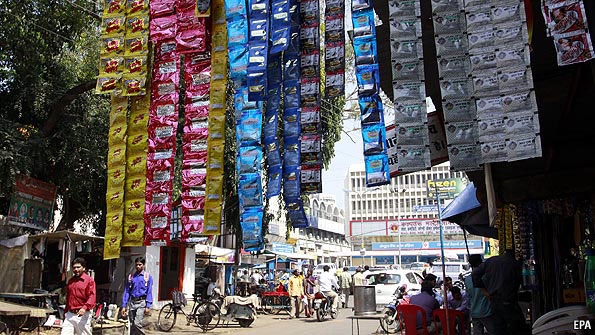
Image credit: SciShark

Oral cancer in India: Chewed out

Many poor Indians addicted to nicotine are likely to indulge their habit by chewing gutka. In 2010 a survey by the National Cancer Registry Programme (NCRP) found that one in three inhabitants of the state of Madhya Pradesh aged 15 and older—or some 15m people—use the stuff, a preparation of crushed betel nut, tobacco and an acacia extract called catechu. Even more worryingly, a report in 2008 estimated that 5m Indian children were addicted. It is not uncommon for tykes as young as eight to be users. Gutka is also popular among women, in part because smoking among the fairer sex remains frowned upon in much of India. Add cheapness—1 rupee, or 2 cents, buys a sachet, whereas a cigarette costs at least twice as much—and it is little wonder that two-thirds of Indian tobacco users get their fix in chewable form.

As a result, however, India has one of the highest rates of oral cancer in the world. More than 80,000 new cases are reported every year across the country. The NCRP study reported 35,000 cases of oral cancer in Madhya Pradesh alone, equivalent to four times the national average of around 13 cases per 100,000 people—and almost eight times the world’s. The state’s government has now taken a drastic step. On April 1st it introduced a complete ban on the sale of all chewing-tobacco products.

Bhavna Mukopadhyay, who heads the Voluntary Health Association of India (VHAI), an advocacy, has praised the move. Speaking after it was announced in March, she called for a country-wide gutka ban under the rules introduced in August 2011 by India’s Food Safety and Standard Authority. These followed a ruling by the Supreme Court in February that year, banning the use of plastic in gutka sachets and calling the gutka habit a menace to public health. Because it could not ban the sale of gutka without the government’s backing, the court chose to make the manufacturers’ life difficult by prohibiting the use of plastic in packaging. This forces producers to package it in paper instead, making transportation of large quantities trickier.

However, the VHAI has found that many were brazenly flouting the ruling. Others have simply decamped to towns in Nepal and continue to use plastic sachets which are then smuggled into India. There are also troubling reports that some gutka contains waste from perfumeries and tanneries as flavouring, making it even more noxious. The government lacks the labs needed to ascertain adulteration of this kind, Ms Mukhopadhyay laments. It may also be reluctant to enforce its own rules, wary of antagonising a $10 billion industry.

According to a recent paper in the Lancet, 5.6m Indians die of cancer each year. Many live in the countryside; most never seek medical attention. Tobacco, the paper’s authors write, is responsible for a third of those deaths. Getting Indians to spit it out might save millions of lives.

Also published at economist.com.

References:

  1. Most cancer patients in India die without medical attention: studyDown to Earth, March 29, 2012
  2. Madhya Pradesh bans gutkha and other chewing tobacco productsDown to Earth, April 3, 2012
  3. SC bans plastic gutka sachets from March 1Times of India, December 8, 2010
  4. Global Adult Tobacco Survey: IndiaWorld Health Organization, October 19, 2010
  5. Gutka still sold in plastic sachetsThe Hindu, March 13, 2011
  6. 2011 Census Data: Madhya PradeshGovernment of India

 Image credit: The Economist