Too often we try to hide ourselves behind big words that don’t mean much. It is unfortunate that we find it very hard to follow the simple advice: Say it as you see it.
Andreas Kluth of the Economist calls all this Orwellian gobbledygook because it was George Orwell who pointed out in his famous essay Politics and the English language that, “The whole tendency of modern prose is away from concreteness”.
There was some frustration in the undergraduate labs yesterday. A particular experiment has been failing to give the desired product more number of times than we’d like. When it happens a few times, we have no qualms in blaming students’ poor skills. But when it happens too many times, it is usually a sign that we need to revisit the procedure.
When one of the student doing that experiment left us with a fallen face yesterday, my senior remarked, “After a long day in the lab, it’s not nice to leave with nothing.”
My immediate response to that was, “What will happen to them if they think of doing organic synthesis for their PhDs!”
As I write my thesis I realise that it’s mostly a narrative of what did not work. A long list of negative results with some positive spikes. Yet, at the end of three and a half years, I feel I have done something – placing a handful of atoms together to make something that no one has made before. In the process, I have learnt from my failures and added a few bricks to this large construction called science.
One thing they don’t tell those who are thinking of going to grad school is that you need patience, a lot of it. The undergraduate’s frustration reminds me of my own. But in the name of science, I failed, got up, and failed again. I persevered.
As I look to enter one of the toughest markets for a graduate student (science journalism), I realise that I will need patience and perseverance in large doses. The stories of science writers aren’t those of indulgence, fortune, and success but those of moderation, hardship, and failures. Yet those stories are inspirational because whatever little fame and success came their way was worth it’s weight in gold.
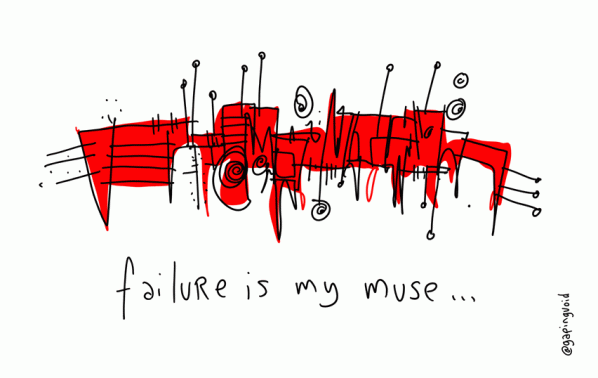
When (and not if) I fail, I will need to be reminded of all these stories. Failure will have to become my muse, again.

 Akshat Rathi